

What if a part-time CFO could shape leadership decisions without being in the business every day? Integrating a part time cfo with your senior management team isn’t about adding another voice to every conversation. It’s about bringing financial insight into the right discussions, early enough to influence the outcome. If figures arrive after decisions are made, or managers aren’t sure where the CFO’s authority begins, even strong financial expertise can feel disconnected from daily operations.
It’s reasonable to want clear roles and practical input, not extra complexity. A part-time CFO should complement the operational knowledge of existing leaders and help the team connect financial performance with priorities such as growth, cash flow and investment.
This guide explains how to establish decision rights and working relationships, build a useful rhythm for management meetings and reporting, and turn financial analysis into agreed actions. You’ll learn how to involve your CFO in the decisions that matter while keeping responsibilities clear and leadership joined up.
Key Takeaways
- Define the CFO’s purpose, priorities and decision-making authority with the CEO and senior team before the role begins.
- Keep strategic financial leadership distinct from the operational responsibilities held by functional managers.
- Use management discussions and focused reporting to surface changing performance, risks, assumptions and decisions that need attention.
- Make integrating a part time cfo with your senior management team a planned process, from diagnosing needs to reviewing how the arrangement works.
- Shape the role around your business priorities, existing finance capacity and the complexity of decisions ahead.
Why integrating a part-time CFO with your senior management team matters
Growing businesses often reach a point where leadership needs stronger financial input, but a full-time executive may not be necessary. The challenge is getting that expertise into decisions while there’s still time to shape them. If the finance lead only sends reports after management meetings, the team may understand what happened without knowing what to do next.
Integrating a part time cfo with your senior management team means agreeing how the CFO contributes to decisions, receives relevant information and supports financial priorities. It doesn’t require constant presence. It requires a clear connection between financial insight and the leadership team’s work.
A CFO’s contribution goes beyond preparing figures. The Chief Financial Officer role centres on financial leadership, but the practical scope of a part-time arrangement depends on the agreed remit and the business’s needs. Define the contribution around the decisions leaders need to make, rather than relying on a generic list of finance tasks.
What should a part-time CFO contribute to the leadership team?
A part-time CFO can interpret performance, support planning and test the financial assumptions behind proposed decisions. For example, if the sales team proposes expanding into a new market, the CFO can help assess the likely effect on cash flow, costs and resources. The operational manager brings knowledge of delivery; the CFO connects the proposal to its financial implications.
This is embedded leadership, not simply report delivery or occasional advice. The CFO needs appropriate access to information and a defined route into relevant discussions. Their role is to strengthen decisions and constructively challenge assumptions, while managers retain ownership of their operational areas.
When does a business need CFO input at management level?
Consider bringing financial leadership into management discussions when growth choices involve competing priorities, cash flow is difficult to predict, or historical reporting doesn’t provide enough forward visibility. These signs don’t automatically mean a business needs a full-time CFO. They may show that leaders need more strategic interpretation of the numbers before committing resources or setting plans.
Routine bookkeeping and reporting help maintain accurate financial records and show past performance. CFO input focuses on what the information means for future choices. For further context on the role, read about the strategic role of a Finance Director. Understanding this distinction helps the business set a useful remit and involve the CFO where their perspective can make a difference.
Set the part-time CFO’s remit, authority and relationships before they start
A clear remit gives the CFO a useful place in the leadership team without unsettling established responsibilities. Before work begins, the CEO and senior managers should agree why financial leadership is needed, which priorities it will address and how the CFO is expected to contribute. This makes integrating a part time cfo with your senior management team a deliberate role-design exercise, rather than leaving colleagues to guess how much influence the new leader has.
Be explicit about decision rights. For each area, decide whether the CFO will advise, recommend, approve within agreed limits or escalate an issue to the CEO or another decision-maker. The appropriate authority depends on the business and its existing governance. Clear boundaries reduce duplicated work, prevent delays caused by uncertainty and help a part-time leader build trust through a defined contribution.
Agree responsibilities without undermining existing managers
Map the CFO’s responsibilities against those of the CEO, finance staff and functional leaders. In areas such as budgets, investment choices and performance reviews, input may be shared, but ownership should remain clear. For example, a department head can explain delivery requirements and own the operational plan, while the CFO tests affordability and recommends how to fund it. Agree who makes the final decision before a proposal reaches the meeting.
A short responsibility guide can record the arrangement:
- Functional manager: provides operational context and owns delivery within their area.
- CFO: supplies financial analysis, highlights risks and recommends options within the agreed remit.
- CEO or delegated decision-maker: makes or escalates the final decision where required.
Treat this as a working guide, not a rigid chart. Review it if priorities change or decisions repeatedly fall between roles.
Build trust with the CEO, finance team and department heads
Introduce the CFO’s remit and working approach before a high-stakes decision arises. Explain what they’ll be involved in, how managers can raise concerns and what information they’ll need. Invite department heads to describe the operational factors behind results and forecasts. That context helps the CFO distinguish a temporary variance from a wider planning issue. It also shows managers that financial challenge is intended to improve decisions, not take over their teams.
Agree expectations for confidentiality and constructive disagreement, including how sensitive information is handled and how unresolved differences reach the CEO. A shared understanding makes challenge safer and more useful. An overview of part-time CFO and Finance Director services can help clarify how this type of financial leadership may fit into a management structure.
Create a management rhythm that makes financial insight useful
Financial reporting creates value when it helps leaders decide what to do next. A management rhythm gives the part-time CFO and senior team a reliable way to connect results, forecasts and priorities. The right meeting frequency depends on the pace of change, the decisions ahead and the information available, rather than a fixed schedule for every business.
Keep reports focused on material movements, risks, assumptions and choices that need leadership attention. A useful pack might include management accounts, a cash-flow forecast, budget comparisons and a small set of performance indicators. Choose measures that reflect company objectives and that managers can influence. Detailed transactions and supporting calculations can sit in an appendix; the main report should make trends and implications easy to see.
What financial information should reach senior managers?
Give leaders enough context to understand what is changing and why. If sales are below plan, for instance, pair the variance with relevant operational information, such as delayed projects or changes in demand. Then show whether the forecast or cash outlook is affected. Avoid presenting metrics without an owner or a clear connection to a business priority. The aim is not to report everything, but to make important signals visible in time for action.
How should CFO input shape management meetings?
Share concise pre-reading early enough for leaders to review it. The CFO can flag questions, risks and decisions for the agenda, rather than using meeting time to read out figures. During the discussion, connect financial variances to their operational causes, test assumptions and consider practical responses. Close each decision with an owner and next step, then revisit progress through the agreed reporting process.
A simple information flow can keep discussions purposeful:
| Stage | Information or action |
|---|---|
| Before | Management accounts, forecast changes, key assumptions, risks and decisions required. |
| During | Questions on causes, implications and options; agree decisions, owners and actions. |
| After | Record outcomes, responsible owners and follow-up items; update relevant forecasts or plans. |
Review the rhythm as the business changes. A period of rapid growth or heightened cash-flow uncertainty may call for closer discussion; a more stable period may need less frequent formal review. The purpose of integrating a part time cfo with your senior management team is to make financial insight timely and actionable, not to add meetings for their own sake.
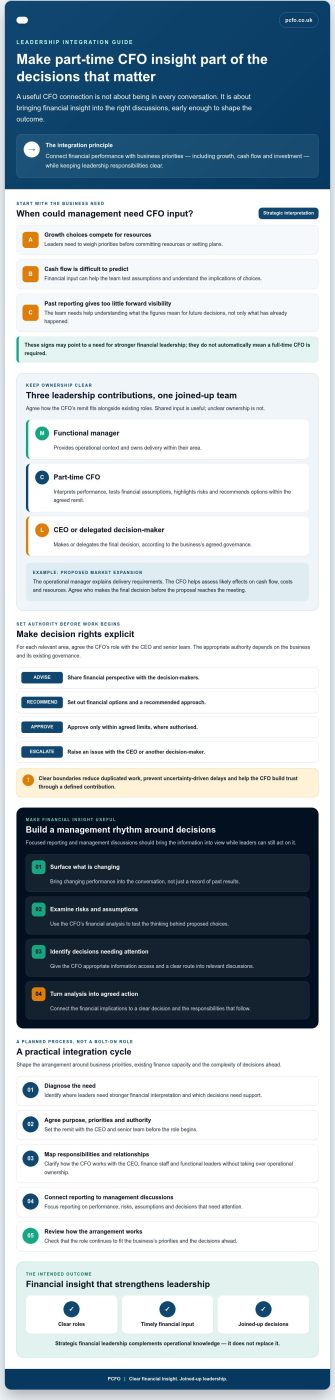
Integrate a part-time CFO with your senior team in five practical steps
A staged approach helps turn the agreed remit into a useful working relationship. These steps give the CEO and management team a starting point, while leaving room to adapt the arrangement to the business’s priorities.
- Diagnose the need. Identify where financial input would improve decisions. Consider upcoming growth choices, cash-flow questions, planning gaps or areas where leaders lack forward visibility.
- Agree the remit. Set out the CFO’s priorities, responsibilities and decision rights with the CEO and relevant managers. Clarify where the CFO will advise or recommend, and who holds final approval.
- Introduce the role. Explain the CFO’s contribution and working approach to the senior team and finance staff. Make clear how managers can share operational context, raise questions and involve the CFO in relevant decisions.
- Establish routines. Agree how information will be shared, which leadership discussions need CFO input and how actions will be recorded. Set a cadence that fits the company’s needs rather than adopting a fixed schedule by default.
- Review and refine. Check whether reporting and meetings are helping leaders make decisions. Adjust the remit, priorities or communication routines as circumstances change.
Prepare the team and agree the first priorities
Before the CFO begins, gather current business plans, management reporting, budgets, forecasts and unresolved financial questions. Ask senior managers which decisions need clearer financial visibility or constructive challenge. This gives the initial review a practical focus and connects financial work to operating priorities.
Agree a short list of initial priorities together. These might include improving the usefulness of forecasts for planning or clarifying the financial assumptions behind a proposed investment. Treat them as areas of focus, not guaranteed outcomes. When considering the scope and level of commitment, include the expected responsibilities, access to information and working arrangements in the discussion.
Review the arrangement and refine the working model
Once the CFO has worked with the team, ask whether leaders receive timely, understandable information and whether it helps them decide what to do. Invite feedback on role clarity, collaboration and the usefulness of the CFO’s input. If discussions repeatedly lack the information needed, or responsibilities remain unclear, adjust the reporting or decision process.
Effective integrating a part time cfo with your senior management team is an ongoing practice, not a one-off introduction. As priorities and decision needs evolve, revisit the working model. The PCFO website outlines part-time CFO support for businesses considering this kind of arrangement.
Make part-time CFO integration a lasting advantage for your business
Part-time financial leadership works best when the CFO’s input is matched to the decisions your business needs to make. Clear communication and role boundaries help the CFO contribute at a senior level while existing managers retain ownership of their operational areas. The right arrangement depends on your priorities, the capacity of your finance team and the complexity of decisions facing the business.
For some teams, the main need is stronger financial interpretation and planning. Others may need additional operational finance support alongside strategic leadership. Business planning and growth advisory can complement CFO-level input when the business is assessing its direction or considering how to fund and manage growth. The goal is a joined-up approach that fits your circumstances, not a standard model applied to every company.
How can you tell whether the integration is working?
Look for practical signs in how the team operates. Are decisions made with a clearer understanding of their financial implications? Do leaders know who owns each decision, and are agreed actions followed through? Ask managers whether they receive useful financial information for the choices within their remit, and whether the CFO’s challenge adds perspective without blurring accountability.
No single measure or review period proves that an arrangement is successful for every business. Use feedback from the CEO, finance team and department heads alongside evidence from planning and decision-making. If information arrives too late, or the CFO’s role remains unclear, refine the working approach rather than assuming the arrangement itself is wrong.
Choosing support that fits your management team
Before agreeing support, compare the proposed remit with the decisions and capabilities your business needs. Clarify how the finance leader will work with executives and existing finance staff, and whether the emphasis is strategic leadership, operational finance support or a combination suited to the company. If your finance team also needs operational capacity, outsourced accountancy solutions may be relevant.
Integrating a part time cfo with your senior management team is an ongoing partnership that should adapt as priorities change. Consider the business’s needs, the existing finance capacity and the decisions where additional financial leadership would be useful.
Turn financial insight into joined-up leadership
Integrating a part time cfo with your senior management team works best when the role is shaped around the decisions your business needs to make. Agree clear responsibilities, give the CFO a place in relevant leadership discussions, and establish a reporting rhythm that helps managers act on financial insight. Review the arrangement as priorities evolve, so the CFO’s contribution continues to fit your team.
PCFO provides fractional and outsourced CFO and Finance Director services, alongside business planning, growth advisory and outsourced accountancy solutions. This support can complement your existing managers and finance capacity, connecting financial leadership with business priorities.
To discuss how part-time finance leadership could support your management team, contact PCFO. A clear, practical arrangement can help your leaders make decisions together.
Frequently Asked Questions
What does a part-time CFO do within a senior management team?
A part-time CFO brings financial interpretation and forward planning into leadership decisions. They can help managers understand performance, assess cash-flow implications and test the assumptions behind plans or investment proposals. Integrating a part time cfo with your senior management team means agreeing where that input is needed and how it reaches decision-makers. The CFO complements operational leaders, who retain responsibility for their teams and delivery.
How can a part-time CFO build trust with senior managers?
A part-time CFO builds trust by being clear about their remit, listening to managers and using operational context when interpreting financial results. Introduce their role before key decisions arise, and explain how colleagues can share information or raise concerns. Constructive challenge should focus on assumptions and options, not individual performance. Agree how confidential information will be handled and how unresolved differences will be discussed with the CEO.
Can a part-time CFO attend regular management meetings?
Yes, a part-time CFO can attend management meetings where financial insight supports the agenda. Agree which discussions need their input, what pre-reading is useful and how they’ll contribute to decisions. The right attendance pattern depends on the business’s priorities and the CFO’s remit, so there’s no universal frequency. Meetings should connect financial information with operational issues and end with clear decisions, owners and follow-up actions.
How should a business divide responsibilities between a CFO and its other managers?
Set out who advises, recommends and makes the final decision for each relevant area. The CFO can assess affordability, forecast effects and financial risks, while functional managers explain operational requirements and remain accountable for delivery. The CEO or another authorised leader should retain final approval where agreed. For shared topics such as budgets or investment proposals, document each person’s contribution to prevent duplicated work or unclear ownership.
What information should a part-time CFO receive before joining a management team?
Prepare current business plans, management accounts, budgets, cash-flow forecasts and relevant performance measures. Include the assumptions behind forecasts, upcoming decisions and unresolved financial questions, as well as an outline of existing finance responsibilities. This gives the CFO context for initial discussions with the CEO and managers. Share operational explanations for significant changes too, so analysis reflects what is happening across the business rather than figures alone.
How do you measure whether a part-time CFO is adding value?
Review whether the CFO’s contribution helps leaders make more informed decisions, understand financial implications and follow through on agreed actions. Ask whether reports arrive in time to be useful, managers understand their responsibilities and the CFO’s input addresses the agreed priorities. Consider feedback from the CEO, finance team and department heads. No single metric or fixed timescale proves value for every business, so assess progress against the remit.
Is a part-time CFO suitable for a growing small or medium-sized business?
A part-time CFO may suit a growing business that needs senior financial leadership but does not require a full-time executive. Suitability depends on the company’s priorities, existing finance capacity and the complexity of decisions ahead. PCFO provides part-time and outsourced CFO and Finance Director services for growing businesses, alongside business planning and growth advisory. Agree the role’s scope and working relationships to ensure the arrangement complements the capabilities already in the team.