

Series A readiness isn’t about reaching one magic revenue figure. It’s about showing that your growth case stands up to scrutiny. The series a funding financial requirements uk start-ups face aren’t universal, so it can be difficult to judge whether the timing is right.
A credible funding case depends on more than tidy accounts. Investors will want to understand how past performance supports your forecasts, what the funding will enable and how confidently you can explain the numbers. Preparing this evidence early helps you identify gaps before they become difficult questions during due diligence.
This practical checklist covers common readiness signals and the financial, company and investor-requested records to organise. It also shows how to turn preparation into a plan, without treating investor expectations as fixed rules. You’ll have a clearer view of what’s in place, what needs attention and where Finance Director or CFO support could help connect operational performance to your funding case.
Key Takeaways
- Series A is a funding stage, not a regulated UK status with one universal eligibility test. Assess whether your evidence supports a scalable growth case.
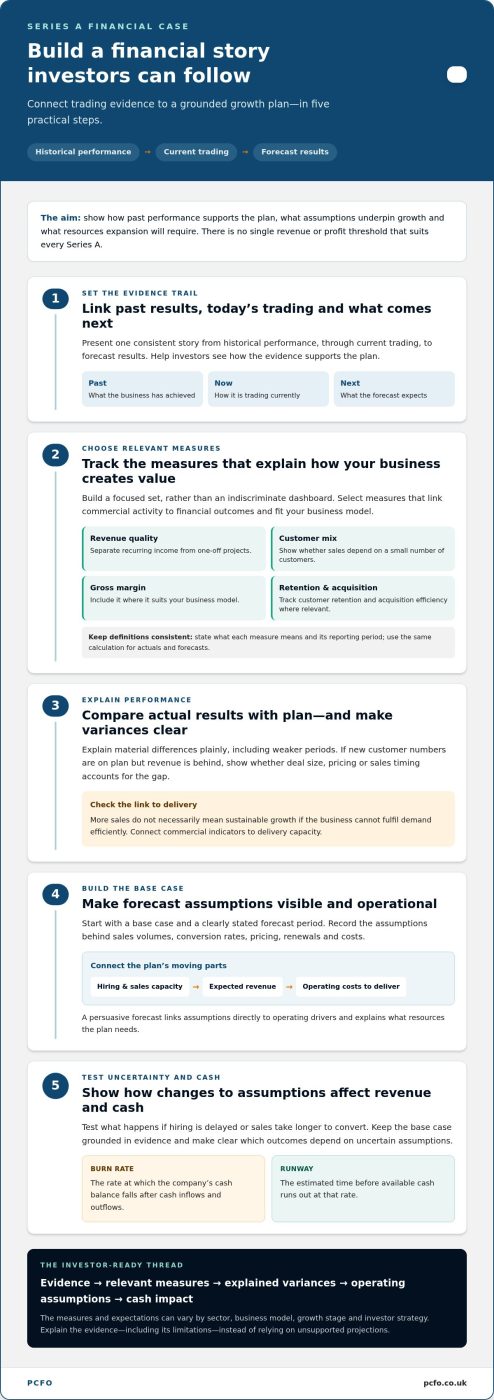
- Connect historical results, current trading and forecasts so investors can follow a consistent financial story.
- Use this series a funding financial requirements uk checklist to identify financial, company and investor-requested records to organise.
- Turn preparation into a practical plan by assigning an owner, a clear output and a decision point to each step.
- Choose finance support that fits your business’s complexity and capabilities, from founder-led preparation to fractional finance leadership.
Series A Funding Requirements in the UK: What Investors Really Assess
Series A is a stage of equity funding, not a regulated status with a single UK eligibility test. It generally describes investment intended to help a business build on early evidence of demand and scale its operations. The Series A Funding Overview provides background on how these rounds are commonly understood, but the label alone doesn’t determine whether a company is ready to raise.
Investors look for a persuasive case that the business can grow, supported by evidence rather than a headline figure in isolation. They may consider customer demand, repeatable sales, the size of the opportunity, the team’s ability to deliver and how new capital would be used. Priorities vary by sector, business model, stage of growth and investor strategy.
What does Series A readiness mean for a UK company?
Readiness means showing why growth is plausible and how the business can pursue it. Useful signals might include customers returning or renewing, a repeatable sales process and a clear opportunity to reach more customers. The evidence will differ for a subscription business, a marketplace or a company with longer project-based sales.
Strong potential doesn’t replace credible financial information. Investors need to understand how trading supports the plan, what assumptions underpin expected growth and what resources expansion will require. Explain the evidence, including its limitations, rather than relying on optimistic projections without a sound basis.
Are there fixed financial thresholds for Series A?
No single revenue or profit threshold applies to every Series A. There’s no universal UK revenue, profit or valuation level that automatically qualifies a start-up for this stage. Investors may weigh growth, customer retention, gross margins and cash requirements differently. A business with recurring revenue, for example, may be assessed partly on retention. Another business may need to explain its project pipeline, delivery capacity and margin profile.
That’s why searches for series a funding financial requirements uk can be misleading if they suggest there’s a pass-or-fail number. The practical question is whether your metrics make sense together and support the amount of capital you’re seeking, its intended use and a credible growth plan.
Keep investor expectations separate from formal company obligations. Company filings and accounting responsibilities arise from the company’s circumstances and applicable rules, not from a Series A label. Investor due diligence is different: investors may request management information, explanations and supporting records to evaluate risk and the funding case. Meeting filing obligations doesn’t guarantee investment, and an investor’s preferred metrics aren’t automatically legal requirements.
Before approaching investors, identify which evidence demonstrates demand, which assumptions underpin the plan and where the financial picture needs clarification. Finance leadership can connect operational performance to forecasts, so your funding case is coherent and the figures are ready for scrutiny.
Build the Financial Case: Metrics, Forecasts and Cash Runway
A persuasive financial case connects what the business has achieved with what it plans to do next. Investors should be able to follow one story from historical performance, through current trading, to forecast results. If revenue is growing but margins are falling, explain what’s driving the change and whether the forecast assumes the trend will continue or improve.
Choose measures that show how your business creates and retains value. Distinguish recurring income from one-off projects, and show whether sales depend on a small number of customers. Track gross margin, customer retention and acquisition efficiency where they suit your model. A marketplace, a subscription business and a consultancy won’t use identical indicators, so focus on measures that link commercial activity to financial outcomes.
Which financial metrics should founders prepare?
Build a focused set of metrics rather than an indiscriminate dashboard. Compare actual results with plan, then explain material variances plainly, including weaker periods. If new customer numbers are on plan but revenue is behind, for instance, show whether deal size, pricing or sales timing accounts for the difference. Link indicators to delivery capacity too: more sales may not mean sustainable growth if the business can’t fulfil demand efficiently.
Make each measure easy to interpret. State its definition and reporting period, and use the same calculation for historical results and forecasts. Consistent definitions help investors assess performance without having to reconcile changing measures.
How should a Series A financial forecast be built?
Start with a base case and a clearly stated forecast period. Record the assumptions behind sales volumes, conversion rates, pricing, renewals and costs. Connect planned hiring and sales capacity to expected revenue, then include the operating costs required to deliver it. A persuasive forecast links its assumptions directly to operating drivers.
Test how changes to key assumptions affect the plan. If hiring is delayed or sales take longer to convert, show the impact on revenue and cash. Keep the base case grounded in evidence, and make clear which outcomes depend on uncertain assumptions.
Explain burn rate, the rate at which the company’s cash balance falls after cash inflows and outflows, and runway, the estimated time before available cash runs out at that rate. These are planning measures, not guarantees. Customer receipts, supplier payments and investment in growth can change the picture. Show how much cash the plan requires, what the funding would pay for and how those activities support the next stage of growth.
For a deeper look at planning approaches, explore this FP&A consultant versus software comparison. A finance leader can connect operating performance to forecasts and clarify the assumptions. Flexible Finance Director and CFO support can help build that discipline without assuming you need a permanent executive.
UK Due Diligence: Organise Company Records and Financial Evidence
A well-organised diligence folder helps investors follow the financial story and see how it connects to company records. It also makes gaps easier to spot early. The series a funding financial requirements uk are not a single statutory checklist: legal and filing obligations depend on the company and its circumstances, while investors may request additional material to assess the opportunity.
Keep these categories distinct. Statutory filings meet applicable company obligations; investor diligence supports an investment decision. Filing accounts with Companies House doesn’t guarantee funding, and an investor request doesn’t automatically make a document a legal requirement. Don’t assume a statutory audit is required simply because you’re raising capital.
Which financial records belong in a diligence folder?
Use consistent file names, dates and versions, and label each document as final or draft. Reconcile key figures across accounting reports, the pitch deck and the data room. If a figure differs because documents cover different periods or use different definitions, explain the reason rather than leaving investors to guess.
| Category | Records to organise | Preparation check |
|---|---|---|
| Core financial records | Statutory accounts, current management accounts, budgets, cash forecasts and relevant tax records. | Check periods, balances and totals align; note any accounting estimates or assumptions that materially affect the figures. |
| Company records | Companies House filings, constitutional documents and a current record of share ownership. | Check that records are up to date and that ownership information agrees across relevant documents. |
| Investor-requested materials | Material customer and supplier contracts, board decisions and agreements that affect ownership or company obligations. | Organise by topic, explain commitments and flag any information that needs context. |
Document significant judgements, such as when revenue is recognised, if the timing or treatment could affect reported performance. Keep supporting explanations beside the relevant figures. Include outstanding financial commitments, such as agreed costs not yet paid, so the cash picture has the necessary context. Reconciled accounts and clear management reporting help investors understand the evidence, but you still need to explain it.
Which UK company records may investors request?
Investors may ask to review Companies House filings, the company’s constitutional documents, its current share ownership record and board decisions relevant to the proposed investment. Agreements affecting ownership, funding arrangements or other company obligations may also be relevant. Requests vary with the transaction and investor, so prepare an organised set rather than assuming every company will be asked for an identical list.
Before describing a filing or record as mandatory, check current Companies House guidance and the Companies Act 2006 as they apply to your company. Accounting treatment and filing obligations can depend on the company’s circumstances. A finance leader can help maintain reliable reporting and connect records to the funding case. Specialist legal advice may be appropriate for interpreting company documents and obligations.
Series A Preparation Checklist: Turn Gaps into a Fundraising Plan
Turn preparation into a sequence of evidence checks, not a last-minute document chase. Prioritise gaps that could undermine confidence in the numbers, weaken the forecast or leave likely investor questions unanswered. For example, explaining a material variance may matter more than refining a lower-priority presentation detail.
Use the checklist below to assign accountability and agree what “ready” means at each stage. Status should reflect the evidence available, not simply whether someone has started the task.
| Step | Accountable owner | Evidence and output | Status and next action |
|---|---|---|---|
| Assess the evidence | Founder, with finance lead | Summary of trading, customer traction and reporting gaps | Mark ready, in progress or blocked; decide which gaps could affect investor confidence. |
| Close reporting gaps | Finance lead or accounts owner | Reconciled management figures and clear variance explanations | Resolve discrepancies; decide whether figures are reliable enough to use in forecasts and investor materials. |
| Validate forecasts | Finance lead and operational owners | Base case, documented assumptions and downside scenario | Test hiring, sales capacity and costs; decide whether the plan remains credible under pressure. |
| Organise records | Finance and legal owners | Structured financial and company document folders | Identify missing or inconsistent records; decide what needs correction, explanation or specialist review. |
| Prepare outreach | Founder, with finance input | Funding rationale, use of proceeds and intended milestones | Check the story against the evidence; decide whether to begin investor conversations or address priority gaps first. |
What should founders complete before approaching investors?
Confirm that management figures reconcile and that you can explain recent performance, including weaker periods and changes against plan. Test forecast assumptions against operational capacity and a credible downside scenario. If the plan depends on new hires, show how their timing affects delivery and expected revenue.
Your funding rationale should connect the amount sought to specific uses of proceeds and intended milestones. Keep the same logic across the forecast, investor presentation and supporting materials. The series a funding financial requirements uk founders prepare for are easier to manage when each claim can be traced to evidence, an assumption or a clearly stated plan.
How can founders prepare without losing operating focus?
Schedule preparation alongside normal reporting, so reconciliations, forecast updates and document organisation become part of a manageable routine. Assign finance responsibilities for figures and assumptions, legal responsibilities for reviewing company documents, and founder responsibilities for strategy and investor communication. Advice informs decisions; formal approvals should follow the company’s appropriate governance process.
For growing businesses, strategic Finance Director support can help coordinate reporting, planning and operational evidence. If you need experienced finance leadership to structure your preparation, explore support for your fundraising plan.
Strengthen Series A Readiness with the Right Finance Leadership
Preparing for a funding round doesn’t automatically mean you need a full-time finance executive. The right level of support depends on your business’s complexity, the expertise already available and the work still to be done. Founders may manage preparation themselves when reporting is straightforward and they have the necessary skills. As the business grows, additional internal capacity or fractional finance leadership can bring more structure and senior oversight.
Focus on the gaps you need to close, not just the job title you might hire. The search phrase series a funding financial requirements uk points to a broader task: building dependable reporting, forecasts and planning that help explain the business to investors. Finance support should strengthen that process, not imply that funding is assured.
When can fractional finance leadership help?
Fractional Finance Director or CFO support provides senior financial input on a part-time or outsourced basis. It can help when founders need to improve management reporting, test forecasts, interpret performance or connect operational plans with financial outcomes, but don’t require a permanent executive role.
This is strategic finance leadership, focused on decision-useful analysis, planning and financial processes. It’s distinct from statutory audit, a separate professional service, and from permanent executive recruitment. The value lies in helping the leadership team understand what the numbers show and which decisions they support, not simply producing more reports.
How can founders decide what support they need?
Start with a practical review of the work involved. If the main challenge is maintaining accurate transaction records, stronger accountancy processes may be the priority. If forecasts need rebuilding around hiring, sales capacity and cash requirements, business planning expertise may be more relevant. Where the issue spans reporting, strategy and investor preparation, senior finance leadership can coordinate those areas.
Founder-led preparation can work where the finances are manageable and the right expertise is already in the team. Internal finance capacity may suit a sustained workload that needs regular, day-to-day attention. Fractional support brings experienced leadership flexibly, particularly when specialist input is needed for a defined growth or planning challenge. These approaches can complement one another.
Make the choice specific to your business. List the gaps, the decisions they affect and the output you need, such as reliable management reporting, a tested forecast or a clearer growth plan. Then agree who owns each task and how finance support will work with founders and operational leads. Business growth advisory can connect financial preparation to wider scaling priorities.
Assess your reporting, forecasting and planning needs. PCFO provides fractional and outsourced Finance Director and CFO support, alongside business planning and growth advisory, to help UK businesses strengthen financial processes and make informed decisions as they prepare for growth.
Take a confident next step towards funding
Fundraising preparation doesn’t need to become a separate, overwhelming project. Use your readiness assessment to choose the next practical action, assign responsibility and review progress as the business evolves. Treating the series a funding financial requirements uk as an evidence-building process can help you make considered decisions instead of viewing readiness as a pass-or-fail test.
If clearer reporting, stronger forecasts or joined-up planning would help, PCFO provides fractional and outsourced Finance Director and CFO support, alongside business planning, growth advisory and outsourced accountancy solutions. This support can connect financial information with the decisions your business needs to make, in a way that reflects your current requirements.
Discuss how strategic finance support could strengthen your funding preparation. Start with the areas that need the most attention, then build your plan one considered step at a time. Move towards investor conversations with greater clarity and confidence.
Frequently Asked Questions
Does a UK company need to be profitable to raise Series A funding?
No. A company can raise Series A funding while loss-making, provided investors see a credible case for future growth and understand how the business manages its cash. A start-up investing in product development, for example, may have operating losses but can explain how spending supports customer acquisition or recurring revenue. Investors may still scrutinise margins, cash needs and the assumptions behind a path to more sustainable trading.
How much revenue does a UK start-up need before Series A?
There’s no fixed revenue figure that qualifies a UK start-up for Series A. The series a funding financial requirements uk depend on the business model and the investor’s assessment of its opportunity. A company with recurring contracts may demonstrate traction through renewals and predictable income, while another may be assessed on its sales pipeline and delivery capacity. Show how revenue is generated, whether it can grow and what supports the forecast.
How long does it take to raise a Series A round in the UK?
There’s no dependable standard timetable. The process can vary with investor interest, the complexity of the business, the quality of preparation and the time needed to agree terms and complete due diligence. Plan for fundraising to compete with normal operational demands rather than assuming it will fit into a short window. Keep trading and reporting responsibilities covered, and avoid committing to spending that depends on funding before it completes.
What is the difference between seed funding and Series A funding?
Seed funding commonly helps a company develop its early product, test demand or establish its initial market presence. Series A generally supports the next phase, when the business seeks capital to build on evidence of demand and expand. These labels describe stages of fundraising, not a guaranteed sequence or formal UK company classification. Some companies raise through different routes, and the evidence expected depends on their circumstances and prospective investors.
Can a UK start-up raise Series A funding without audited accounts?
Potentially, yes. A Series A round doesn’t itself mean a company must obtain an audit. Whether statutory accounts require an audit depends on the company’s circumstances and applicable rules, which should be checked against current UK guidance. Investors may still request additional checks or supporting information as part of their review. Be ready to explain how accounts were prepared and provide clear reconciliations. Don’t present unaudited figures as independently audited.
What is a Series A data room, and what should it contain?
A Series A data room is an organised, usually digital, collection of documents shared with prospective investors for review. Alongside financial information, it may hold material contracts, company ownership records, board papers, product or market evidence and details of significant obligations. Name and date files clearly, control access, and keep one current version of each document. Track investor questions so responses remain consistent and confidential information is shared appropriately.
Is Series A funding taxable in the UK?
Money a company receives in exchange for issuing shares is generally treated differently from trading income, so it isn’t normally taxed as ordinary sales revenue. However, the tax and accounting treatment can depend on how the investment is structured, including whether it involves shares, loans or other instruments. Record the transaction appropriately and consider the company’s wider tax position. Seek advice from a qualified tax professional on the specific terms before completion.