

What if your KPI report shows that sales have slowed, but gives you no clear reason or next step? KPI reporting for growing businesses should do more than present figures. It should connect performance to business priorities, show what is changing and help you decide where to act.
If your reports are crowded with metrics, arrive too late or leave you guessing about the drivers behind results, you’re not alone. As a business grows, reporting needs to become more consistent and useful without adding complexity for its own sake. The aim isn’t to track everything. It’s to focus on the measures that matter.
This practical 2026 guide explains how to choose relevant KPIs, set a clear target and owner for each measure, and report trends, risks and decisions in a way your team can use. It also shows how to establish a repeatable review process that can adapt as your business changes, so reporting becomes a tool for moving forward, not just a record of what has already happened.
Key Takeaways
- Make KPI reporting for growing businesses a regular process that links important objectives to performance measures and decisions.
- Choose KPIs by tracing each business goal to the outcomes and operational drivers that influence it, then assign an owner and review point.
- Build a focused report that gives each KPI context, including its definition, current result, comparison and commentary.
- Use variances to guide a structured review: investigate what changed, agree an action and revisit ownership.
- Connect financial reporting with planning and growth priorities so performance insights can inform decisions as your business develops.
KPI reporting for growing businesses: what it is and why it matters
KPI reporting for growing businesses is the regular process of selecting, presenting and acting on measures that show progress towards important objectives. It gives leaders more than a snapshot of activity: it helps them see what has changed, explore why and decide whether a response is needed. A focused report makes performance easier to discuss across the business by linking results to the priorities they are meant to support.
A key performance indicator (KPI) is not simply a figure worth tracking. It measures progress towards an objective that matters to the business. Website visits or customer enquiries, for example, can provide useful context, but they become KPIs only when they are tied to a defined goal and inform a decision. The Key Performance Indicator (KPI) Wikipedia overview also discusses how KPIs are used across different sectors and management frameworks.
Reporting turns selected measures into a shared management tool. Leaders can spot a change, assess whether it reflects a wider trend or a one-off event, and decide what to investigate or do next. The value depends on relevant, consistently prepared data and clear interpretation. A polished dashboard cannot compensate for figures that are incomplete, out of date or disconnected from business priorities.
How is a KPI report different from a list of business metrics?
A broad data inventory records what the business can measure. A KPI report narrows that information to priority performance measures, each linked to an objective and a person responsible for monitoring or explaining it. This context makes a figure actionable: readers can understand why it is included, what movement matters and who can investigate it.
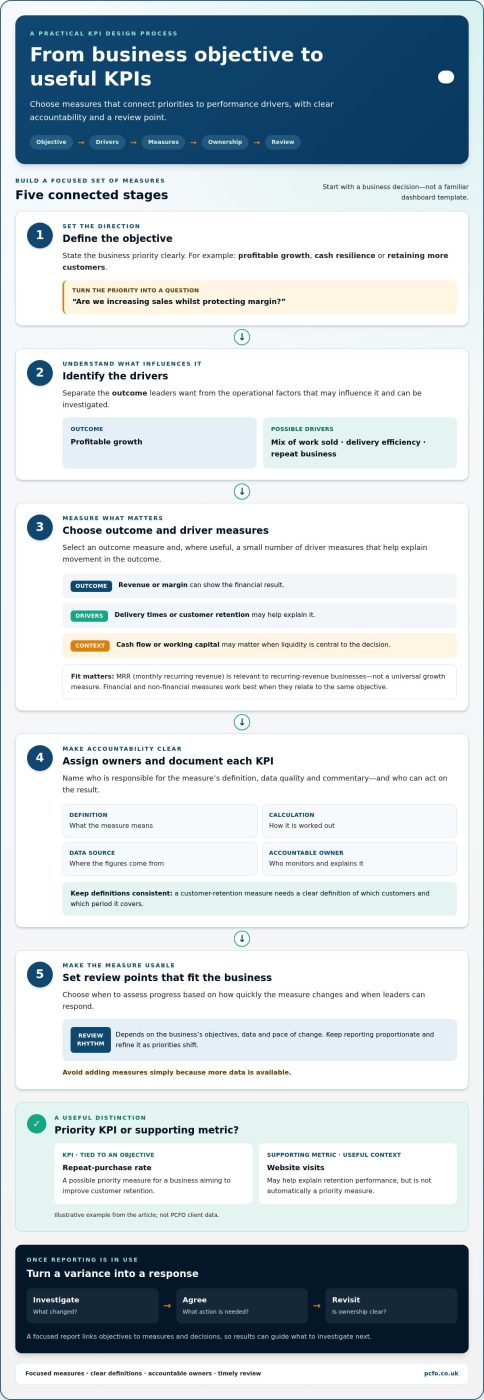
Illustrative example, not PCFO client data: A business aiming to improve customer retention might track its repeat-purchase rate as a KPI, with a named owner and regular review. Website visits could remain a supporting metric, useful for context but not a priority measure unless it helps explain retention performance.
Why growing businesses need reporting that develops with them
As a business adds teams, products or customer groups, a result that once seemed straightforward can hide important differences. Overall sales may rise, for example, while performance varies between product lines. Reporting needs to evolve so leaders can see which parts of the business are contributing to results and where assumptions may need revisiting.
A shared report gives decision-makers a common view of results, definitions and emerging issues. It can reduce confusion when teams use different reporting periods or interpret the same measure in different ways. The right KPIs and review frequency depend on the business’s objectives, data and pace of change. Keep reporting proportionate and refine it as priorities shift, rather than adding measures simply because more data is available.
How to choose KPIs that connect business goals with performance drivers
Start with a business decision, not a familiar dashboard template. Effective KPI reporting for growing businesses links an objective to the results that matter and the activities that may influence them. This helps distinguish an outcome, such as improving profitability, from the operational drivers leaders can investigate and influence.
Use this sequence to build a focused set of measures:
- Define the objective. State the priority clearly, such as achieving profitable growth, improving cash resilience or retaining more customers.
- Identify its drivers. Ask what could influence progress. For profitable growth, relevant factors might include the mix of work sold, delivery efficiency or repeat business.
- Choose measures. Select an outcome measure and, where useful, a small number of driver measures that help explain movement in the outcome.
- Assign owners. Name who is responsible for the measure’s definition, data quality and commentary, as well as who can act on the result.
- Set review points. Choose when to assess progress based on how quickly the measure changes and when leaders can respond.
Start with the business objective, not a standard KPI checklist
Turn the priority into a question the report must answer. For profitable growth, that might be: “Are we increasing sales whilst protecting margin?” The question shapes which measures are relevant and what decisions the report should inform. A standard KPI list copied from another firm can mislead if its revenue model, customers, operating model or stage of growth differs from yours. KPI.org’s guidance on understanding key performance indicators can also help frame measures around performance improvement.
Balance financial outcomes with the drivers behind them
Financial and non-financial measures can complement one another when they relate to the same objective. Revenue or margin may show the outcome, while delivery times or customer retention could help explain it. Cash flow or working capital may matter when liquidity is central to the decision. MRR, or monthly recurring revenue, is relevant to businesses with recurring-revenue models, not a universal growth measure.
For each KPI, document its definition, calculation method, data source and accountable owner. This prevents teams comparing figures built on different assumptions. For example, a customer-retention measure needs a consistent definition of which customers and period it covers. A Finance Director or CFO can connect these measures to business planning, so financial results and operational drivers support the same priorities. Finance leadership support for growth decisions can help establish reporting that develops alongside the business.
What should a growing business include in its KPI report?
A useful report gives each priority measure enough context to support a decision. Include the business objective, KPI definition, current result, comparison, accountable owner and concise commentary. This helps leaders see not just whether a figure has moved, but what it relates to and who can explain or respond to it.
Where data allows, compare the actual result with its target, the previous period and a forecast. Each comparison answers a different question: are we meeting the intended level, how has performance changed, and where might it be heading? The illustrative figures below are examples only.
| KPI | Actual | Target | Prior period | Forecast |
|---|---|---|---|---|
| On-time delivery | 92% | 95% | 90% | 93% |
A result of 92% alone says little. The comparisons show improvement from the prior period, a remaining gap against target and a forecast that still falls short. Commentary can note a known cause, such as a temporary capacity constraint, or flag that the reason is still being investigated. Trend and context turn a snapshot into a useful prompt for discussion.
Which reporting elements help leaders interpret a KPI?
Apply the same definition, calculation method, data source and time period each time you report a measure. If a target relies on assumptions, such as planned capacity or expected demand, make those visible too. Consistency lets people compare like with like and spend less time reconciling conflicting figures.
Keep commentary brief and specific. Explain material movement, state known causes and record unresolved questions for follow-up. If data is missing, estimated or delayed, label it clearly and identify the affected period. Transparency is more useful than presenting an uncertain figure as precise.
Give decision-critical KPIs prominence, then keep supporting detail available for investigation. There’s no universal number of measures that suits every business. Include a KPI if it informs a current objective or decision; move detail that doesn’t meet that test out of the main view.
Do you need a spreadsheet, dashboard or finance system?
Choose a format that suits the complexity of your data, the effort needed to update it, the number of people who need to collaborate and the maturity of your reporting process. A spreadsheet may be practical when measures are limited and updates are manageable. A dashboard or finance system can bring together more data, but only if the inputs and definitions are dependable.
The tool won’t resolve unclear ownership or inconsistent calculations. Establish the process first, then select technology that supports it. For a related perspective on balancing internal capability and software, explore the FP&A consultant versus software comparison. Strong KPI reporting for growing businesses depends on information leaders can interpret and act on, whatever format presents it.
How to review KPI reports and turn variances into action
A KPI review should create a clear route from an unexpected result to a considered response. The right cadence depends on the decisions involved, how quickly performance can change and when reliable data is available. A fast-moving operational measure may need closer attention than a longer-term outcome. Set a rhythm the team can maintain, then adjust it when the business or its priorities change.
A missed target is a signal to investigate, not proof of poor performance. The target may rely on assumptions that have shifted, or a one-off event may have affected the result. Review the evidence before deciding whether performance needs to change.
- Identify the variance. Clarify what moved, by how much and against which comparison.
- Investigate the drivers. Check the data and explore relevant operational factors without assuming a cause.
- Agree an action. Decide whether to intervene, gather more information or keep monitoring.
- Revisit ownership. Confirm who will complete the action and when its effect will be reviewed.
How should leaders investigate a KPI that is off target?
Start with the foundations: check the data source, reporting period and KPI definition. Then compare the result with previous periods to judge whether it appears to be a one-off movement or part of a sustained trend. Explore relevant operational causes, such as a change in capacity or customer behaviour, but keep assumptions separate from confirmed facts. Record what needs further analysis if the driver isn’t clear yet.
This keeps the review balanced. A variance can prompt a useful question without triggering an immediate change that may not address the underlying issue.
Who should own KPI reporting and follow-up?
Give each measure a named owner who can explain its source and movement, and make clear which leader is accountable for decisions. These roles can sit with the same person in a small team, provided the responsibilities are understood. Keep the process workable with the people and systems available, rather than creating reporting tasks no one has capacity to maintain.
Strategic Finance Director support for growing businesses can connect KPI discussions with planning and business priorities, particularly as reporting needs develop.
Capture the outcome in a brief decision log: the variance discussed, agreed action or further analysis, responsible owner, due date and result at the next review. This creates continuity between meetings and makes it easier to see whether a decision helped. To strengthen the link between performance insight and business decisions, explore PCFO’s finance leadership support.
How PCFO can help make KPI reporting more strategic
PCFO provides part-time Finance Director and CFO support to connect KPI reporting with the plans and priorities behind business decisions. Rather than treating reports as a record of past results, senior finance leadership can help interpret what the figures suggest, identify gaps in visibility and bring financial insight into growth discussions. The focus is on making reporting useful to the business, not adding complexity for its own sake.
This support is useful when priorities are changing, internal finance capacity is limited or leaders can see that performance has shifted but can’t yet explain why. A Finance Director or CFO can work with the leadership team to examine the measures, clarify what they show and facilitate discussion about the choices available. The reporting approach should reflect the organisation’s stage, objectives and information needs, rather than forcing every business into the same model.
When can external finance leadership add value to KPI reporting?
External finance leadership adds value when reports don’t clearly connect results to plans or when the business has grown beyond informal ways of reviewing performance. A part-time Finance Director or CFO can shape measures around strategic priorities, interpret financial performance alongside relevant business information and support management discussions. This develops decision-focused reporting without assuming a fixed template fits every organisation.
The value comes from creating a clearer link between what the business wants to achieve, what the reports reveal and what leaders decide to do. For instance, a growth plan may need financial insight to help leaders assess progress and consider the implications of their choices. PCFO’s outsourced accountancy solutions support the financial information that reporting relies on. Business planning also helps keep measures connected to objectives as priorities evolve.
What does a practical first conversation about reporting cover?
A useful discussion starts with your business objectives and the decisions you need to make. It can explore the reports you already use, where performance is hard to interpret and which information gaps make planning more difficult. This identifies what would make reporting clearer and more relevant, rather than introducing measures or processes without a defined purpose.
PCFO tailors support to your organisation’s stage and priorities, from improving visibility around financial performance to connecting reporting with growth plans. Its business growth advisory service aligns insight with the decisions involved in developing a business. As your needs change, reporting can be reviewed and adapted too.
Effective KPI reporting for growing businesses is an ongoing management discipline, not simply a dashboard. If your reports aren’t giving you enough clarity to make confident decisions, discuss your reporting challenges and business priorities with PCFO. A practical conversation can help identify where strategic finance input can support your next steps.
Make your next business decision with greater clarity
Useful KPI reporting for growing businesses isn’t a finished document to file away. It’s a management habit that develops as your priorities, operations and confidence in the underlying information change. The next step needn’t be a complete reporting overhaul. Start with one important decision ahead, then consider what insight would help you make it with greater confidence.
If your current reports leave important questions unanswered, a fresh perspective can help you identify where visibility is missing and how financial insight might better support your plans. PCFO brings together part-time and outsourced Finance Director and CFO services, business growth advisory, business planning support and outsourced accountancy solutions for growing businesses. Support can be shaped around your organisation’s stage and priorities.
Discuss strategic finance support for your growing business and explore how clearer reporting could support the decisions in front of you.
Frequently Asked Questions
What does KPI reporting mean for a growing business?
KPI reporting for a growing business gives leaders a structured way to understand whether priority objectives are on track and what decisions may be needed. It brings selected measures together with their meaning and context, so people can discuss performance using a shared reference point. For example, a leader considering whether to expand a team could use relevant performance information to test assumptions, rather than relying on a single headline figure.
How many KPIs should a growing business track?
There’s no universal KPI count; the right number is the smallest set that gives leaders a clear view of the objectives they’re managing. Ask of each measure: what decision could it inform, who can explain it, and is its data dependable? If a KPI has no clear use, move it to supporting analysis. That keeps the main report focused while preserving useful detail for deeper investigation.
What is the difference between a leading and a lagging KPI?
A lagging KPI records an outcome after it has happened, while a leading KPI tracks a factor that may influence a future outcome. For example, completed-period revenue is lagging; qualified sales opportunities may be a leading indicator for future sales. The relationship isn’t certain, so review whether the leading measure has reliably helped explain outcomes over time. Use both types only where they illuminate the objective being managed.
How often should a business report KPIs?
Report each KPI often enough to support decisions, but not more frequently than reliable data allows. A team may check service workloads during its regular operations review, while assessing a longer-term financial measure at a broader planning meeting. Keep the chosen schedule consistent so changes can be compared meaningfully. If the underlying data arrives late or is revised, make that timing clear rather than presenting an incomplete view as current.
What should a business do when a KPI misses its target?
Confirm the figure is accurate and comparable before deciding how to respond. Then consider whether the miss reflects a temporary event, a changed assumption or a persistent issue. For instance, a short-term delay may call for monitoring, while repeated slippage could warrant a review of capacity or process. Agree who will investigate or act, and set a point to assess what the follow-up reveals. A miss alone doesn’t establish the cause.
Can a KPI report include non-financial measures?
Yes, non-financial KPIs can help explain the conditions behind financial results. A business reviewing customer retention, for example, might also examine service quality or delivery performance if these relate to its customer experience objective. Define the measure consistently and make sure someone can explain what its movement means. Don’t include a measure merely because it’s easy to collect; it should add insight to a business question.
Do growing businesses need specialist software for KPI reporting?
No, specialist software isn’t essential for every business. A spreadsheet can work where data sources are limited, updates are manageable and the people using the report can collaborate effectively. More complex reporting may call for tools that bring information together, but implementation alone won’t ensure useful insights. Before changing systems, map where figures come from, how often they’re refreshed and what information leaders need to make decisions.
Who should be responsible for KPI reporting in a small business?
Responsibility should be shared clearly between those who maintain the information and the leaders who decide what to do with it. For each KPI, name a person who can explain its source and flag data issues, then identify who owns related decisions and follow-up. In a small team, one person may cover both roles, or founders may work alongside external accounting and business advisory specialists such as Proledger to ensure figures remain accurate and up to date. The key is to make the responsibilities explicit, so reporting doesn’t depend on assumptions or memory.