

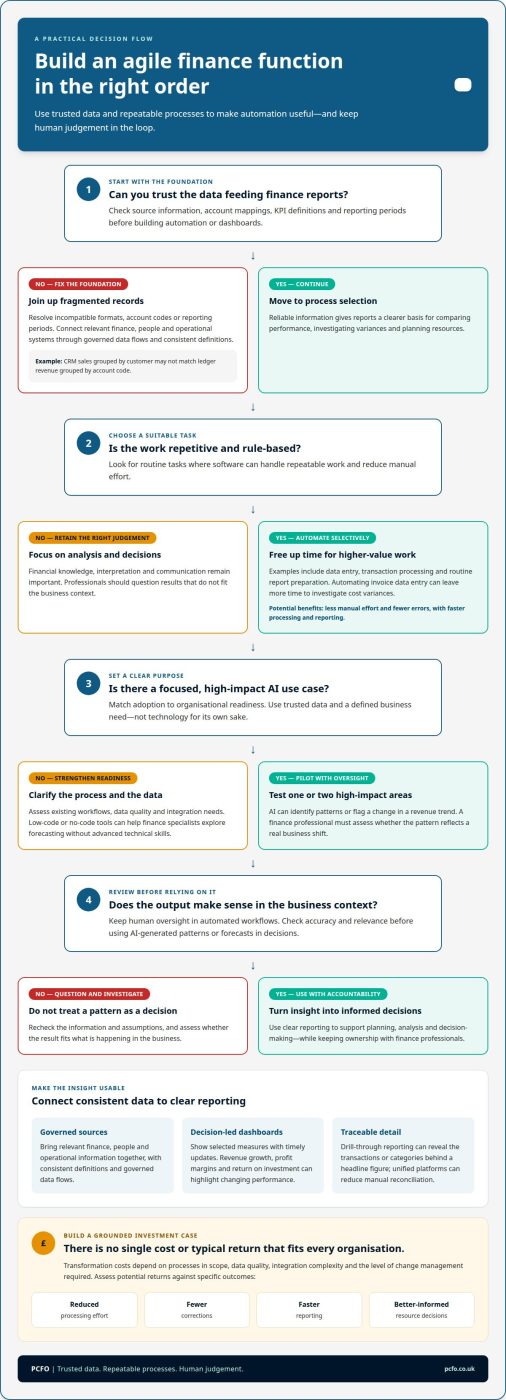
AI alone won’t make finance agile. Trusted data, repeatable processes and strong controls matter just as much. Building a data-driven finance function means combining automation and predictive insight with reliable source systems, so finance spends less time on routine work and more time supporting decisions.
It’s understandable to expect faster reporting and clearer answers from new technology. But those benefits depend on the quality and consistency of the information behind each report, as well as appropriate oversight of automated processes. This article explains how AI can support routine tasks and forward-looking analysis, and where human judgement remains essential.
You’ll also learn how dashboards and real-time reporting can make financial performance easier to interpret, which core systems can feed a dependable finance data model, and how governance and access controls help protect accuracy and sensitive information. Together, these foundations can help finance respond more confidently as business needs change.
Key Takeaways
- Prioritise a trusted finance data foundation and repeatable processes before introducing AI to targeted, high-impact tasks.
- Use clear dashboards and timely reporting to help decision-makers understand performance and act on emerging trends.
- Connect relevant finance, people and operational systems through governed data flows to reduce fragmentation and improve consistency.
- Build access controls and human oversight into automated workflows so faster insight does not come at the expense of accuracy or accountability.
How Can AI Help You Build a Truly Agile Finance Function?
AI supports agility when it improves specific finance processes, rather than adding technology without a clear purpose. A finance team can start with repeatable tasks, then use trusted data and human oversight to apply automation selectively.
Automating Repetitive Finance Tasks
Automation uses software to handle repeatable work, such as data entry, transaction processing and routine report preparation. It can reduce manual effort and errors, giving finance professionals more capacity for planning, analysis and decision support. For example, automating invoice data entry can give the team more time to investigate cost variances. Robotic process automation and machine-learning algorithms can also process high transaction volumes and produce reports faster. The benefit is not simply speed: it is more time for work that requires judgement.
Transformation Costs and ROI
Digital transformation costs depend on the processes in scope, data quality, integration complexity and the level of change management required. A business connecting clean, compatible systems faces different work from one consolidating fragmented records and redesigning manual workflows. There is no single cost or typical return on investment that fits every organisation. Assess potential returns against specific outcomes, such as reduced processing effort, fewer corrections, faster reporting and better-informed resource decisions. This makes the investment case more useful than a broad promise of savings.
Skills for Analytics and Automation
Effective finance analytics combines financial knowledge with data interpretation, process understanding and clear communication. Professionals need to recognise how changing assumptions affect a forecast, explain what a dashboard shows and question results that do not fit the business context. Low-code or no-code tools can help finance specialists explore forecasting without advanced technical skills. Human oversight remains important: AI can suggest patterns or hypotheses, but finance professionals must assess their relevance before using them in decisions.
A finance adviser should first assess existing processes and identify suitable automation opportunities. Next, they should establish a finance-owned data foundation, automate repeatable workflows and pilot AI in one or two high-impact areas. This sequence helps build a more reliable, responsive finance function without treating technology as a substitute for sound judgement.
Dashboards, reports and real-time insights
Useful reporting turns financial data into clear signals for decisions, not simply a larger volume of charts. Finance teams need reliable definitions, timely updates and measures linked to business outcomes.
Finance Reporting Foundations
Assessing reporting foundations means tracing how figures move from source systems into reports and management decisions. A finance adviser reviews the consistency of account mappings, KPI definitions and reporting periods before recommending new dashboards. For example, if sales and finance systems classify revenue differently, a report may show conflicting totals. Resolving that logic first gives leaders a clearer basis for comparing performance, investigating variances and planning resources.
AI in Financial Reporting
AI in reporting uses tools such as machine learning to analyse financial information and support faster preparation or interpretation. Its value depends on data quality, integration and clear review processes. For example, an AI-supported forecast can highlight a change in a revenue trend, while a finance professional assesses whether the pattern reflects a real business shift. Adoption should match organisational readiness, with focused use cases helping teams understand accuracy and practical value before expanding.
Dashboards and Real-Time Insights
A dashboard presents selected financial measures in a visual format, while real-time reporting updates those measures as new data becomes available. A unified platform can reduce manual reconciliation between separate sources and give management a more joined-up view of financial health. Revenue growth, profit margins and return on investment can help teams identify where performance is changing. Drill-through reporting then lets users examine the transactions or categories behind a headline figure.
Clear reporting also depends on who needs each view and what decision it supports. A board report may focus on overall performance and forecast movement, whilst an operational dashboard can surface cost changes for closer investigation. Self-service access can help stakeholders find relevant information without creating avoidable reporting bottlenecks. For businesses shaping this approach, finance reporting support can help connect measures with planning and decision-making.
Which source systems should a finance professional recommend to feed the model?
A useful finance data model connects relevant systems through governed data flows and consistent definitions. The right sources depend on the decisions, reporting and planning processes the business needs to support.
Fragmented Data and Legacy Systems
Fragmented data sits across systems that use different formats, account codes or reporting periods. Legacy finance software may not connect easily with newer CRM, HR or operational platforms, leaving teams to combine spreadsheets manually. For example, sales recorded by customer in a CRM may not match revenue grouped by account code in the ledger. These gaps complicate analytics and make it harder to trace a reported figure back to its source.
Choosing Tools for Existing Systems
A finance professional assesses AI tools against existing systems, data flows and defined business needs. Compatibility matters: a forecasting tool is less useful if it cannot access reliable ledger and sales data. The adviser considers integration, data formats, security controls and the work required to maintain connections. For example, an AI tool that uses a governed feed from the finance system may be a better fit than one relying on repeated spreadsheet uploads.
Assessing Systems and Data Quality
A system and data-quality assessment examines whether information is complete, consistent, current and traceable. A professional maps the path from source records through transformations into reports, then identifies duplicate entries, missing fields and conflicting definitions. Success can be measured against agreed outcomes, such as fewer manual reconciliations, more consistent reporting and improved forecast usefulness. A finance data platform can clean and merge datasets before analysis while retaining clear links to their sources.
Comparing Finance Technology Options
ERP, cloud accounting and analytics tools serve different purposes, so a professional compares them against transaction complexity, reporting needs and integration requirements. ERP systems can connect core business processes; cloud accounting supports financial record-keeping; analytics tools organise information for insight. A modern finance model may draw on finance, HR, CRM and selected operational systems, then provide planning and reporting layers. The recommended combination should support the business’s processes without duplicating existing capabilities.
Governance, controls, and access
Governance sets clear rules for how finance data is defined, handled and accessed. For a forecast, consistent account mappings and approved adjustments help ensure teams interpret figures on the same basis. Controls should also show where data came from, who changed it and how the final number was produced.
A finance professional can improve data quality by mapping data flows, identifying inconsistent definitions and assigning responsibility for key records. For example, they can establish a shared definition of revenue and document how adjustments enter management reports. Clear access permissions then help ensure staff can use information suited to their roles.
Security depends on protecting sensitive records without blocking legitimate finance work. Role-based access can restrict payroll details to authorised users while allowing managers to view relevant departmental costs. A unified platform can support consistent governance and access controls across connected sources, rather than relying on separate spreadsheet permissions.
AI and automation introduce risks when data is incomplete, systems are poorly integrated or outputs go unchecked. Anomaly detection may flag unusual spending, but a finance professional still needs to investigate the transaction and distinguish an error from a valid exception. Automated compliance monitoring and audit-trail generation can support control processes, but should sit within defined review procedures.
Finance leaders should balance speed with scrutiny. A practical control framework defines who approves changes, how exceptions are escalated and which outputs require human review. For example, teams can review changes to allocation rules before automated journals are generated, preserving a clear record of the decision and its rationale.
Strong governance makes reporting and forecasting more dependable by connecting data definitions, access and review responsibilities. To strengthen these arrangements alongside financial planning, discuss finance governance support.
A unified data platform can give finance teams control over access to sensitive data, help maintain governance standards, and support data quality and consistency. Nearly 12% of contractors reported a data security breach in the previous 12 months, and data security attacks such as ransomware increased by 148% after the COVID-19 pandemic began in early 2020.
At a large superannuation fund, a spreadsheet-heavy allocation process took 3 to 4 days at month end before its logic was moved into a controlled environment. Anomaly-detection algorithms can flag unusual spending or transaction discrepancies that may indicate fraud or operational inefficiencies.
PCFO: Finance Director Services
PCFO provides Finance Director Services to help growing businesses strengthen financial oversight and turn reporting into informed decisions. This support can be valuable when data is spread across systems, forecasts need clearer assumptions, or leaders want finance to contribute more directly to business planning.
With a clearer view of financial performance, business owners can make more considered decisions about growth and resource allocation. PCFO also offers Chief Financial Officer Services, Business Growth Advisory and Business Planning Consultant support, aligning financial leadership with the needs of the business.
To strengthen your finance function, contact PCFO to discuss the support that fits your business.
Make financial insight part of everyday decisions
Building a data-driven finance function is an ongoing business capability, not a one-off technology project. As your organisation changes, revisit whether financial information still supports the decisions leaders need to make. New markets, changing priorities or a different growth plan can all shift which insights matter most.
The next step is to connect finance priorities with practical leadership support. PCFO offers Finance Director Services, Chief Financial Officer Services and Business Growth Advisory to help businesses develop financial direction alongside their wider plans. The right focus may be improving decision support, strengthening planning or making finance more responsive to change.
Start a conversation about the finance function your business needs next. Contact PCFO to discuss your finance function, and take a considered step towards more confident decisions.
Frequently Asked Questions
Why Should Finance Leaders Act Now?
Finance leaders should act when business decisions are outpacing the insight available from existing reports. If an organisation is considering expansion, seeking funding or facing changing costs, outdated assumptions can weaken planning. For mission-driven teams working to transition from short-term survival to financial sustainability, insights from Nonprofit Solutions Matter, Inc. demonstrate how evaluating revenue streams and operational readiness can strengthen future planning. Improving how finance information supports decisions helps leaders assess options earlier and understand their financial implications. This creates a stronger basis for responding to change, rather than relying on figures that no longer reflect current priorities.
What does a data-driven finance function look like?
A data-driven finance function uses reliable financial and operational information to guide everyday decisions and future plans. For example, before approving a growth initiative, leaders can consider its expected effects on cash flow, working capital and profit margins together. Building a data-driven finance function also means translating analysis into clear actions, with finance professionals explaining the assumptions behind recommendations and helping teams assess whether results align with business priorities.