

What if the rapid growth you’ve fought to achieve becomes the exact catalyst for a cash flow crisis? Many ambitious directors find that scaling too quickly leads to overtrading, where the demand for working capital outstrips available reserves. It’s a common anxiety for those looking to take their operations global without a robust UK business international expansion strategy in place. We recognise that scaling a company often feels like building the aircraft whilst it’s already in flight, and you shouldn’t have to choose between seizing a market opportunity and maintaining your company’s financial stability.
Our strategic template provides the financial frameworks and operational logic required to scale your business with total confidence. We believe that sustainable expansion is a financial engineering challenge rather than just a sales target. We will examine how to protect your cash runway in the current 3.75% base rate environment, ensure alignment between the board and operations, and provide a clear, financial-led roadmap to help you navigate the UK’s evolving trade posture and export incentives.
Key Takeaways
- Learn how to construct a formalised roadmap that aligns your financial resources with operational capacity to ensure sustainable scaling.
- Identify the four pillars of growth, including strategies for deepening market penetration and entering new geographic sectors.
- Understand why a robust cash flow forecast is more critical than your sales pipeline when managing the working capital requirements of expansion.
- Utilise our structured template to execute a successful uk business international expansion strategy through rigorous internal audits and market validation.
- Discover how strategic finance leadership, such as a part-time Finance Director, can bridge the gap between board-level vision and operational reality.
What is a Strategic Business Expansion Strategy in the UK?
A strategic business expansion strategy is a formalised roadmap that aligns your financial resources, market opportunities, and operational capacity. It’s far more than a statement of intent to increase sales; it’s a structural blueprint that ensures your company’s foundations remain secure as you build upwards. For directors, developing a uk business international expansion strategy means moving beyond a “growth at all costs” mindset. It requires a forensic understanding of how your company’s infrastructure will respond to increased pressure across new territories or sectors.
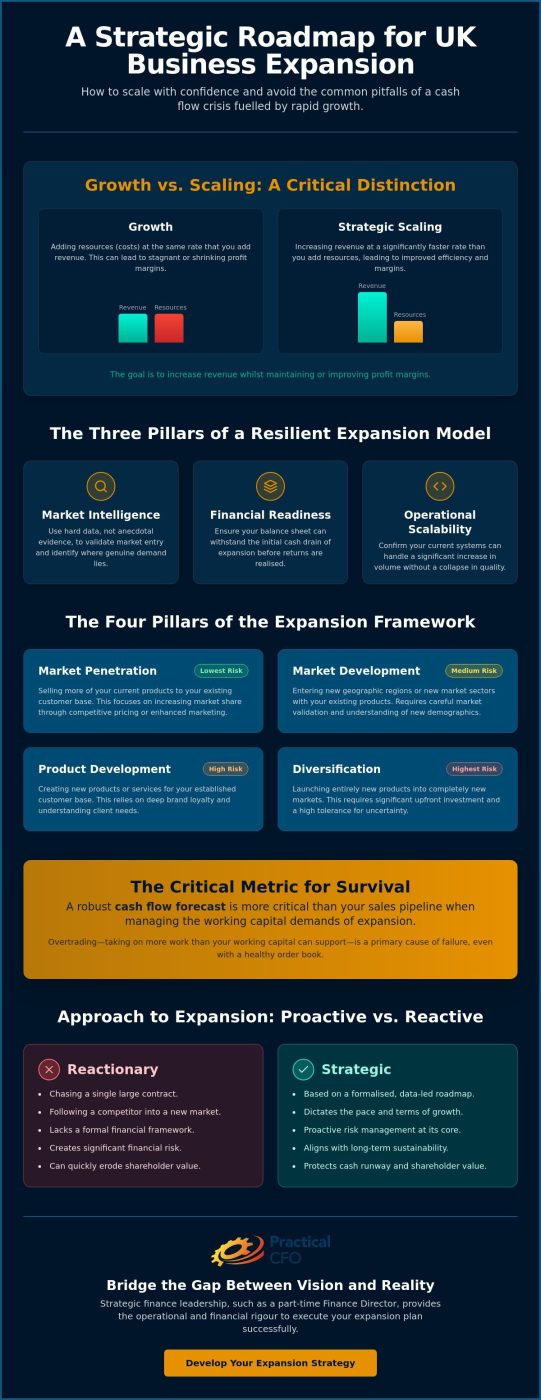
We often see UK SMEs mistake growth for scaling. Growth typically involves adding resources at the same rate as revenue, which can lead to stagnant margins. Scaling, however, allows you to increase revenue whilst maintaining or improving those margins. In the current 2026 economic climate, where the Bank of England base rate sits at 3.75% and inflation is recorded at 2.8%, the margin for error is slim. Many expansion plans fail because of overtrading, a situation where a company takes on more work than its working capital can support. Without clear cash visibility, you risk a liquidity crisis even whilst your sales pipeline looks healthy. Engaging a business scale up consultancy during this phase can provide the financial infrastructure needed to survive rapid revenue growth without compromising stability.
The Core Components of a Strategic Plan
To build a resilient expansion model, you must focus on three primary pillars:
- Market Intelligence: This involves identifying where the real demand lies amongst your target demographics. You shouldn’t rely on anecdotal evidence; use hard data to validate your market entry.
- Financial Readiness: Your balance sheet must be robust enough to withstand the initial cash drain that expansion demands before the returns manifest. We focus on ensuring your cash runway is protected.
- Operational Scalability: Evaluate whether your current systems, from supply chain to customer service, can handle a 5x increase in volume without a total collapse in quality.
Reactionary vs. Strategic Expansion
Reactionary expansion often occurs when a business chases a single large contract or follows a competitor into a new market without a framework. This approach creates significant financial risk and can quickly erode shareholder value. By contrast, a proactive uk business international expansion strategy allows you to dictate the pace of growth. This approach aligns with a broader global business strategy that accounts for international nuances and long-term sustainability. Strategic expansion is a delicate balance of proactive risk management and calculated opportunity capture.
The Four Pillars of the Expansion Framework
To build a sustainable uk business international expansion strategy, you must first categorise your growth objectives. We view expansion through four distinct pillars, each carrying a different risk profile and capital requirement. By identifying which pillar your current goals fall into, you can better allocate your financial resources and avoid the common trap of spreading your management team too thin.
- Market Penetration: This involves selling more of your current favourite products to your existing UK customer base. It is generally the lowest-risk approach, focusing on increasing market share through competitive pricing or enhanced marketing.
- Market Development: This pillar focuses on entering new geographic regions or sectors. If you’re moving goods across borders, consulting the UK government export guide is an essential first step for regulatory compliance.
- Product Development: Here, you create new solutions for your established customer base. It relies on deep brand loyalty and an understanding of your clients’ evolving needs.
- Diversification: This is the highest risk-reward pillar. It involves launching entirely new products into new markets, requiring significant upfront investment and a high tolerance for uncertainty.
Assessing Your Growth Levers
The Ansoff Matrix remains a cornerstone for directors trying to organise their expansion thoughts. It’s vital to evaluate your Cost of Acquisition (CAC) against the projected Lifetime Value (LTV) in any new market. If the CAC is too high, even a successful expansion can drain your reserves before you reach a break-even point. We recommend choosing the pillar that most closely aligns with your current cash runway and risk appetite. If you’re unsure which lever to pull first, our Business Growth Advisory services can help you model the financial outcomes of each strategic path.
Horizontal vs. Vertical Expansion
Horizontal expansion focuses on increasing your reach, such as opening new branches or acquiring a competitor. Vertical expansion involves owning more of your supply chain. For example, a UK food manufacturer might scale through vertical integration by acquiring its primary packaging supplier. This move protects margins against price volatility and secures the supply chain, though it requires a heavy initial capital outlay. Each approach has different implications for your working capital. Horizontal moves often require more marketing spend, whilst vertical moves demand significant operational investment. Your choice should reflect your long-term goal of protecting shareholder value whilst managing immediate liquidity.
Financial Modelling: The Engine of Your Expansion Plan
Whilst a sales pipeline indicates potential, your cash flow forecast dictates reality. In any uk business international expansion strategy, the ability to fund the gap between investment and return is the difference between success and insolvency. Managing working capital is often the most significant hidden cost of scaling. You’re frequently paying for additional stock, new premises, or expanded payroll long before your first international invoices are settled. Without a clear model, you’re essentially flying blind into a potential liquidity trap.
We advocate for a rigorous stress-testing approach to protect your company’s future. Ask yourself: what happens if growth is 50% slower than your most optimistic forecast? By identifying clear break-even points for new market entries, you can set “stop-loss” markers that protect the core business from being dragged down by a struggling subsidiary. This level of foresight is a key part of a strategic framework for global expansion, ensuring that every move is backed by data rather than hope.
Cash Flow Forecasting for Scale
Moving from historical reporting to forward-looking strategic forecasting is essential for any expanding business. It’s not just about what you spent last month; it’s about your burn rate and remaining runway over the next eighteen months. The role of a fractional CFO is pivotal here. They provide the high-level modelling required to predict liquidity gaps before they become crises, allowing you to make informed decisions about when to accelerate and when to hold back. This proactive oversight ensures you don’t overreach and jeopardise your existing UK operations.
Funding Your Expansion
You have two primary paths to fund your growth: internal and external. Reinvesting profits is the safest route, but it often limits your speed. Navigating the UK debt and equity markets in 2026 requires a more nuanced approach, especially with the Bank of England base rate currently held at 3.75%. If you’re seeking expansion capital, your business must be “investment ready.” This means having clean data, clear forecasts, and robust systems that can withstand the scrutiny of due diligence. Engaging specialist business growth advisory UK services can help you build the investment-ready financial infrastructure that satisfies the most demanding lenders or VCs. You might also explore non-dilutive options like Innovate UK business growth grants, which can provide significant capital for innovative projects, with some funds offering between £50,000 and £5 million for qualified UK registered government research organisations or on-farm trials.
The UK Business Expansion Strategy Template
A successful uk business international expansion strategy requires a methodical approach to execution. We have developed a five-phase template designed to move your company from theoretical planning to operational reality without compromising financial stability. This framework ensures that every growth lever you pull is backed by data and supported by your existing infrastructure. By following a structured roadmap, you can avoid the fragmented decision-making that often leads to overtrading or resource exhaustion.
- Phase 1: Internal Audit and Gap Analysis: Assess your current skills, cash reserves, and systems to ensure they can support increased volume.
- Phase 2: Market Validation and Pilot Testing: Test your product-market fit in a controlled environment before a full-scale rollout.
- Phase 3: Financial Structuring and Resource Allocation: Align your capital with the most promising growth opportunities identified during validation.
- Phase 4: Operational Execution and KPI Tracking: Implement the strategy whilst monitoring financial and operational performance forensicly.
- Phase 5: Review and Pivot: Use real-world data to refine your approach and adapt to market feedback.
Phase 1: The Internal Audit
Conducting a SWOT analysis specifically focused on expansion capacity is your first priority. You must identify the critical path items, such as regulatory compliance or supply chain logistics, that must be resolved before scaling begins. It’s also the time to assess whether your board possesses the necessary financial expertise to oversee a complex expansion. If you discover gaps in your senior leadership’s ability to model future scenarios, it’s better to address these before you commit capital to new markets.
Phase 2 & 3: Validation and Finance
During the validation phase, setting SMART goals for the first six months is essential for measuring early success. Establishing a finance director function ensures that your budget is managed with professional oversight and that cash flow remains the priority. You must define strict go/no-go criteria for each stage of the rollout. This prevents the “sunk cost fallacy” from driving poor decision-making if a particular market or product doesn’t perform as expected. If you need assistance in formalising these phases, our Business Planning Consultant services can provide the structured guidance required to de-risk your roadmap.
Execution is not a linear process; it’s a continuous feedback loop. Phase 5 is perhaps the most critical, as it requires the humility to pivot based on what the data tells you. Maintaining alignment between the board’s vision and operational reality ensures that your expansion remains sustainable in the long term, protecting both your cash runway and your brand reputation.
Executing Your Strategy with Strategic Finance Leadership
Founders often struggle to transition from operator to strategist during a period of rapid growth. Whilst you may have built your company on operational excellence, a successful uk business international expansion strategy requires a shift toward strategic foresight and capital management. You cannot afford to be stuck in the day-to-day administrative weeds when your focus should be on high-level market positioning and resource allocation. This is where strategic finance leadership becomes the bridge between your vision and a sustainable reality.
Moving from basic accountancy to a model of strategic business growth advisory allows you to treat your finance function as a value-driver rather than a back-office necessity. A part-time Finance Director provides the intellectual rigour required to de-risk your growth plan. They ensure that every decision is backed by data, protecting your cash runway whilst you pursue new opportunities. This professional oversight is what transforms a promising SME into a robust, scalable organisation. Working alongside a specialist business scale up consultancy can further strengthen this transition by ensuring your financial infrastructure keeps pace with the demands of high-growth phases.
The Fractional FD Advantage
Accessing C-suite expertise through a fractional model provides your board with high-level authority without the overhead of a full-time executive salary. This approach offers several key benefits for expanding firms:
- Objective Perspective: An FD provides a data-led viewpoint that can challenge a CEO’s growth assumptions, preventing emotional decision-making.
- Investor Relations: They act as a primary point of contact for banks and expansion investors, speaking the language of capital and building institutional trust.
- Strategic Navigation: They help you navigate the complexities of UK Corporation Tax, currently at 25% for profits over £250,000, ensuring your tax strategy is as efficient as your operational one.
Long-term Value Creation
Expansion should never be pursued at the expense of your company’s ultimate valuation. Strategic finance leadership focuses on building a scalable finance department that grows in tandem with your company’s complexity. By professionalising your systems and reporting now, you ensure your expansion leads to an exit-ready business. This foresight ensures that every move you make today increases the saleability and value of the business tomorrow.
A well-executed expansion strategy creates a legacy of stability and profit. We believe that your financial framework should be as ambitious as your sales targets. If you are ready to move beyond historical reporting and embrace a proactive roadmap for growth, Speak to PCFO about your expansion goals today. We provide the steady hand and strategic insight required to navigate your company’s next chapter with total confidence.
Future-Proofing Your Path to Scale
Sustainable growth is rarely the result of chance; it’s the product of rigorous financial engineering and strategic foresight. By prioritising cash flow visibility and following a structured execution template, you protect your company’s core whilst capturing new market opportunities. We’ve explored how a robust uk business international expansion strategy relies on moving beyond historical reporting to embrace forward-looking modelling that anticipates liquidity gaps before they manifest. Whether you’re deepening market penetration or diversifying your product range, your financial framework must remain the engine of your progress.
Success in today’s environment requires a steady hand at the helm of your financial strategy. Our team provides expert Finance Directors for hire and specialised business growth advisory for UK SMEs, backed by a proven track record in exit strategy and scaling. We’re here to help you transition from an operator to a strategist, ensuring your expansion creates lasting shareholder value. To discuss how we can de-risk your roadmap and secure your cash runway, Book a Strategic Growth Consultation with a PCFO Expert. Your next phase of growth deserves the clarity that only strategic finance leadership can provide.
Frequently Asked Questions
What is the most common mistake UK businesses make when expanding?
The most common mistake is overtrading, where a company’s sales growth outpaces its available working capital. This often happens when directors focus on the sales pipeline without considering the lead times for international payments or the upfront costs of new stock. Without a forensic cash flow forecast, even a successful expansion can lead to a liquidity crisis that threatens the core UK business.
How much cash reserves should a business have before starting an expansion strategy?
You should typically aim to have a cash reserve that covers at least six to twelve months of your projected expansion costs and increased overheads. This buffer ensures you can withstand the initial period where expenses rise before revenue from new markets begins to flow. Your specific requirement will depend on your sector’s typical payment cycles and the capital intensity of your growth model.
Is it better to grow organically or through acquisition in the UK market?
Organic growth is generally lower risk as it allows you to build your culture and systems incrementally. Acquisition offers a faster route to market share but carries significant financial and integration risks. For many UK SMEs, a hybrid approach works best, using organic growth to test the waters before considering a strategic acquisition to consolidate their position.
How does a business expansion strategy differ from a standard business plan?
A standard business plan focuses on day-to-day operations, whereas a uk business international expansion strategy specifically addresses the structural changes needed to scale. It maps out the gap between your current capacity and your future goals. This strategy focuses heavily on financial modelling, resource allocation, and risk mitigation rather than just historical performance or general marketing.
When should I hire a Finance Director to help with my expansion?
You should consider hiring a Finance Director when your growth decisions start to involve complex capital allocation or external funding. If you’re struggling to move from operational management to strategic oversight, an FD provides the necessary data-led perspective. They bridge the gap between the board’s vision and the company’s actual financial capacity, ensuring expansion doesn’t jeopardise stability.
What are the key KPIs to track during a business expansion phase?
The most critical KPIs to track are your cash runway, monthly burn rate, and the Customer Acquisition Cost (CAC) relative to Lifetime Value (LTV). You must also monitor the specific break-even points for each new market or product line. Tracking these metrics forensicly allows you to identify which growth levers are performing and which require a strategic pivot.
How do I know if my business is actually ready for expansion?
Your business is ready for expansion when your core operations are consistently profitable and your management team has the capacity to delegate. You must have clean, reliable financial data and systems that can handle increased volume without breaking. If your current UK performance is volatile, it’s usually wiser to stabilise the core before pursuing a uk business international expansion strategy.
Can I expand my business internationally whilst maintaining UK operations?
You can certainly expand internationally whilst maintaining your UK operations, provided you ring-fence the capital required for growth. It’s essential to ensure that the international arm doesn’t drain the resources of the parent company to the point of failure. Using a separate financial model for the expansion allows you to track its performance independently whilst protecting your primary revenue stream.