

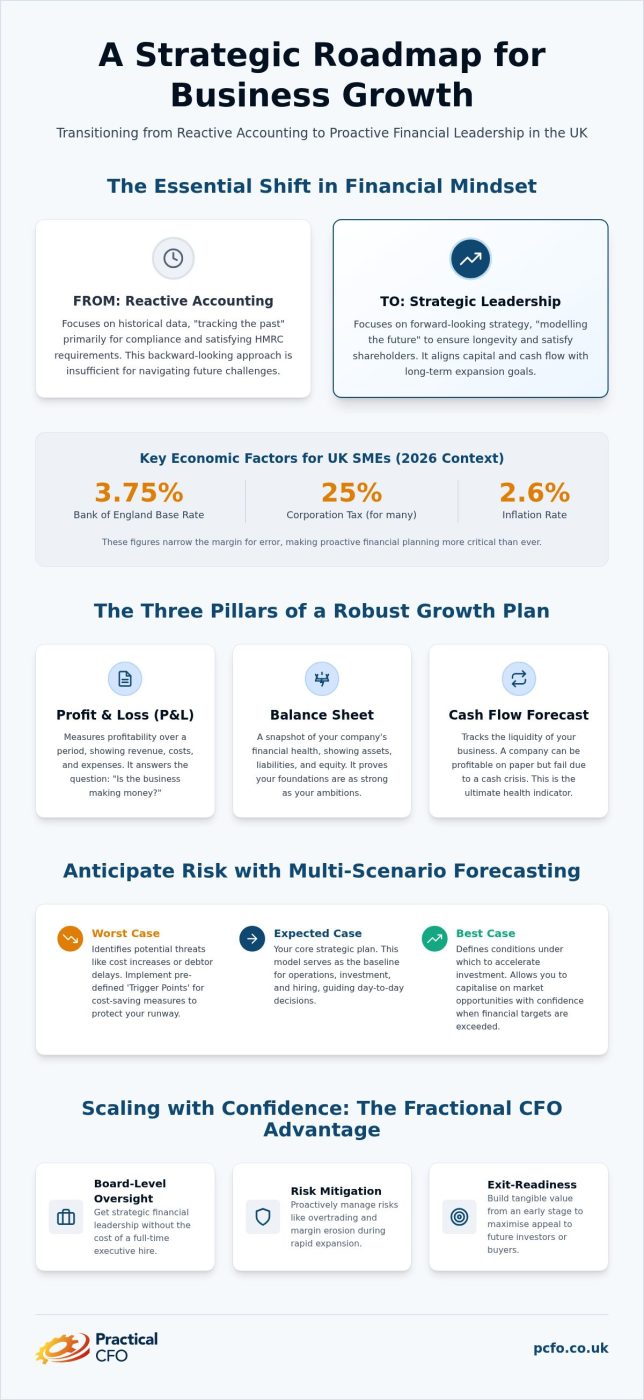
Scaling a business is a financial stress test that often reveals structural weaknesses only when the pressure becomes unbearable. You might notice that whilst your turnover is climbing, your cash reserves are dwindling, or that your current accounting support is too reactive to help you navigate the complexities of 2026. With the Bank of England base rate at 3.75 per cent and corporation tax at 25 per cent for many, the margin for error has narrowed. Effective financial planning for business growth UK requires more than just keeping the books in order; it demands a shift towards proactive, strategic oversight that anticipates challenges before they manifest as crises.
You likely recognise that relying on historical data is no longer sufficient for making high-stakes board-level decisions. This guide provides a clear roadmap to transition from basic accounting to sophisticated financial leadership. We outline how to secure your cash flow against overtrading, utilise real-time data for more confident forecasting, and ensure your business is exit-ready from an early stage. You will discover how to build a resilient financial architecture that supports sustainable expansion and long-term stability.
Key Takeaways
- Learn why moving beyond reactive accounting to strategic financial leadership is essential for navigating the complexities of the 2026 UK market.
- Identify the core financial pillars and multi-scenario forecasting techniques required to build a resilient roadmap for sustainable scaling.
- Discover how to bridge the ‘Growth Gap’ by aligning your sales velocity with cash flow runway to prevent overtrading.
- Establish a clear execution strategy for financial planning for business growth UK by defining ‘North Star’ metrics and conducting a comprehensive financial audit.
- Understand the role of a fractional CFO in providing board-level strategic oversight and exit-readiness without the cost of a permanent executive hire.
Beyond the Balance Sheet: Why Strategic Financial Planning is Critical for UK SMEs
Strategic financial planning isn’t merely about compliance or filing tax returns; it’s the deliberate alignment of your capital, cash flow, and credit facilities with your long-term expansion goals. Whilst traditional accounting focuses on “tracking the past” to satisfy HMRC, strategic leadership focuses on “modelling the future” to satisfy shareholders and ensure longevity. For UK SMEs in 2026, the economic environment requires this shift in mindset. With the Bank of England base rate at 3.75 per cent and inflation at 2.6 per cent, the cost of capital remains a significant factor in any expansion strategy. You must ensure your growth is funded by sustainable margins rather than relying on expensive, short-term debt.
Effective financial planning for business growth UK moves the conversation from historical reporting to forward-looking strategy. As a business matures, the complexity of its financial requirements increases. You’re no longer just managing a bank balance; you’re managing a complex ecosystem of investments, liabilities, and opportunities. This requires a transition from reactive book-keeping to a model where every financial decision is a calculated step towards a specific commercial outcome.
The Difference Between a Business Plan and a Growth Plan
A traditional business plan often serves as a static document designed to secure initial funding or satisfy a bank manager. In contrast, a growth plan is a tactical, high-velocity roadmap typically covering the next 12 to 36 months. It focuses intensely on revenue drivers and the scalability of your operations. By examining capital requirements against sales targets, this plan acts as a vital stress test for your current model. It forces you to ask whether your infrastructure can actually handle the volume your sales team is promising. A robust growth plan identifies the exact point where you’ll need to hire new talent or invest in new technology before the lack of capacity begins to throttle your progress.
Financial Planning as a Risk Mitigation Tool
Rapid expansion is inherently risky. Overtrading, talent acquisition costs, and price volatility can quickly erode margins if they aren’t anticipated. Strategic financial planning for business growth UK allows you to model these scenarios in advance. You can “fail on paper” by testing how a 10 per cent increase in raw material costs or a delay in debtor payments would impact your runway. Understanding the Core Components of a Financial Plan helps leaders identify which levers to pull when market conditions shift unexpectedly. This process often involves “Strategic Overhead Reduction,” where you identify and eliminate inefficiencies to protect your margins during periods of heavy investment. By modelling the “worst-case” scenario, you gain the confidence to pursue the “best-case” with clarity and composure.
Core Components of a Robust Business Growth Financial Plan
A resilient framework for financial planning for business growth UK rests on three essential pillars: the Profit and Loss statement, the Balance Sheet, and the Cash Flow forecast. Whilst many owners focus solely on the P&L to measure success, scaling requires a deep understanding of your balance sheet strength and liquidity. You need to know if your assets can support your liabilities as you take on larger contracts or expand your team. Without this holistic view, a business can appear profitable on paper whilst simultaneously facing a terminal cash crisis. It’s about ensuring that your foundations are as strong as your ambitions.
Strategic leaders employ multi-scenario forecasting to prepare for market volatility. By modelling ‘Best’, ‘Expected’, and ‘Worst Case’ outcomes, you create a safety net for your growth plans. This approach allows you to set clear “Trigger Points”—pre-defined financial thresholds that dictate when to accelerate investment or when to implement cost-saving measures. Adopting an exit strategy planning services mindset from the outset ensures that every growth initiative adds tangible value to the company. This makes the business more attractive to future investors or buyers, even if an exit is years away. It’s about building a legacy that is transferable and valuable.
Dynamic Budgeting and Rolling Forecasts
Static annual budgets often become obsolete within months for a fast-growing UK SME. The pace of change in 2026 requires more agility. We recommend implementing rolling forecasts that adapt to real-world market shifts every quarter. This dynamic approach allows you to reallocate resources based on current performance rather than outdated assumptions from the previous year. It provides the flexibility to pivot quickly, ensuring you maintain control whilst scaling at pace. This constant refinement keeps your financial strategy aligned with the reality of your operating environment.
KPIs That Actually Matter for Growth
Moving beyond top-line revenue is vital for sustainable expansion. You should focus on high-impact metrics like Customer Acquisition Cost (CAC) versus Lifetime Value (LTV) to ensure your sales efforts remain profitable. For board-level reporting, “Burn Rate” and “Runway” are critical. They tell you exactly how long your capital will last at your current spending levels. Utilising professional management accounting services UK provides these insights in real-time, allowing you to make informed decisions with confidence. This data-driven approach removes the guesswork from your expansion strategy. If you’re looking to refine your internal reporting, a business planning consultant can help you identify the specific metrics that drive your unique business lifecycle.
Managing the ‘Growth Gap’: Balancing Cash Flow Runway with Sales Velocity
A common frustration for directors is the “growing broke” phenomenon. You might find your sales team hitting record targets whilst your bank balance reaches new lows. This paradox occurs because of the “Growth Gap”, which is the time lag between the cash outflow required to fund expansion and the cash inflow from completed sales. In the context of financial planning for business growth UK, understanding this gap is the difference between a successful scale-up and a cash flow crisis. Whilst a healthy sales pipeline is a positive indicator, it’s a poor substitute for a detailed cash flow forecast. Revenue is merely a promise of future liquidity; it doesn’t pay today’s wages or supplier invoices. You must ensure your cash runway is long enough to support your sales velocity until the cycle completes.
The Hidden Costs of Scaling Too Fast
Scaling often involves “Step Costs” that aren’t incremental. You might find that hiring one additional consultant requires a move to a larger office or a significant upgrade to your IT infrastructure. These sudden leaps in expenditure can drain reserves faster than anticipated. Additionally, rapid growth often brings increased tax liabilities that require careful management. With the VAT registration threshold at £90,000 and corporation tax at 25 per cent for profits over £250,000, your cash reserves must be protected to meet these statutory obligations. Managing PAYE for a growing workforce also adds to the monthly cash pressure. “Profit is a matter of opinion, but cash is a matter of fact; scaling without liquidity is merely a fast track to insolvency.”
Optimising Working Capital Management
Managing your working capital effectively is the most direct way to bridge the growth gap. This involves tightening your credit control to reduce debtor days and negotiating better terms with your own suppliers to keep cash in the business longer. Every day that cash sits in your debtors’ ledger is a day it isn’t working for your expansion. Similarly, inventory management plays a vital role; excess stock is simply cash tied up on a shelf that could be used for marketing or recruitment. A professional business growth advisory uk helps identify these specific bottlenecks, providing the strategic oversight needed to keep your runway clear. By refining these internal processes, you ensure that your sales velocity never outpaces your financial stability. This steady, methodical approach to capital management builds the foundation for truly sustainable scaling.
Implementing Your Growth Strategy: From Forecasting to Board-Level Execution
Execution is the point where theoretical models transform into operational reality. To move from a static document to a living strategy, you need a methodical approach to implementation. Successful financial planning for business growth UK follows a structured five-step process:
- Step 1: Conduct a full financial audit. Analyse your current strengths and weaknesses to identify exactly where your capital is tied up and where inefficiencies exist.
- Step 2: Define “North Star” metrics. Establish clear, measurable growth targets for the next 12, 24, and 36 months to provide a consistent sense of direction.
- Step 3: Build a bottom-up model. Create a financial framework based on operational drivers, such as headcount and lead generation, rather than arbitrary revenue goals.
- Step 4: Establish monthly board reviews. Analyse variances between your actual performance and your forecasts to understand why deviations are occurring.
- Step 5: Iterate continuously. Use real-time market feedback to refine your assumptions and adjust your course as the economic landscape evolves.
Establishing a Governance Framework
SMEs often overlook the need for a formal finance function until a crisis occurs. Establishing a governance structure early ensures that your leadership team remains aligned as the business scales. Monthly board packs are essential tools for this. They provide a transparent view of performance that keeps stakeholders and investors informed and confident. By utilising strategic budgeting and forecasting, you create a culture of accountability where every department understands its impact on the bottom line. This structure allows you to lead with composure rather than reacting to monthly bank statements.
Leveraging Financial Technology (FinTech)
Integrated cloud accounting is no longer optional for firms seeking rapid expansion. It provides the real-time visibility needed to make high-stakes decisions without waiting weeks for month-end reports. When considering the fp&a consultant vs software uk debate, it’s vital to remember that technology is only as good as the strategy behind it. Software can aggregate data, but human interpretation remains superior for identifying strategic nuances and long-term trends. A seasoned advisor can spot the “why” behind the numbers that automated systems often miss. If you are ready to move from reactive reporting to proactive leadership, our Finance Director Services provide the expert oversight your board needs to execute with precision.
Scaling with Confidence: How a Fractional CFO Orchestrates Sustainable Expansion
Many UK business owners reach a plateau where their current accounting support, whilst excellent at compliance, lacks the strategic depth required for high-level expansion. This is the point where the fractional CFO or Finance Director model becomes essential. It serves as a vital bridge between basic book-keeping and the heavy-weight financial leadership typically found in large corporations. By engaging a part-time expert, you secure board-level expertise at a fraction of the cost of a full-time executive hire. This allows you to lead your organisation with the composure that comes from having a steady, experienced hand at the helm of your financial strategy.
PCFO acts as an embedded advisor rather than a distant contractor. We take the time to understand your specific business lifecycle, identifying the unique challenges and opportunities within your sector. This partnership allows the CEO to step away from the granularities of cash flow management and focus on their primary strengths: sales, innovation, and product development. With a strategic partner handling the financial architecture, you can pursue aggressive growth targets without the constant anxiety of structural failure.
The Strategic Value of a Part-Time Finance Director
A part-time Finance Director brings a level of commercial acumen that transforms how a business interacts with the wider financial world. This role is critical when managing complex investor relations, navigating fund-raising rounds, or leading high-level banking negotiations. In an era where the Bank of England base rate sits at 3.75 per cent, having an expert who can negotiate favourable credit terms is invaluable. An FD also ensures your business is constantly moving towards “exit-readiness.” By implementing rigorous controls and transparent reporting today, you maximise the company’s valuation for a future sale or succession. Understanding the strategic role of a finance director is often the catalyst for shifting from a small-scale operation to a market leader.
Transitioning to High-Level Financial Oversight
Identifying the “tipping point” for advanced financial planning for business growth UK is a matter of recognising when your decisions carry more weight than your data can support. If you are committing to multi-year leases, hiring significant headcount, or entering new international markets, you require more than just a retrospective view of your accounts. The ROI of hiring a strategic partner is found in the costly mistakes avoided and the profit leaks identified through meticulous analysis. A fractional CFO provides the intellectual rigour needed to ensure your growth is both profitable and permanent. If you are ready to move from reactive accounting to proactive leadership, Contact PCFO today to discuss your business growth advisory needs.
Securing Your Business Legacy Through Strategic Oversight
Sustainable expansion requires more than just increased sales; it demands a resilient financial architecture that can withstand the pressures of rapid scaling. By shifting from reactive book-keeping to proactive leadership, you’ll ensure your organisation is protected against the “Growth Gap” and prepared for future opportunities. Effective financial planning for business growth UK is a continuous process of refinement, using real-time data to steer your company with confidence.
PCFO provides bespoke financial leadership tailored to your specific business lifecycle. Whether you require fractional FD services to manage complex board-level decisions or specialised expertise in exit strategies, we act as your authoritative strategic partner. Our approach ensures you avoid costly profit leaks whilst building a company that is attractive to investors and ready for long-term success.
Book a consultation with a PCFO Business Growth Advisor today to discuss your roadmap for sustainable expansion. We look forward to helping you navigate your next phase of growth with clarity and precision.
Frequently Asked Questions
What is the difference between a business plan and a financial plan for growth?
A business plan is a foundational document often used for initial funding or setting broad objectives. In contrast, a financial plan for growth is a tactical roadmap focusing on the next 12 to 36 months of operations. It aligns your capital resources with specific revenue drivers and scalability requirements. Whilst the business plan defines the “what,” the growth plan provides the “how” through detailed modelling of cash flow and capital allocation.
How often should a UK SME update its financial growth plan?
A UK SME should ideally update its financial growth plan every quarter using rolling forecasts. Static annual budgets quickly become obsolete in a scaling environment. By reviewing your plan frequently, you can adapt to real-world market shifts and adjust your strategy based on actual performance. This methodical approach ensures that your financial planning for business growth UK remains relevant and responsive to the volatile economic conditions of 2026.
Can I manage financial planning for growth without a Finance Director?
Whilst you can manage basic compliance with a standard accountant, navigating complex expansion without a Finance Director introduces significant risk. An FD provides the strategic foresight needed for high-stakes decisions, such as fund-raising or infrastructure investment. Without this board-level oversight, businesses often struggle with overtrading or poor capital allocation. A fractional FD offers a cost-effective solution, providing the necessary leadership without the overhead of a full-time executive.
What are the biggest financial risks when scaling a business in the UK?
The primary risks include overtrading, where sales outpace cash reserves, and the rising cost of capital with the Bank of England base rate at 3.75 per cent. Additionally, navigating the 25 per cent corporation tax rate for profits over £250,000 requires precise tax planning. Talent acquisition costs and infrastructure “Step Costs” also pose threats to liquidity. Robust scenario modelling is essential to identify these bottlenecks before they result in a terminal cash crisis.
How much does a fractional CFO cost compared to a full-time hire?
A fractional CFO provides board-level expertise for a few days a month, making it significantly more affordable than a full-time hire. You avoid the substantial costs associated with executive salaries, bonuses, and benefits packages. This model allows UK SMEs to access high-level strategic advice tailored to their specific business lifecycle. It’s an efficient way to secure institutional knowledge and professional financial leadership whilst maintaining a lean overhead structure during rapid expansion.
What financial documents do I need to prepare for a Series A or B funding round?
Investors typically require a comprehensive suite of financial documents, including historical P&L statements and balance sheets. You must also provide detailed cash flow forecasts and multi-scenario growth models. A clear capitalisation table and evidence of robust management accounting processes are vital. Demonstrating that your financial planning for business growth UK is data-driven and exit-ready will significantly increase investor confidence during the due diligence process.
How does an exit strategy impact my current financial planning?
An exit strategy should inform your financial planning from an early stage to maximise business valuation. It influences how you manage clean data, intellectual property, and long-term contracts. By planning with an eventual sale in mind, you ensure that your financial systems are transparent and your margins are optimised. This proactive mindset makes the business more attractive to buyers and simplifies the transition process when you eventually decide to exit.
What is the “Growth Gap” and how can I avoid it?
The “Growth Gap” is the time lag between paying for expansion costs, such as new hires or inventory, and receiving the resulting revenue. To avoid this, focus on tight working capital management. You can bridge the gap by reducing debtor days, negotiating better supplier terms, and maintaining a healthy cash runway. Using detailed cash flow forecasting allows you to anticipate these liquidity dips and secure appropriate funding before they become critical.