

Why is your accountant only telling you what happened last year, whilst you are losing sleep over what might happen next month? When evaluating a fractional cfo vs accountant, the distinction isn’t merely a matter of qualification; it’s a fundamental difference between looking in the rearview mirror and navigating the road ahead. You likely already have a reliable professional handling your tax returns and VAT. However, if you feel a sense of unease regarding your cash flow runway or frustration with reactive reporting, you are likely bumping against the ceiling of what traditional accountancy provides.
We understand the anxiety that comes with preparing for a funding round or an eventual exit without a clear financial roadmap. This article provides the critical distinctions between financial compliance and strategic leadership to help you determine the right investment for your company’s growth. We will explore a clear decision-making framework for hiring, the tangible ROI of strategic finance, and how to ensure your business is fully future-proofed for the challenges of the 2026 financial landscape.
Key Takeaways
- Grasp the “Sat-Nav” analogy to differentiate between forward-looking strategic forecasting and historical financial reporting.
- Explore the critical distinctions in a fractional cfo vs accountant comparison, focusing on the shift from tax compliance to building long-term enterprise value.
- Identify the specific “complexity triggers” that indicate when your business has outgrown standard accountancy and requires board-level financial leadership.
- Recognise how these roles work in tandem, with the accountant providing clean data whilst the CFO utilises that information to navigate your three-to-five-year roadmap.
- Gain the peace of mind that comes from a clear decision-making framework, ensuring your business is ready for funding rounds or a successful exit.
The Great Financial Muddle: Why Founders Confuse Accountants and CFOs
Many business owners operate under the assumption that all finance professionals perform roughly the same function. This misconception often leads to a financial muddle where a founder expects board-level strategy from a professional trained primarily in compliance. When you compare a fractional cfo vs accountant, you aren’t comparing two versions of the same job. You are comparing two entirely different perspectives on your business’s health and trajectory.
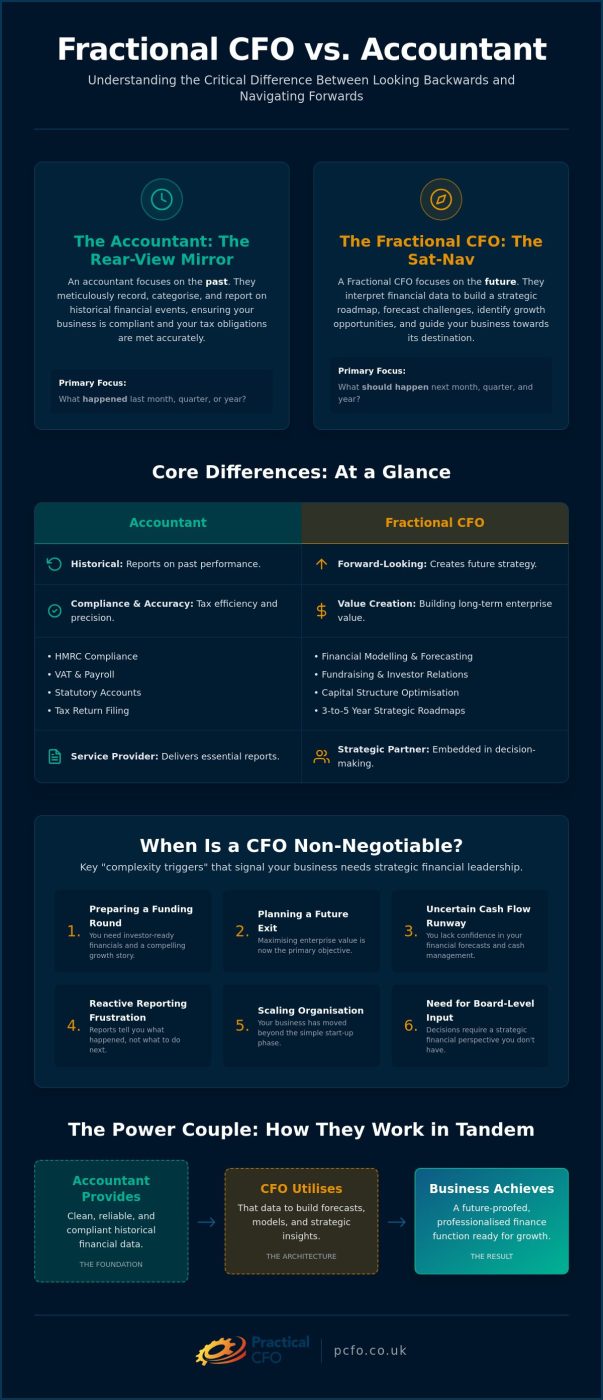
Think of it as the Rear-view Mirror vs. Sat-Nav analogy. Your accountant is focused on the rear-view mirror; they ensure that your historical data is accurate, your VAT is filed, and you remain on the right side of HMRC. This is essential work. However, you cannot drive a car safely by only looking backwards. A fractional CFO acts as your Sat-Nav, looking through the windscreen to forecast obstacles, identify growth opportunities, and map out the most efficient route to your destination.
This distinction is central to the Finance Maturity Curve for UK SMEs. As a company moves from the startup phase into a scaling organisation, its needs shift from basic bookkeeping to complex financial modelling and strategic navigation. Relying solely on a compliance-led accountant during a rapid growth phase is a common trap. It often results in reactive reporting that tells you where you were, rather than proactive insights that tell you where you are going. Understanding the principles of strategic financial leadership for smes is essential for founders who want to make this transition successfully.
What is a Fractional CFO?
A fractional CFO provides high-level financial leadership on a part-time or project basis. This model allows you to access the expertise of a seasoned Chief Financial Officer (CFO) for a fraction of the cost of a full-time executive hire. Their focus is squarely on the future. They handle high-level deliverables such as investor-ready board packs, capital structure optimisation, and fundraising strategy. If you are wondering what is a fractional cfo in a practical sense, they are the partner who turns your financial data into a growth engine. Whilst a traditional Finance Director often focuses on internal operations and team management, the CFO role is inherently more strategic and externally focused, prioritising enterprise value and long-term viability.
The Evolving Role of the Modern Accountant
Your accountant is the bedrock of your financial function. Their remit covers the critical must-haves of business ownership: HMRC compliance, payroll, VAT, and the production of statutory accounts. They ensure your foundation is solid. Confusion often arises because many accounting firms now market themselves as advisory partners. In reality, this advice is usually limited to tax planning, R&D tax credits, or software implementation. A great accountant is the foundation of your house, but they are not the architect of your expansion. They provide the clean, reliable data that a CFO needs to build a scalable future. Recognising that these roles are complementary, rather than interchangeable, is the first step toward professionalising your finance function.
Core Differences: Fractional CFO vs Accountant Comparison
Understanding the fractional cfo vs accountant dynamic requires a shift in how you view financial data. An accountant’s primary objective is tax efficiency and precision. They ensure your books are balanced, your payroll is accurate, and your tax liabilities are minimised. In contrast, a CFO focuses on building enterprise value. Their goal is to make the business more valuable to shareholders, investors, or potential buyers by optimising the capital structure and improving operational efficiency.
The relationship between the CEO and these professionals also differs significantly. An accountant typically acts as a service provider, delivering essential reports on a monthly or quarterly cycle. A fractional CFO functions as an embedded strategic partner. Research from Purdue University highlights the fundamental difference between a CFO and an accountant as a shift from transaction-oriented reporting to future-oriented strategic planning. Whilst your accountant reports what was spent, your CFO predicts what to invest to achieve your desired growth.
Compliance vs. Strategy: A Deep Dive
A CFO prioritises business growth advisory uk over routine bank reconciliations. They don’t just interpret a Profit & Loss statement; they build dynamic cash flow forecasts that simulate various market scenarios. This allows you to see the impact of a new hire or a new product line months before the first invoice is sent. When targets are missed, an accountant reports the variance. A CFO diagnoses the root cause and adjusts the investment strategy to correct the course immediately.
The ROI of Each Role
The accountant’s ROI is defensive. They save you money by identifying tax-efficient structures and ensuring you avoid costly HMRC penalties. The CFO’s ROI is offensive. They generate capital by improving gross margins, securing competitive funding, and preparing the business for exit strategy planning services. The Strategic Dividend of a CFO is the measurable increase in business valuation that results from professionalised financial leadership. If you find yourself questioning whether your current setup is sufficient for your next stage of growth, our Chief Financial Officer services can provide the clarity you need.
When is an Accountant Enough (and When is a CFO Non-Negotiable)?
Every business begins in a “Steady State” phase. During this period, your primary concerns are ensuring that transactions are recorded correctly and that you remain compliant with HMRC. If your business model is straightforward, your margins are stable, and you aren’t planning an aggressive expansion or a complex exit, a competent accountant is often sufficient. They provide the necessary peace of mind that your statutory obligations are met without the overhead of executive-level advice.
However, growth introduces complexity triggers that a compliance-led approach cannot resolve. When you move into multi-entity structures, engage in international trade with its associated VAT hurdles, or experience rapid headcount growth, the fractional cfo vs accountant debate becomes a matter of survival. These triggers demand a level of finance director level oversight to manage risk and maintain control. Another subtle trigger is the “Founder Ceiling”. If you find yourself spending your Sundays inside a spreadsheet rather than leading your team, your business has outgrown its current financial structure.
Signs Your Business Has Outgrown Your Accountant
The most common sign is having plenty of data but zero insights. You might receive a monthly management pack, but if you cannot answer the “so what?” regarding your next investment, you lack strategic leadership. Cash flow surprises are another red flag. If you only realise you are short on capital when the payroll run is due, your reporting is reactive. Finally, if you are preparing for a Series A funding round or substantial bank lending, investors will expect a level of financial sophistication that goes far beyond basic bookkeeping. Engaging a part time cfo for hire is a practical and cost-effective way to meet these investor expectations without committing to a full-time executive salary.
The High-Stakes Scenarios
There are specific moments in a company’s lifecycle where a CFO is non-negotiable. Exit planning is a primary example. To maximise value, you need to professionalise your finance function at least 24 months before you intend to sell. A CFO ensures your “due diligence” folder is immaculate and your growth story is backed by rigorous data. Similarly, during a turnaround or restructuring phase, you need a partner who can navigate a crisis with intellectual rigour. They move the conversation beyond simply cutting costs to optimising spend, ensuring that every pound invested is actively contributing to the long-term trajectory of the business.
The Power Couple: How a CFO and Accountant Work Together
A common misconception amongst founders is that hiring a CFO means making your accountant redundant. In reality, the fractional cfo vs accountant dynamic is a powerful synergy rather than a competition. These roles are complementary. An accountant ensures your data is clean and compliant, whilst the CFO provides the strategic direction required to scale. When these two functions align, they create a robust financial backbone that supports aggressive growth without compromising on governance.
The workflow is straightforward. Your accountant manages the engine room, processing transactions and maintaining the ledger. The CFO then takes this verified data to build the models that drive board-level decisions. By leveraging a fractional cfo pricing uk model, SMEs can bridge this expertise gap without the prohibitive cost of a full-time executive hire. This partnership also up-skills your existing finance team. A CFO introduces higher standards of reporting and challenges your external accounting firm to provide more granular, useful data.
Organising the Finance Function
Success requires a clear hierarchy. The CFO sits above the accounting function, overseeing the work of either your in-house bookkeeper or your external firm. They ensure that everyone is working from a “Single Version of the Truth” within your accounting software. This oversight ensures that the reports landing on your desk are board-ready and accurate. If you are looking to professionalise your internal processes, our Finance Director Services can help you establish this structure efficiently.
Communication Protocols
To avoid duplicate work and wasted fees, you must establish a disciplined monthly cycle. It begins with the accountant closing the previous month’s books by a set deadline. Once the data is verified, the CFO conducts a strategic review to identify trends, risks, and opportunities. This prevents the accountant from spending time on high-level analysis they aren’t trained for, and the CFO from getting bogged down in transactional queries. The CFO acts as the “Translator” between the CEO and the Accountant. This ensures that technical financial constraints are communicated as clear business options, allowing the founder to make confident, informed choices about the company’s future.
The PCFO Approach: Strategic Leadership for Growing UK SMEs
PCFO acts as the strategic architect for your business, bridging the gap between necessary bookkeeping and board-level strategy. Many founders struggle with the fractional cfo vs accountant decision because they don’t realise these roles can coexist in a powerful, cost-effective partnership. We don’t just deliver dense reports that gather dust on a digital shelf. Instead, we focus on providing practical, actionable advice that enables you to make immediate, confident decisions about your company’s future.
Our fractional model is built on flexibility. We recognise that a scaling business has different requirements at £1 million turnover than it does at £10 million. Our services adapt to your specific lifecycle, providing high-level expertise exactly when it’s needed without the burden of a full-time executive salary. We are committed to helping UK founders scale with pace whilst maintaining the rigorous financial control necessary to satisfy investors and stakeholders alike.
Beyond the Spreadsheet
Your Next Steps to Strategic Clarity
Transitioning your finance function from reactive to proactive begins with a clear understanding of your current organisational health. We start every partnership with a comprehensive financial health check. This process identifies specific gaps in your reporting, cash flow management, and internal controls. It establishes a baseline that allows us to move beyond historical reporting and towards a future defined by strategic foresight and intellectual rigour.
By professionalising your finance function today, you ensure your business is future-proofed for upcoming funding rounds or an eventual exit. We provide the reliability and proactive mindset required to turn your finance department from a cost centre into a strategic asset. Book a discovery call with PCFO to see how a Fractional CFO can transform your growth.
Professionalising Your Finance Function for Scalable Growth
Choosing between a fractional cfo vs accountant isn’t a matter of replacing one with the other; it’s about recognising when your business requires a shift from historical reporting to forward-looking strategy. Whilst your accountant maintains the essential foundation of HMRC compliance and clean data, a fractional CFO provides the strategic partner mindset necessary to navigate complex funding rounds or prepare for a high-value exit. This professionalised approach ensures that your finance department evolves from a back-office function into a powerful engine for growth.
At PCFO, we specialise in UK SME scaling, offering the intellectual rigour and proactive leadership needed to bridge the gap between bookkeeping and board-level decision-making. We help you move beyond the “Founder Ceiling” by future-proofing your business and ensuring every pound invested is actively building enterprise value. Ready to transform your financial data into a roadmap for success? Book a Strategic Consultation with PCFO today. We look forward to helping you secure the long-term trajectory of your business with confidence and clarity.
Frequently Asked Questions
Can my accountant act as my CFO?
An accountant can provide basic financial advice, but they rarely have the strategic experience required to act as a CFO. The core difference in the fractional cfo vs accountant debate lies in the perspective; an accountant looks at what happened, whilst a CFO plans what should happen next. Transitioning from compliance to strategic leadership requires a different set of board-level skills that most compliance-led firms don’t possess.
Is a fractional CFO more expensive than an accountant?
A fractional CFO typically commands a higher day rate than a standard accountant because they provide high-level strategic guidance rather than transactional processing. Whilst the upfront cost is higher, the ROI is found in improved margins, better capital allocation, and increased business valuation. This model provides the expertise of a seasoned executive for a fraction of the cost of a full-time salary, which can often exceed £150,000 in the UK.
How many hours a month does a fractional CFO typically work?
Most fractional CFOs work between two and four days per month for a typical UK SME. The actual hours depend on your current business complexity and specific goals, such as preparing for a funding round or managing a restructuring phase. This flexible arrangement allows you to scale the support up or down as your needs evolve, ensuring you only pay for the strategic oversight you actually require.
Will a fractional CFO help with my business exit?
A fractional CFO is essential for a successful exit because they focus on maximising your company’s enterprise value. They professionalise your finance function and prepare rigorous due diligence folders at least 18 to 24 months before a sale. This proactive preparation ensures that your growth story is backed by data. This directly impacts the final valuation and the overall smoothness of the transaction for all parties involved.
Do I need to hire a full-time CFO if I have a fractional one?
You don’t need a full-time CFO if your fractional partner is meeting your strategic needs and providing sufficient board-level oversight. Most businesses only consider a full-time hire when their revenue and operational complexity grow to a point where daily executive financial leadership becomes necessary. Until that point, the fractional model bridges the gap between basic bookkeeping and the need for a permanent executive management presence.
How does a fractional CFO interact with HMRC?
Your fractional CFO acts as a strategic supervisor rather than a direct point of contact for routine HMRC queries. They ensure that your tax strategy aligns with your long-term growth plans, whilst your accountant handles the actual VAT and Corporation Tax filings. This hierarchy ensures that compliance is maintained without distracting the CFO from high-level strategic navigation, capital management, and building long-term enterprise value.
Can a fractional CFO help secure Series A funding in the UK?
Securing Series A funding in the UK is significantly easier with a fractional CFO because they understand exactly what venture capitalists and institutional lenders require. They build the robust financial models and investor-ready board packs that establish immediate credibility in the boardroom. Their presence reassures potential investors that the business has the financial leadership necessary to manage a significant capital injection responsibly and effectively.
What is the difference between a Finance Director and a CFO in a UK SME?
In a UK SME, a Finance Director typically manages the internal finance team and day-to-day operations, whilst a CFO focuses on external strategy and capital structure. The CFO role is generally more concerned with the long-term trajectory and enterprise value of the business. Understanding the nuances of fractional cfo vs accountant roles helps you realise that a CFO provides a more elevated, strategic perspective than a standard director.