

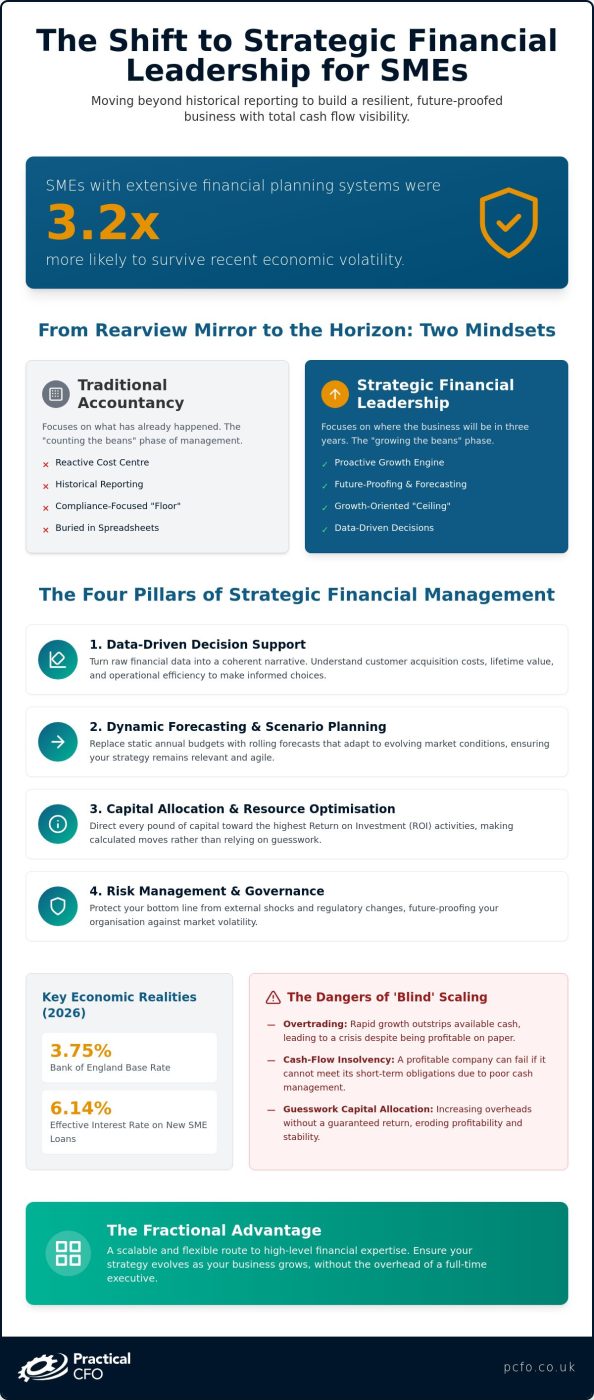
SMEs with extensive financial planning systems were 3.2 times more likely to survive recent economic volatility than those relying on reactive management. It’s a sobering reality for many business owners who feel “blind” to future cash flow issues or struggle to articulate their financial health to stakeholders. You likely started your company to innovate and lead, not to get buried under spreadsheets that only tell you what happened last month. we understand that the transition to strategic financial leadership for smes can feel like a significant leap when you’re focused on daily operations.
This guide provides the roadmap you need to bridge that gap and drive sustainable business value. You’ll learn how to move beyond historical reporting to master the strategic tools that improve profitability and provide total cash flow visibility. We’ll outline a clear framework for 2026 that empowers you to make data-driven decisions and approach board-level financial discussions with absolute confidence. This article explores the mechanisms of strategic finance and the specific steps required to future-proof your organisation’s trajectory.
Key Takeaways
- Understand how strategic financial leadership for smes transforms your finance function from a reactive cost centre into a proactive engine for sustainable growth.
- Discover the four pillars of strategic management that enable you to turn complex numbers into a clear, actionable narrative for confident board-level discussions.
- Learn to distinguish between the compliance-focused floor of traditional accountancy and the growth-oriented ceiling provided by strategic financial leadership.
- Gain insights into building an investor-ready business by using robust forecasting and clean data to maximise your organisation’s long-term valuation.
- Explore how the fractional model provides a scalable route to high-level expertise, ensuring your financial strategy remains flexible as your business evolves.
What is Strategic Financial Leadership for SMEs?
Strategic financial leadership for smes is a fundamental shift from looking in the rearview mirror to scanning the horizon. Traditional accounting focuses on what has already happened; it is the “counting the beans” phase of business management. True leadership is about “growing the beans” through data-driven insight and proactive navigation. In 2026, with the Bank of England base rate at 3.75% and tighter borrowing conditions, you can’t afford to be reactive. You need to be agile. This transition relieves the constant financial anxiety many founders feel, replacing it with the calm confidence required for high-level board discussions.
The role of a leader in this context is to translate complex data into a narrative that drives the business forward. It’s about future-proofing the organisation against market volatility whilst ensuring that every pound of capital is working toward a specific goal. When you move beyond historical reporting, you gain the clarity needed to make bold, informed decisions that others might miss.
Beyond Bookkeeping: The Leadership Mindset
A finance director doesn’t just manage the books. They focus on where the business will be in three years, not just where it was twelve months ago. This mindset requires deep commercial awareness; it’s about understanding how a change in supply chain costs or a shift in market behaviour impacts the bottom line. This approach aligns with the core principles of Strategic Financial Management, where every fiscal decision serves the primary objective of long-term value creation. Leaders who prioritise this discipline influence company culture, instilling a sense of accountability and precision throughout the entire organisation.
Why SMEs Fail Without Strategic Oversight
Scaling without a clear financial map is dangerous. Many businesses fall into the trap of overtrading, where rapid growth outstrips available cash. It’s a common pitfall; a company can be profitable on paper whilst being entirely cash-flow insolvent in reality. Without strategic financial leadership for smes, capital allocation becomes guesswork rather than a calculated move. This lack of oversight often leads to “blind” scaling, where owners increase overheads without a guaranteed return on investment. Ultimately, missing these strategic cues means you’re less likely to benefit from business growth advisory uk, as your foundations aren’t robust enough to support the next level of expansion.
The Four Pillars of Strategic Financial Management
To embed strategic financial leadership for smes, you must view finance as an active engine rather than a passive record-keeping function. This shift requires a structured framework that supports long-term stability whilst allowing for rapid tactical pivots. By focusing on four specific pillars, business owners can move from reactive fire-fighting to a position of controlled, sustainable growth. These pillars represent the transition from simply managing costs to actively orchestrating business value.
- Data-Driven Decision Support: This involves turning raw financial data into a coherent narrative. It’s about knowing not just what the numbers are, but what they say about your customer acquisition costs, lifetime value, and operational efficiency.
- Dynamic Forecasting and Scenario Planning: Static budgets are historical documents by the time they’re finished. Strategic leadership relies on rolling models that adapt as market conditions evolve.
- Capital Allocation and Resource Optimisation: With the effective interest rate on new SME loans reaching 6.14% in early 2026, capital is an expensive resource. Every pound must be directed toward the highest ROI activities.
- Risk Management and Governance: This pillar protects your bottom line from external shocks, such as the upcoming changes to statutory sick pay and family-related pay rates effective from April 2026.
Dynamic Forecasting and Scenario Planning
Static annual budgets often fail because they don’t account for the volatility of the modern UK economy. Strategic leaders employ rolling forecasts that are updated monthly or quarterly, ensuring the business remains aligned with current reality. This approach is supported by this SBA guide on managing business finances, which emphasises the need for regular financial analysis to maintain health. Scenario planning acts as a strategic buffer, allowing SMEs to model potential disruptions, such as supply chain shocks or further shifts in the Bank of England base rate, before they impact the balance sheet. Scenario planning is a vital tool for SME resilience that transforms “what if” anxieties into “if then” action plans.
Capital Allocation: Investing for Growth
Effective capital allocation is the difference between scaling and simply spending. A strategic leader identifies which specific business units or product lines are driving the highest margins and directs resources accordingly. This might mean pausing a low-margin project to fund a high-growth technology investment or a critical new hire. Balancing short-term liquidity with these long-term strategic investments ensures the business doesn’t run out of oxygen whilst climbing. If you’re finding it difficult to determine where your next pound of investment should go, our business growth advisory services can provide the clarity needed to optimise your resource spend.
Financial Leadership vs. Traditional Accountancy
Many business owners mistake a proficient accountant for a strategic partner. Whilst your year-end accountant is vital for maintaining compliance, their focus is inherently retrospective. They ensure your VAT returns are accurate, your payroll is processed, and your Corporation Tax filings meet HMRC requirements. This is the “floor” of your financial house; it is essential for stability but does not provide the height needed for growth. In contrast, strategic financial leadership for smes represents the “ceiling” — the vision and foresight that allow for true expansion.
The deliverables provided by these two roles are fundamentally different. An accountant produces statutory accounts and tax returns, which are historical records of what has already occurred. A strategic leader produces board-level growth roadmaps, investor-ready reports, and multi-year financial models. Understanding the distinction between a fractional cfo vs accountant is critical for any founder who wants to use finance as a tool for scaling rather than just a reporting obligation.
These functions should not exist in isolation. Instead, they must collaborate to support the business owner. The accountant provides the clean, verified data that serves as the raw material. The strategic leader then shapes this data into a narrative that informs commercial strategy. When these two roles work in harmony, the business gains both the safety of compliance and the momentum of strategic direction.
The Role of the Finance Director in the Boardroom
A Finance Director acts as a “critical friend” to the CEO or founder. Their role is to challenge assumptions with intellectual rigour and objective data. They don’t just report that costs have risen; they explain how those costs impact long-term margins and suggest tactical pivots to protect profitability. By translating complex financial data into actionable strategic advice, they empower the leadership team to make decisions with absolute clarity. This transparency also facilitates better stakeholder management, as investors and lenders are far more likely to support a business that demonstrates deep financial control.
When “Just an Accountant” Isn’t Enough
There are clear signals that your business has outgrown its current finance structure. If you find yourself struggling to communicate your financial health to investors, or if you’re making major capital decisions based on “gut feel,” you have reached a ceiling. Relying on historical data to navigate the 2026 economic landscape is a significant risk. When you need to bridge this expertise gap without the overhead of a full-time executive hire, a part time cfo for hire provides a scalable solution. They bring the high-level foresight required to future-proof your organisation whilst ensuring your daily operations remain lean and efficient.
Driving Growth and Preparing for a Strategic Exit
Strategic financial leadership for smes transforms a business from a lifestyle operation into a transferable, scalable asset. It ensures your organisation is “investor-ready” by providing the level of transparency and rigour that institutional buyers or lenders expect. This process relies on clean data and robust forecasting, which directly influence business valuation by reducing the perceived risk for external parties. Strategic overhead reduction is also a key component; it focuses on improving profitability through efficiency rather than cutting the resources that fuel future expansion. Professional exit strategy planning services should ideally commence three to five years before a planned sale to ensure all value drivers are fully optimised.
Managing Cash Flow whilst Scaling
The “Growth Paradox” explains why rapidly expanding businesses often face critical cash shortages despite record sales. As turnover increases, so does the demand for working capital to fund inventory, receivables, and additional overheads. Managing this gap requires a disciplined approach to your cash conversion cycle. The cash conversion cycle is a key metric for SME leaders that measures how quickly a company can convert its investments in inventory and other resources into cash flows from sales. By shortening this cycle, you can fund growth internally and reduce your reliance on expensive external debt, which is particularly relevant given the 6.14% effective interest rate on new SME loans recorded in early 2026.
Preparing for Investment or Sale
Preparing for investment or a strategic sale requires a rigorous due diligence process that acts as a stress test for your entire operation. A strategic finance leader manages the M&A process to ensure you capture maximum value during negotiations and that no “red flags” derail the deal. They focus on making your financial house impeccable, from clean balance sheets to defensible multi-year projections. Succession planning is equally vital during this phase. Buyers are looking for a business that functions independently of the founder, and a robust financial leadership structure provides that assurance. To ensure your business is positioned for a high-value departure, you can access our expert exit strategy support to begin the preparation process today.
Implementing Financial Leadership: The Fractional Advantage
Integrating an outsourced finance leader into your existing team is a collaborative process rather than a disruptive one. They act as a bridge between your operational staff and the boardroom, ensuring that daily bookkeeping activities feed directly into high-level strategy. During the first 90 days, the focus is on establishing total visibility. You can expect a comprehensive audit of your financial systems, the implementation of rolling forecasts, and the delivery of a strategic roadmap that aligns with your long-term objectives. This immediate impact replaces uncertainty with a structured, data-driven plan for the future.
Building a Scalable Finance Function with PCFO
At PCFO, our approach is defined by composure, authority, and a deep sense of partnership. We don’t view ourselves as external consultants but as embedded advisors invested in your success. We customise our services to suit your specific business lifecycle, whether you’re managing rapid growth, navigating a turnaround, or preparing for an exit. This “service-first” architecture ensures that we solve organisational gaps immediately, providing the steady hand needed to alleviate the financial anxieties that many UK founders face. Our goal is to ensure your finance function scales at the same pace as your ambitions.
Next Steps: From Accounting to Strategy
Moving your business from basic accounting to strategic financial leadership for smes starts with a clear assessment of your current position. We recommend conducting a financial health check to identify exactly where your leadership gaps lie. This process allows you to define a specific scope of work that targets your most pressing needs, whether that’s improved cash flow visibility or investor-ready reporting. Taking this first step toward board-level financial advice ensures your organisation is equipped with the intellectual rigour and proactive mindset required for sustainable growth throughout 2026 and beyond.
Securing Your Business Legacy in 2026
The transition from basic accounting to strategic financial leadership for smes is the defining step for any founder looking to build a scalable, investor-ready asset. By embedding the four pillars of financial management, you move beyond historical reporting to achieve total cash flow visibility and board-level confidence. This guide has explored how a proactive mindset, supported by the flexible fractional model, allows you to navigate economic volatility whilst protecting your long-term margins. Compliance is merely your foundation; strategic leadership is the ceiling that determines how high your business can grow.
We specialise in providing professional FD and CFO services on a fractional basis to help you bridge the gap between compliance and commercial strategy. Whether you require expert business growth advisory or specialised exit strategy planning support, our team acts as the steady hand at your helm. It’s time to stop feeling blind to future financial shifts and start leading with data-driven precision. Professional financial oversight shouldn’t be a luxury reserved for large corporations; it’s the engine that drives SME success.
Discover how PCFO’s strategic financial leadership can scale your business and provide the clarity you need to thrive. We look forward to partnering with you to future-proof your organisation’s trajectory.
Frequently Asked Questions
What is the main difference between a Finance Director and an Accountant?
An accountant focuses on historical compliance and retrospective reporting, ensuring your tax filings and statutory accounts are accurate. A Finance Director provides strategic financial leadership for smes by looking forward to influence future outcomes. They translate past data into strategic roadmaps, manage capital allocation, and act as a commercial partner to the CEO.
How much does strategic financial leadership cost for an SME?
The cost depends on the complexity of the mandate and the frequency of support required. Industry benchmarks for fractional experts in the UK typically range from £700 to £1,200 per day, whilst monthly retainers for one or two days of support per week can range between £3,000 and £8,000. This model allows businesses to access high-level expertise at a fraction of the cost of a full-time executive salary.
When is the right time for a growing business to hire a fractional CFO?
You should consider a fractional CFO when your turnover exceeds £1 million or when your financial complexity outpaces your current team’s expertise. Other triggers include preparing for a fundraise, navigating a merger, or feeling “blind” to future cash flow requirements. If you’re making major commercial decisions based on gut feel rather than data, the time is right.
Can a strategic finance leader help my business secure Series A funding?
Yes, a strategic finance leader is instrumental in securing institutional investment. They professionalise your financial function, build robust three-year models, and manage the rigorous due diligence process required by venture capitalists. Their presence in the boardroom provides investors with the reassurance that the company’s capital will be managed with intellectual rigour and discipline.
What are the key KPIs a strategic financial leader should monitor?
Strategic leaders move beyond the basic profit and loss statement to monitor forward-looking indicators. They focus on metrics such as the Working Capital Ratio, Customer Acquisition Cost (CAC) compared to Lifetime Value (LTV), and EBITDA margins. By tracking these figures, they ensure the business remains lean and profitable whilst scaling at pace.
How does strategic financial leadership improve business valuation for exit?
Strategic leadership increases valuation by de-risking the business for potential buyers. By implementing strategic financial leadership for smes, you ensure that your data is clean, your forecasts are defensible, and your margins are sustainable. A business that demonstrates strong financial control and a clear growth narrative often commands a higher multiple during an exit process.
Does my SME need a full-time Finance Director or a fractional one?
Most SMEs do not require a full-time Finance Director until they reach a significant scale or enter a period of intense M&A activity. A fractional director provides the same level of institutional knowledge and strategic oversight without the permanent overhead. This model offers the flexibility to scale the support up or down as your business lifecycle evolves. When you are ready to transition to a permanent leadership structure, particularly in specialised sectors like global fintech and digital banking, Mark Loucas Ltd can provide the executive search expertise needed to secure top-tier talent.
What role does a CFO play in risk management for UK SMEs?
A CFO future-proofs the business by identifying and mitigating external and internal risks. In 2026, this includes navigating complex regulatory shifts such as Making Tax Digital for Income Tax and the EU Deforestation Regulation. They model “what if” scenarios to ensure the business can withstand economic shocks, interest rate changes, or sudden shifts in market behaviour.