

A forecast should do more than predict sales: it should show how decisions affect cash, profit and financial position. To build a financial forecast from scratch, set clear assumptions, project revenue and costs, then connect three statements: the income statement, cash flow statement and balance sheet. The result is a practical planning tool, not just a set of figures.
It’s natural to focus on whether sales will grow. But a useful forecast also shows when customers are likely to pay, what costs will fall due and how much cash the business may need along the way.
This guide explains what financial forecasting is and how to build three-statement projections step by step. You’ll also learn how to document assumptions, test scenarios and use the forecast to guide decisions and manage risk as conditions change.
Key Takeaways
- Connect the income statement, cash flow statement and balance sheet so each projection reflects the others.
- Document the assumptions behind revenue, costs and non-operating items, then show how changes could affect the forecast.
- Use forecast scenarios to assess cash needs, plan resource allocation and identify risks before making strategic decisions.
- Consider financial leadership support when you need to turn projections into a practical business plan and ongoing decisions.
Pro forma income statements, balance sheets, and cash flow statements
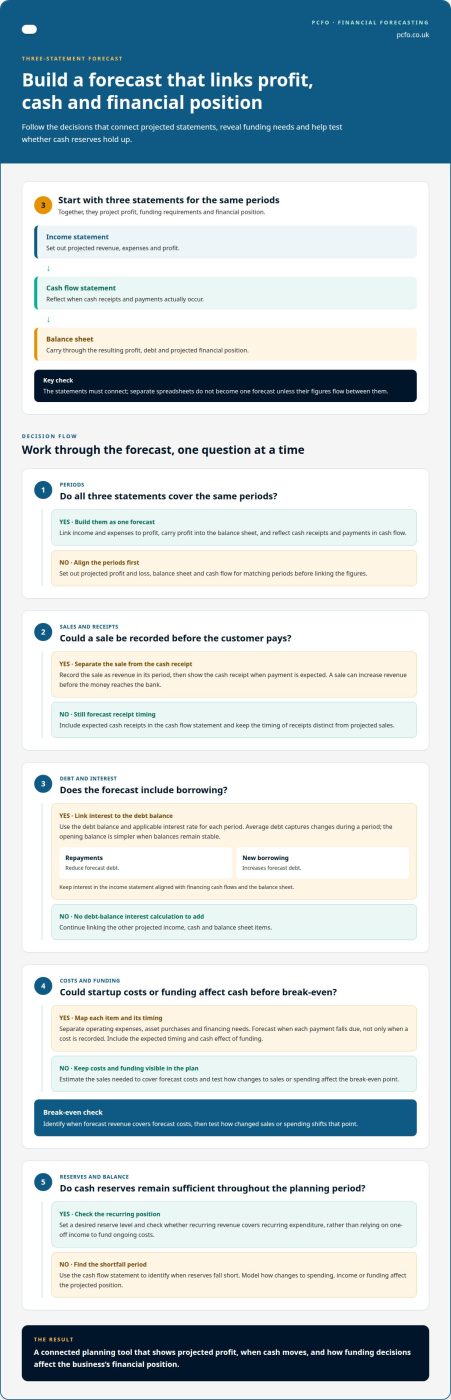
Build three linked pro forma statements: an income statement, a cash flow statement and a balance sheet. Together, they help forecast profit, funding requirements and financial position.
To forecast startup costs and funding needs, map expected expenses, payment timing and financing against projected cash. Estimate break-even by identifying when forecast revenue covers forecast costs, then test how changes to sales or spending affect that point.
-
Prepare the projected financial statements
Set out projected profit and loss, balance sheet and cash flow statements for the same periods. Start with revenue and expenses in the income statement; carry the resulting profit into the balance sheet, and reflect cash receipts and payments in the cash flow statement. Check that the statements connect, rather than treating separate spreadsheets as a single forecast. For example, a sale can increase revenue before the payment reaches the bank.
-
Forecast interest expense from debt balances
Use the debt balance and applicable interest rate to forecast interest expense for each period. Applying the rate to average debt captures borrowing changes during the period; using the opening balance is simpler when balances remain stable. Check that planned repayments reduce forecast debt and new borrowing increases it. This keeps interest in the income statement aligned with financing cash flows and the balance sheet.
-
Link costs, funding and break-even
Separate startup costs into operating expenses, asset purchases and financing needs. Project when each payment falls due, not only when a cost is recorded. Then calculate the sales needed to cover forecast costs. If the business needs funding before reaching break-even, include the expected timing and cash effect of that funding in the statements.
-
Test reserves and structural balance
Set a desired reserve level and forecast whether cash reserves remain sufficient across the planning period. A structural-balance approach checks whether recurring revenue covers recurring expenditure, rather than relying on one-off income to fund ongoing costs. Use the cash flow statement to identify periods when reserves fall short, then model how changes to spending, income or funding affect the projected position.
Communicating forecast assumptions and uncertainty
Make each projection explainable: record its assumptions, purpose and period. Clear metrics help decision-makers and investors understand what could change the outcome.
-
Define forecast assumptions and objectives
State what the forecast must inform, such as hiring, funding or launch timing, then document the assumptions behind each objective. Record the source and owner of each input, including expected customer demand, supplier terms and planned spending. Compare projections with actual results during reviews. Avoid presenting estimates as known outcomes; show which assumptions have the greatest effect on revenue or cash.
-
Set revenue and go-to-market assumptions
Build revenue projections from specific inputs: pricing, customer segments, sales channels and contract structure. For example, connect a sales target to the number of customers, expected purchase frequency and route to market, rather than applying an unexplained growth rate. For a pre-revenue startup, projections rely on assumptions rather than trading history. Make the link between the go-to-market plan and each revenue line clear to investors.
-
State limitations and time horizons
Label estimates and explain limitations, including how market shifts or delayed customer decisions could affect results. A startup financial model typically covers 3-5 years, while a bottom-up startup forecast commonly focuses on 1-2 years and a top-down forecast on 3-5 years. Cash flow estimates are generally more reliable in the short term. Small businesses should review forecasts monthly, comparing projections with actual results and revising changed assumptions.
-
Build financial forecast scenarios
Create best-case, base-case and worst-case scenarios by changing key assumptions, such as sales conversion, customer payment timing or operating expenses. Keep the base case tied to the current plan; make the other cases reflect plausible variation, not arbitrary extremes. Compare each scenario’s cash position and funding needs. Avoid relying on a single projection or leaving risks untested, as either can conceal how sensitive the plan is to changing conditions.
What is financial forecasting?
Financial forecasting uses historical performance and current assumptions to estimate future income, costs and cash. For a small business, a spreadsheet can recalculate cash flow when income or spending changes.
-
Estimate sales income and cash receipts
Use historical sales, customer demand or market research to estimate sales income; new businesses can use consumer surveys when numerical data is limited. Forecast when each receipt will arrive, not just when a sale is recorded. For example, a January sale paid in February belongs in February’s cash receipts. Small UK businesses can begin by forecasting expected sales over 6 to 12 months. Separate estimates from actual results.
-
Forecast operating costs and overheads
List expected operating costs by category, including payroll, rent, raw materials, marketing and tax bills. Link each estimate to the activity that drives it, such as staffing plans or planned production, and note when payment is due. This helps distinguish an expense recorded for a period from its cash impact. Avoid carrying historical costs forward unchanged when operations or plans have changed.
-
Forecast taxes and non-operating items
Estimate income taxes using forecast profit and the tax assumptions relevant to the business; keep tax payments separate from operating costs. Add non-operating income where relevant, such as grants, tax refunds, owner investment, royalties or licence fees. Include interest income only when the forecast supports it, and state the balance or activity that drives the estimate. UK tax, VAT and accounting treatments affect forecast timing and profit, so keep assumptions visible and distinct.
-
Build a cash flow forecast
Map cash receipts and payments across the forecast period, including operating expenses, capital expenditure and financing activity. Compare payment dates with customer receipts to estimate working capital needs. A startup financial model should include an operational cash flow overview for the coming 12 months. Keep a running cash total weekly or monthly, and use a spreadsheet to recalculate it when assumptions change. Forecasts can use historical trends, moving averages or market research, depending on available data.
Using forecasts for strategic planning and risk management
Use the forecast to connect business decisions with their expected effects on cash, profit and available capital. Review the analysis regularly, then adjust plans as actual results and conditions change.
- Translate priorities into forecast decisions. Link each strategic objective to its expected financial impact. For example, model a planned product launch against its associated sales, staffing and marketing costs. This shows whether the business has enough capital for the decision and when cash may be needed. Keep the assumptions visible so leaders can see what must happen for the plan to work.
- Test the timing of commitments. Use the forecast to compare alternative dates for spending or recruitment. A UK small business can test the effect of hiring someone in March instead of January, then compare cash and profit across both periods. This turns the forecast into a decision tool, rather than a static estimate of the expected amount.
- Identify cash and working-capital risks early. Look for periods when payments fall due before expected receipts arrive. Prolonged negative cash flow can put pressure on working capital and everyday operations. Use the forecast to plan how the business will cover shortfalls, and assess how delayed customer payments or changed spending could affect available cash.
- Compare actual performance with the plan. Review the forecast monthly and compare expected results with actual sales, expenses and cash movements. Investigate material differences, identify which assumptions changed, then update the relevant projections. This analysis helps distinguish a timing difference from a change that requires a strategic response.
- Use scenarios to manage uncertainty. Review the base case alongside stronger and weaker outcomes, focusing on their effect on cash, capital needs and planned commitments. If a downside scenario reduces available cash, decide which costs can be delayed or which investment can be staged. Revisit these choices as trading conditions and business priorities change.
If you need to connect forecast analysis with practical business decisions, explore business planning support.
PCFO: Chief Financial Officer Services
PCFO provides Chief Financial Officer Services to help growing businesses turn financial forecasts into informed decisions. This support can be useful when projections need to guide funding choices, resource allocation or a changing growth plan, but the business lacks senior financial input to connect analysis with action.
Finance Director Services provide ongoing financial direction, while Business Growth Advisory and Business Planning Services help align forecasts with business objectives. The focus is not simply producing figures. It is making assumptions clear, assessing their implications and using the forecast as plans evolve.
If you’re ready to bring more financial insight into your planning, contact PCFO to discuss your requirements.
Make your next decision with greater clarity
A forecast becomes more valuable when it shapes the choices ahead, not just the numbers on a page. As priorities change, use it to revisit investment plans, assess the effect of new commitments and decide which assumptions need closer attention. Building a financial forecast from scratch gives you a structured starting point, but its lasting value comes from keeping it connected to real business decisions.
If you need senior financial input to turn projections into a practical plan, PCFO offers Finance Director Services, Chief Financial Officer Services and Business Growth Advisory. This support brings financial analysis into growth planning and helps you make decisions with a clearer view of their implications.
Contact PCFO to discuss your forecast and consider how it can support your next business decision. A clear, adaptable plan gives you a stronger basis for moving forward.
Frequently Asked Questions
Do I need an accountant to do this?
No, you can prepare a working forecast yourself, particularly if your records are organised and your assumptions are straightforward. An accountant can review the underlying figures and identify gaps in how you have treated income, costs or tax. This is especially useful before sharing projections with lenders or investors. Keep forecasts distinct from statutory accounts, which serve a different reporting purpose.
How do you forecast revenue for a startup when you’re pre-revenue?
Build the estimate from evidence about the market and your route to customers, rather than extrapolating sales history you don’t have. Define customer groups, pricing, sales channels and expected contract structure. Market research can help assess demand, while consumer surveys can indicate behaviour. Show how each assumption leads to projected sales, then update the estimate as customer conversations and early trading provide better evidence.
What information and assumptions do you need to build a financial forecast from scratch?
Gather recent bookkeeping records, existing commitments, planned hires, sales pipeline information and financing arrangements. To build a financial forecast from scratch, organise these inputs by the period they affect and note the reasoning behind estimates. For each major assumption, record its source and how a change would affect the outcome. Separate known commitments from estimates so decision-makers can see which figures need the closest review.
How do you create a sales revenue forecast step by step?
Start by identifying the products or services that generate sales, then set out their prices and customer groups. Estimate the number of customers or transactions each channel can produce, using past sales where available and market evidence for new offers. Calculate revenue for each category and period, then compare the result with sales capacity and the go-to-market plan. Track actual sales against assumptions to refine future estimates.
How do you create a projected profit and loss statement and balance sheet?
Start the projected profit and loss statement with forecast sales, then account for the costs associated with earning that income and the business’s operating expenses. For the balance sheet, use the latest actual position as a starting point and project changes to assets, liabilities and equity. Check that the projected movements are consistent with planned activity and financing. Keep the statements linked, so a changed assumption flows through the model.
How do you use historical data, market research and UK economic indicators in a forecast?
Use historical results to identify patterns in sales, margins and spending, but separate unusual events from repeatable trends. Add market research when customer demand or a new product lacks a reliable trading record. Relevant UK indicators, such as inflation, borrowing costs and changes in customer demand, can inform assumptions about prices, expenses and sales. Explain how each indicator affects the business, rather than applying a broad economic trend mechanically.