

Your accountant delivers the monthly figures, and yet you walk into the board meeting feeling no more certain about your next decision than you did before. Sound familiar? For many ambitious UK business owners, this is the quiet frustration at the heart of their financial function: data arrives, but clarity doesn’t. If you’ve been exploring outsourced finance director services UK, you’re already asking the right question, because the gap between raw accounting and genuine strategic insight isn’t a reporting problem. It’s a leadership one.
You already know that hiring a full-time Finance Director carries a significant overhead commitment that most scaling SMEs simply can’t justify at this stage. That instinct is entirely reasonable. The challenge is that operating without that senior financial stewardship leaves you exposed: cash flow forecasts that miss the mark, overhead structures that quietly erode your margins, and growth opportunities that pass because the data to support a confident decision just wasn’t there in time.
This article sets out to change that. You’ll discover precisely how professional outsourced financial control transforms your accounting function from a backward-looking record into a proactive engine for commercial growth, covering everything from improved cash visibility to building the financial infrastructure that supports a future exit on your terms.
Key Takeaways
- Traditional accountancy delivers historical records, not commercial intelligence — discover why the reporting gap is a leadership problem that no bookkeeping upgrade can solve.
- Exploring outsourced finance director services UK reveals a spectrum of roles: understanding the distinction between a Financial Controller and a Finance Director is critical to choosing the right level of support for your current growth stage.
- Most scaling SMEs need robust financial process and system design before strategic vision — learn how outsourced financial control builds the operational foundation that makes genuine growth possible.
- Transitioning to outsourced financial control follows a structured roadmap, beginning with a diagnostic phase that exposes the hidden data gaps quietly undermining your decision-making.
- A commercially focused financial partner does far more than ensure compliance — find out how integrated financial leadership can directly support your scaling ambitions and long-term exit strategy.
The Reporting Gap: Why Traditional Accountancy Often Fails Growing UK SMEs
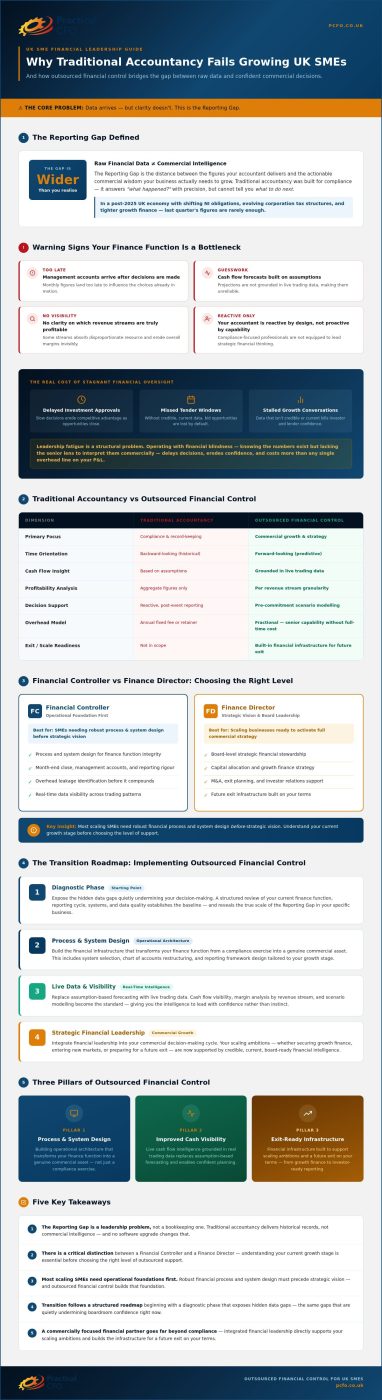
There’s a term worth defining clearly before anything else: the Reporting Gap is the distance between raw financial data and the actionable commercial wisdom a business actually needs to grow. For most scaling UK SMEs, that gap is wider than they realise, and it quietly costs them more than any single overhead line on their P&L.
Traditional accountancy was built for compliance. It answers the question “what happened?” with admirable precision. What it cannot do is tell you what to do next, and in a post-2025 UK economy navigating evolving employer National Insurance obligations, shifting corporation tax structures, and tightening access to growth finance, “what happened last quarter” is rarely the intelligence you need in the boardroom today.
The signs that your current setup has become a bottleneck rather than a catalyst are often hiding in plain sight:
- Monthly management accounts that arrive too late to influence decisions already made
- Cash flow forecasts built on assumptions rather than live trading data
- No clear visibility of which revenue streams are genuinely profitable versus which are absorbing disproportionate resource
- A growing sense that your accountant is reactive by design, not proactive by capability
That last point carries an emotional weight that founders rarely discuss openly. Operating with financial blindness, knowing the numbers exist somewhere but lacking the senior lens to interpret them commercially, creates a specific kind of leadership fatigue. Decisions get delayed. Opportunities get missed. Confidence erodes. It’s not a personal failing; it’s a structural gap that no bookkeeping upgrade can bridge.
From Historical Archive to Strategic Map
The shift from historical reporting to forward-looking intelligence isn’t a software problem. It requires a different kind of financial professional entirely. A financial controller operating at a strategic level doesn’t just close the month; they interrogate it. They identify overhead leakage before it compounds, model scenarios before you commit capital, and translate your trading patterns into a coherent picture of where your business is genuinely heading. Real-time data visibility, particularly in a market where supplier costs and consumer demand can shift within weeks, is no longer a luxury for ambitious SMEs. It’s a prerequisite for confident leadership.
The Cost of Stagnant Financial Oversight
Settling for a function that simply “gets the tax return done” is an entirely understandable starting point. It becomes a liability the moment you’re ready to scale. Slow financial decision-making in the UK SME sector carries a measurable opportunity cost: delayed investment approvals, missed tender windows, and growth conversations that stall because the supporting data isn’t credible or current. This is precisely the context in which businesses begin exploring outsourced finance director services UK providers, recognising that what they need isn’t more data, but sharper leadership of the data they already have.
Defining the Role: What Outsourced Financial Controller Services Deliver in 2026
At its core, an outsourced financial controller service provides high-level financial management and process integrity on a fractional basis. You gain the capability of a seasoned senior finance professional without the full-time overhead commitment, but the value runs considerably deeper than cost arbitrage. The role is fundamentally about building the operational architecture that transforms your finance function from a compliance exercise into a genuine commercial asset.
Three pillars define what a credible service delivers in practice:
- Process and system design: Establishing a single, authoritative source of financial truth across your organisation, so that every stakeholder is working from the same data with the same confidence in its accuracy.
- Working capital management and cash flow forecasting: Moving beyond static monthly snapshots to dynamic, rolling forecasts that reflect live trading conditions and give you genuine forward visibility.
- Commercial margin analysis: Interrogating which revenue streams, customer relationships, and cost centres are genuinely contributing to profitability, and which are quietly diluting it.
That third pillar is where many scaling businesses find the most immediate value. Knowing your headline turnover is useful. Knowing which three clients generate 60% of your net margin, and which product line is absorbing resource at a rate that makes it commercially unviable, is transformative.
The Modern Controller’s Technical Arsenal
A skilled financial controller in 2026 doesn’t manually reconcile spreadsheets. They implement integrated financial technology that automates routine accounting processes, freeing senior attention for analysis rather than data entry. Budgeting and variance analysis become live management tools rather than retrospective reports, holding the organisation accountable to its growth plan in real time. Critically, robust balance sheet management ensures your business remains UK company financial reporting requirements compliant and due-diligence ready at every stage, not just when a transaction is imminent.
Commercial Insight Beyond the Ledger
The controller’s remit extends well beyond internal reporting. When you’re evaluating a new market entry, launching a product line, or renegotiating terms with a lender, you need financial modelling that supports a confident decision rather than a speculative one. A commercially focused controller prepares that analysis, manages stakeholder communication with credibility, and ensures your financial narrative is coherent and compelling.
Integrating this role with outsourced accountancy solutions creates a genuinely seamless finance function, where transactional accuracy and strategic insight operate in concert rather than in silos. That integration is precisely what separates a reactive finance function from one that actively supports growth. If you’re exploring what this looks like in practice for your business, speaking with a fractional finance specialist is a sensible starting point.
This is the capability gap that businesses searching for outsourced finance director services UK providers are genuinely trying to close: not more reporting, but sharper, more commercially grounded financial leadership at the precise moment their growth demands it.
Financial Controller vs Finance Director: Choosing the Right Level of Leadership
One of the most persistent sources of confusion when exploring outsourced finance director services UK providers is the assumption that “Financial Controller” and “Finance Director” describe the same role at different price points. They don’t. They represent genuinely distinct levels of financial leadership, each suited to a different stage of business maturity, and choosing the wrong one is an expensive mistake in either direction.
The distinction matters practically, not just semantically. According to research on UK SME financial challenges and growth, access to appropriate financial expertise remains one of the most cited barriers to scaling for businesses below £10m turnover. The reason that barrier persists is often misalignment: businesses either over-invest in strategic vision before their operational foundations are solid, or they remain stuck at the bookkeeping level long after their complexity demands something more rigorous.
The Financial Controller Focus
A Financial Controller’s primary mandate is integrity. The numbers must be accurate, the systems must be robust, and the reporting must be timely. For businesses in the £1m to £5m turnover range, this is the foundational work that makes everything else possible. Without it, any strategic discussion is built on unreliable data. The key outcomes are stability and genuine visibility: knowing, with confidence, where your cash is, where your margins are leaking, and whether your overhead structure is sustainable at your current revenue level.
The Finance Director Focus
A Finance Director operates at a different altitude entirely. Their focus shifts to capital structure, board-level strategy, fundraising narratives, and long-term value creation. For businesses approaching £5m turnover, or those actively preparing for a strategic sale, this is where fractional FD engagement delivers its most significant return. The key outcomes are growth acceleration and value maximisation: shaping the financial story that attracts investment, supports an acquisition, or positions the business for its next phase.
Why Most SMEs Need the Controller First
Strategic vision without operational accuracy is simply expensive guesswork. Most scaling SMEs genuinely need their financial processes professionalised before they need board-level capital strategy. Attempting to skip that foundation stage is a common and costly error.
PCFO’s approach reflects this reality directly. Rather than applying a single service model regardless of business stage, the graduated framework means you engage at the level your business actually requires today, with the ability to evolve that relationship as your complexity and ambitions grow. Fractional fees across both levels typically represent a fraction of the total cost of a full-time executive hire when salary, employer National Insurance contributions, pension obligations, and recruitment costs are properly accounted for. The commercial case isn’t marginal; it’s compelling.
Choosing the right level of outsourced finance director services UK engagement isn’t about budget alone. It’s about an honest assessment of where your business sits on its growth trajectory and what it genuinely needs next.
The Roadmap to Implementation: Transitioning to Outsourced Financial Control
Knowing you need stronger financial leadership and knowing how to get there are two very different things. For most founders, the transition from founder-led finance to outsourced financial control feels opaque, which is precisely why so many businesses delay it longer than they should. What follows is a clear, stage-by-stage roadmap of what a structured implementation actually looks like in practice.
Step 1: The Diagnostic Phase. Before anything is built, the existing landscape must be honestly assessed. This means identifying the ‘black holes’ in your current financial data: incomplete debtor records, unreconciled balance sheet items, cost centres that haven’t been reviewed in years, and reporting timelines so delayed they’ve lost commercial relevance. This diagnostic isn’t a criticism of your team; it’s a prerequisite for building something reliable on top of what exists.
Step 2: System Clean-up. With the gaps identified, the next priority is standardising your chart of accounts and automating manual data entry wherever possible. This single step eliminates the source of most reporting errors and frees your existing staff from low-value reconciliation tasks. Consistency in how financial data is categorised is what makes meaningful analysis possible downstream.
Step 3: The First Forecast. The earliest tangible deliverable is a 13-week rolling cash flow model built on live trading data rather than assumptions. For many business owners engaging with outsourced finance director services UK providers for the first time, this is the moment the value becomes viscerally clear. Seeing genuine forward visibility, rather than a month-end snapshot, changes how confidently you can commit to decisions.
Step 4: Management Reporting. The Board Pack is redesigned from the ground up. Not more pages, but sharper ones: the metrics that actually drive your business, presented in a format that prompts a decision rather than a question. Variance analysis, margin by revenue stream, and cash position all presented with the context to act on them.
Step 5: Ongoing Partnership. Monthly reviews shift from “what happened?” to “what’s next?” This is where the relationship moves from operational to genuinely strategic.
Preparing Your Team for Change
An outsourced controller doesn’t replace your bookkeeper or finance administrator; they elevate them. The practical collaboration involves clear role delineation: your internal staff handle transactional processing, whilst the controller owns accuracy, interpretation, and forward planning. Internal resistance to new processes is normal and manageable. The most effective antidote is transparency about the ‘why’, paired with 90-day KPIs that demonstrate measurable improvement in reporting timeliness, cash forecast accuracy, and management information quality. When the team sees the output improving, resistance typically dissolves.
Future-Proofing Through Business Planning
Once genuine financial visibility is established, it becomes the foundation for everything more ambitious. Refined business growth advisory planning becomes credible rather than aspirational, because the underlying data is now trustworthy. Scenario planning, specifically modelling what a 10% revenue decline or a 15% cost increase does to your runway and covenant headroom, becomes a standard management tool rather than a crisis response. For businesses with a future transaction in mind, this financial muscle is precisely what outsourced finance director services UK engagement builds: the rigour, the documentation, and the narrative coherence that makes a due diligence process survivable.
Implementation needn’t be disruptive. With the right partner, it’s methodical, phased, and designed around your business rather than imposed upon it. Speak with PCFO to map out what your first 90 days could look like.
Strategic Financial Leadership with PCFO: Future-Proofing Your Business
Compliance is the floor, not the ceiling. PCFO’s approach to financial leadership starts from a fundamentally different premise to that of a traditional accountancy firm: every engagement is measured against commercial outcomes, not just regulatory obligations. The question driving every management review isn’t “are the books in order?” but “is this business better positioned to grow than it was last month?”
To ensure your records are accurate and your compliance is handled professionally, you can visit Count On Me to explore their cloud-based accounting and tax services for SMEs.
That distinction matters considerably in the current UK business environment. With employer National Insurance contributions having risen to 15% from April 2025, corporation tax remaining at its highest rate in decades, and lenders applying increasingly rigorous scrutiny to SME credit applications, the cost of financial ambiguity has never been higher. A seasoned advisor embedded in your finance function doesn’t just help you absorb these pressures; they help you anticipate and structure around them before they become constraints.
PCFO’s finance director services are designed to integrate directly with operational financial control, so the strategic layer and the transactional layer speak to each other fluently. There’s no gap between the numbers and the narrative. When you’re presenting to a lender, a potential acquirer, or your own board, the financial story is coherent, current, and credible.
Tailored Solutions for Your Business Lifecycle
Boutique engagement means your business isn’t processed through a standardised service model built for a different client profile. PCFO’s involvement scales precisely with your stage and complexity: from a focused few days per month during an early-growth phase, through to a substantive fractional FD role as your turnover, headcount, and strategic ambitions expand. The relationship evolves because your business does. That embedded, invested quality is what separates a genuine strategic partner from an external contractor who arrives for month-end and disappears until the next one.
For businesses actively exploring outsourced finance director services UK providers, this lifecycle alignment is where the real commercial case lives. You’re not paying for seniority you don’t yet need, and you’re never left exposed at the moment your growth demands more.
Taking the First Step
A PCFO discovery call begins with an honest assessment of your current financial maturity: where your reporting stands, where the gaps are, and what the next 90 days of structured improvement could realistically deliver. It’s a diagnostic conversation, not a sales pitch.
The businesses that benefit most are those ready to stop managing by instinct and start leading with data. If the monthly figures arrive and clarity still doesn’t, that’s the signal. Speak with PCFO today and find out what genuine financial leadership looks like for your business.
Your Next Stage of Growth Starts with the Right Financial Partner
The gap between financial data and genuine commercial clarity isn’t closed by better software or more frequent reporting. It’s closed by senior financial leadership that’s calibrated precisely to where your business stands today. Across this article, three realities have emerged consistently: traditional accountancy is structurally limited in what it can deliver for scaling SMEs; the distinction between controller and director-level support matters enormously at each stage of growth; and implementation, when structured correctly, is methodical rather than disruptive.
For UK business owners ready to lead with confidence rather than manage by instinct, exploring outsourced finance director services UK providers is a practical, commercially grounded next step. PCFO brings national coverage, deep expertise across fractional CFO pricing models, and a genuine commitment to your long-term trajectory, not just your next month-end.
The businesses that scale with clarity don’t wait until the pressure is undeniable. Book a strategic discovery call with PCFO and take the first step towards financial leadership that genuinely moves your business forward.
Frequently Asked Questions About Outsourced Financial Controller Services
What is the difference between a bookkeeper and an outsourced financial controller?
A bookkeeper records transactions accurately; an outsourced financial controller interprets what those transactions mean for your business. The controller owns the integrity of your entire financial architecture: system design, variance analysis, cash flow forecasting, and management reporting. They operate at a senior level, turning raw data into commercial intelligence that informs decisions rather than simply documenting what’s already happened.
In practical terms, your bookkeeper processes invoices and reconciles bank statements. For businesses in complex sectors such as construction or real estate, you can explore Monthly Bookkeeping to ensure your base data is managed with specialist expertise. Your controller then interrogates why your margins shifted last quarter, identifies the overhead leakage causing it, and models what happens to your cash position if it continues unchecked. Both roles matter; they simply operate at entirely different altitudes.
How many days a month does an outsourced financial controller typically work?
Engagement levels vary considerably depending on your business complexity, turnover, and growth stage. Early-stage businesses often require as few as two to four days per month, focused primarily on management reporting and cash flow oversight. Businesses navigating rapid scaling, a financing process, or operational restructuring may require significantly more senior time during those specific periods.
The fractional model is deliberately designed to flex around your needs rather than lock you into a fixed overhead commitment. As your business grows and your financial complexity increases, the engagement scales accordingly, which is precisely what makes it commercially compelling compared to a full-time hire.
Will an outsourced financial controller help with my 2026 tax planning?
A financial controller’s remit includes structuring your finances to support efficient tax positioning, particularly around areas such as the current 25% corporation tax rate for profits above £250,000, employer National Insurance obligations, and timing decisions around capital expenditure. They ensure your management accounts provide the accurate, timely data that underpins sound tax planning conversations with your accountant or tax adviser.
It’s worth being clear on the distinction: a controller builds the financial foundation and commercial context; specialist tax advice remains the domain of a qualified tax professional. The two work best in coordination, and a skilled controller ensures that coordination is seamless rather than siloed.
Can an outsourced financial controller help us secure a business loan or investment?
Lenders and investors scrutinise the credibility of your financial information as much as the numbers themselves. An outsourced financial controller ensures your management accounts are accurate, current, and presented in a format that withstands due diligence. They build the rolling cash flow forecasts, covenant compliance models, and financial narratives that give a lender or investor genuine confidence in your business’s trajectory.
For businesses exploring outsourced finance director services UK providers specifically to support a fundraising process, this preparation work is often where the most immediate value is realised. A credible financial story, backed by rigorous data, shortens the approval process and strengthens your negotiating position considerably.
How much do outsourced financial controller services cost in the UK?
We don’t publish specific pricing here, as fees vary materially based on your business size, the complexity of your financial function, and the level of engagement required each month. What’s consistent is that the fractional model removes the fixed costs associated with a full-time hire: salary, employer National Insurance contributions at 15%, pension obligations, and recruitment fees. For most scaling SMEs, the net commercial case is compelling rather than marginal.
The most useful starting point is a diagnostic conversation that establishes what your business genuinely needs, so any engagement is calibrated to your actual requirements rather than a standardised package. Speaking directly with a fractional finance specialist will give you a clear picture of what investment is appropriate for your stage.
Do I need to change my current accounting software to work with an outsourced controller?
Not necessarily. A skilled financial controller works across the major cloud accounting platforms used by UK SMEs and will assess your existing setup during the initial diagnostic phase. If your current software is fit for purpose, they’ll work within it. If it’s creating reporting bottlenecks or data integrity issues, they’ll recommend a structured transition rather than imposing an immediate change.
The priority is always a single, authoritative source of financial truth, not a particular software brand. System recommendations are made in service of that goal, and any migration is managed methodically to avoid disruption to your day-to-day financial operations.
How does an outsourced controller prepare my business for a future exit or sale?
Exit readiness is built over time, not assembled in the months before a transaction. An outsourced controller creates the clean, auditable financial records, consistent management reporting history, and documented processes that a prospective acquirer’s due diligence team expects to find. Gaps in this area are among the most common reasons transactions stall or valuations are discounted during negotiation.
Beyond documentation, they ensure your financial narrative is coherent: that your margin profile, revenue quality, and cost structure tell a compelling story about the business’s future earnings potential. For businesses with a sale on the horizon, this work connects directly with exit strategy support, where the financial groundwork laid by the controller becomes the foundation for maximising the value you ultimately realise.