

Scaling a business requires more than just a name on a spreadsheet; it requires a partner who’s as invested in your P&L as you are. You might assume that joining a global franchise network is the safest route to securing high-level financial expertise, but for many UK SMEs, the reality of the FD Centre model often feels more like a transaction than a transformation. It’s understandable why you’d seek out an established provider when your turnover hits that critical growth phase. You want the security of a proven system and the prestige of a national brand.
However, as your business matures, you may find yourself feeling like a small fish in a very large pond, where high fees often subsidise massive network overheads rather than direct, senior-level strategy. This guide explores the limitations of the fd centre model and helps you decide if a network-driven approach or a bespoke, boutique partnership better aligns with your long-term goals. We’ll examine how to ensure your investment goes directly into expertise, how to avoid “cookie-cutter” financial advice, and how to find an FD who truly acts as an embedded member of your leadership team.
Key Takeaways
- Understand how franchise-style structures can lead to standardised financial strategies that may lack the nuance required for complex SME growth.
- Identify the core limitations of the fd centre model, specifically how high network overheads can impact the level of bespoke attention your business receives.
- Learn to evaluate fee structures to ensure your investment is funding senior-level expertise rather than a parent company’s global marketing budget.
- Discover the benefits of an “embedded” partnership where your Finance Director operates as a dedicated, proactive member of your leadership team.
- Gain insights into choosing a boutique alternative that prioritises agile, strategic foresight and tailored support for your specific business lifecycle.
The Rise of the Fractional Finance Network: Context and Model
The landscape of senior finance for UK SMEs has shifted significantly over the last decade. Large-scale networks have popularised the idea of the part-time Finance Director, making high-level expertise accessible to businesses that don’t yet require a full-time executive. These organisations operate as a collection of independent contractors unified under a single, highly visible brand. Names like the “FD Centre” or “CFO Centre” have become synonymous with this approach, leveraging a franchise-style structure to achieve global reach and high brand recognition.
For many business owners, the initial attraction to these large networks is rooted in a desire for security. There is a perceived safety in scale. Choosing a market leader feels like a lower-risk investment when you’re tasking someone with your company’s financial future. However, as many scaling firms eventually discover, the “one size fits all” nature of a large network can create friction. For a niche business or a rapidly growing SME, understanding the limitations of the fd centre model is vital before committing to a long-term contract.
How the Franchise Model Functions in Senior Finance
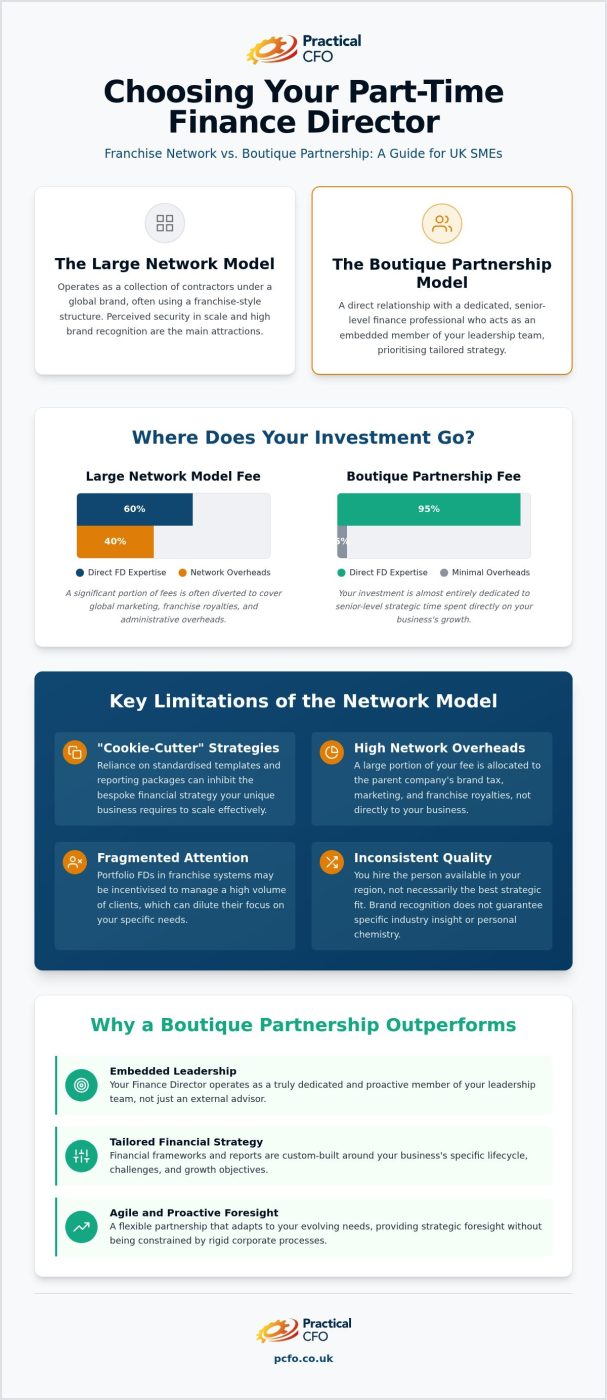
The underlying mechanics of a large finance network are often built on a franchise or royalty-based system. In this model, individual FDs pay for the right to use the central brand and receive lead-generation support. This structure creates what many industry insiders call a “brand tax.” When you pay a premium fee to a large network, a significant portion of that capital is diverted to cover the parent company’s global marketing budgets and franchise royalties. It isn’t always funding the strategic hours spent directly on your business.
This financial arrangement can subtly influence the FD’s focus. To maintain their own margins after paying network fees, a portfolio FD in a franchise system might be incentivised to manage a higher volume of clients. This can lead to a fragmented relationship where you aren’t getting the deep, embedded attention your business requires. Contrast this with a boutique firm or an independent partnership, where the relationship is direct and every penny of your fee is an investment in senior-level expertise.
Why Brand Recognition Isn’t a Strategic Guarantee
The role of a Chief Financial Officer is fundamentally about bespoke navigation and intellectual rigour. A global brand provides a polished logo and a set of standardised templates, but it cannot guarantee the specific chemistry or industry-specific insight your boardroom requires. In a large network, the quality of service can vary significantly between individual contractors. You aren’t necessarily hiring the “brand” expertise; you’re hiring the specific person who happens to be available in your region.
One of the primary limitations of the fd centre model is the risk of prioritising brand consistency over bespoke strategic needs. Large networks often rely on standardised reporting packages to maintain their corporate identity across thousands of clients. Whilst this ensures a baseline level of professional output, it can result in a “cookie-cutter” strategy. A scaling SME needs a partner who builds a financial framework around the business’s unique lifecycle, not one who tries to fit the business into a pre-existing network template.
Personal Connection vs. Network Scale: The Flexibility Gap
One of the primary limitations of the fd centre model is the inherent tension between network scale and individual attention. Large organisations often prioritise volume to sustain their central infrastructure, which can lead to a “flexibility gap.” This occurs when the needs of a scaling SME outpace the rigid processes of a large franchise. The result is often a “cookie-cutter” approach where your business is fitted into a pre-existing framework rather than the framework being built around your unique operational reality.
The Risk of the “Cookie-Cutter” Strategic Approach
Standardised reporting is the engine of a large network. It allows a Finance Director to manage multiple clients efficiently; however, efficiency often comes at the cost of nuance. A template-driven report might satisfy basic compliance, but it rarely captures the sector-specific levers that drive real growth. There is a fundamental difference between an advisor who simply fills a gap in your finance department and one who actively drives a strategic narrative. Bespoke financial planning is critical for Series A or B funding rounds because it provides the intellectual rigour and defensible data that sophisticated investors demand.
Understanding Portfolio Fatigue in Large Networks
Large networks frequently operate on a high-volume portfolio basis. When a Finance Director is stretched across ten or twelve diverse businesses, their capacity for proactive leadership diminishes. This leads to “portfolio fatigue,” where the FD becomes a reactive reporter rather than a strategic navigator. You might see your FD once a month for a board meeting, but they lack the bandwidth to immerse themselves in your company culture or identify risks before they manifest.
This reactive cycle is one of the most persistent limitations of the fd centre model. It creates an environment where FDs may move between roles frequently, disrupting the continuity of your financial leadership. For businesses that require a more integrated partner, a bespoke Finance Director service offers a focused alternative where the advisor acts as an embedded team member. This deeper engagement ensures that your finance function is not just a reporting tool, but a proactive engine for growth that adapts as you scale.
Fee Structures and Hidden Overheads: A Practical Comparison
When an SME engages a fractional Finance Director, the primary objective is to secure the highest level of strategic value for every pound invested. In a large network model, however, the financial mechanics can be surprisingly complex. A significant portion of the fee paid by the client is often diverted away from the individual FD to cover the network’s central overheads. This “brand tax” funds global marketing campaigns, franchise royalties, and a multi-layered management structure. While these elements build the network’s visibility, they don’t necessarily add value to your specific financial strategy.
This diversion of funds is one of the most practical limitations of the fd centre model. For a business owner, it means that a substantial percentage of their investment is not actually paying for time at the boardroom table. In contrast, a boutique partnership operates on a more direct financial basis. Because there are no franchise fees or global marketing levies to satisfy, the entirety of the client’s investment is directed towards senior expertise and strategic foresight. This direct model typically results in a higher ROI, as the SME receives more focused attention from an advisor who isn’t constrained by network margin requirements.
Network Royalties vs. Direct Expertise
In many franchise-style networks, the individual Finance Director may only retain between 60% and 70% of the total fee charged to the client. This split can create a subtle but impactful disconnect between the cost to the SME and the motivation of the professional. When an FD is effectively working at a discounted rate to satisfy a parent brand, they may be pressured to take on a higher volume of clients to meet their own income goals. This often leads to the “portfolio fatigue” mentioned previously, where the depth of engagement suffers.
Understanding how these fees are structured is essential for making an informed decision. For a detailed breakdown of how to evaluate these investments, our guide on Fractional CFO Pricing UK provides a strategic look at how boutique firms prioritise value over network overheads. By removing the middleman, boutique firms ensure that the relationship remains focused on your business’s growth trajectory rather than the network’s expansion goals.
The Rigidity of Fixed-Term Network Contracts
Agility is a cornerstone of SME success, yet large networks often rely on rigid, standardised contracts that can be difficult to adapt. These agreements are designed to protect the franchise’s recurring revenue, which can make it challenging to scale services up or down as your business needs change. If your company undergoes a rapid pivot or a sudden funding round, you need a finance partner who can adjust their level of involvement immediately without being blocked by corporate red tape.
Boutique firms typically offer a “service-first” structure that prioritises the client’s lifecycle over a fixed contract term. This flexibility is a vital alternative to the limitations of the fd centre model, providing the freedom to evolve the partnership in real-time. Whether you need an intensive burst of support for an exit strategy or a lighter touch during a period of steady state, a bespoke partner has the autonomy to adapt their service to match your current operational reality.
When a Boutique Partnership Outperforms a Global Network
While global franchises offer a sense of scale, the most critical financial milestones in a company’s journey often require the surgical precision of a boutique partnership. There are specific scenarios where the agile, high-touch approach of a smaller firm provides a decisive advantage over a large network. For UK SMEs navigating complex growth, the ability to access a partner who is deeply integrated into the business’s fabric is often the difference between a missed opportunity and a successful expansion.
A boutique partnership excels when the requirement moves beyond basic reporting and into the territory of high-stakes strategic navigation. Whether you are preparing for a management buyout, navigating a merger, or requiring exit strategy support, you need an advisor whose focus isn’t split across a dozen other network clients. This dedicated attention allows for a level of intellectual rigour that bypasses the common limitations of the fd centre model, ensuring that every financial decision is made with the full context of your operational reality.
Tailoring Strategy to the Business Lifecycle
The needs of an early-stage startup seeking its first round of investment are fundamentally different from those of an established SME looking to streamline its international operations. A large network often relies on a generalist pool of contractors, but a boutique firm like PCFO focuses on matching specific expertise to your current stage of growth. This ensures that your advisor has “been there before” in your specific sector and lifecycle phase.
Matching the right professional to your unique challenges is central to the strategic role of a Finance Director. Rather than receiving a pre-assigned contractor from a regional franchise, you gain a partner chosen for their specific ability to drive your current objectives. This bespoke alignment is essential for businesses that cannot afford the “learning curve” often associated with high-volume portfolio FDs.
The Importance of Embedded Leadership
Embedded leadership defines the boutique experience. It means having a Finance Director who is “in the trenches” with the CEO, understanding the cultural nuances and daily pressures of the business. An embedded FD doesn’t just look at the numbers; they understand how those numbers are generated on the shop floor or in the sales office. This depth of understanding is one of the most significant limitations of the fd centre model, as the franchise structure rarely allows for the time required to build this level of intimacy.
When your FD acts as a true partner, they become a proactive force for future-proofing your business. They identify risks before they appear in the month-end reports and suggest strategic pivots based on real-time operational data. This level of commitment is a hallmark of a boutique service, where the goal is long-term trajectory rather than simply fulfilling a service contract. If you are ready for a finance partner who operates as a dedicated member of your team, explore our bespoke Finance Director services today.
Choosing Your Fractional FD: The PCFO Alternative
Selecting a financial partner is one of the most consequential decisions a business owner will make. PCFO operates as an agile, boutique alternative to the rigid franchise structures discussed throughout this guide. By addressing the limitations of the fd centre model directly, we provide a service that prioritises depth of engagement over network volume. Our approach is built on the belief that a Finance Director should be a steady, experienced hand at the helm of your strategy, not a distant contractor managing a dozen different brands.
We understand that scaling UK SMEs require more than just monthly reports. You need a partner who possesses the intellectual rigour to challenge your assumptions and the strategic foresight to navigate future risks. Because we operate without the burden of global franchise royalties or massive central marketing budgets, your investment is focused entirely on the calibre of advice you receive. This direct relationship ensures that your financial leadership is as flexible and ambitious as the business it serves.
Bespoke Financial Leadership for UK SMEs
Our commitment to quality over quantity is what sets our boutique model apart. PCFO Finance Directors maintain smaller, more focused client portfolios to ensure they have the bandwidth to act as an “Authoritative Strategic Partner.” This allows us to provide board-level advice that is grounded in your specific operational reality. We don’t rely on standardised templates or pre-packaged network strategies. Instead, we build a financial framework that adapts to your current lifecycle stage, whether you are preparing for a funding round or streamlining for profitability.
Choosing a boutique firm means you gain direct access to senior leadership without the “brand tax” associated with larger organisations. This model avoids the common limitations of the fd centre model by ensuring that the person sitting in your boardroom is fully invested in your long-term trajectory. You receive the prestige and expertise of a seasoned executive, delivered with the personal connection and agility of a dedicated team member.
Integrating Strategy with Operational Reality
Effective financial leadership requires a seamless bridge between high-level strategy and day-to-day execution. PCFO provides a comprehensive suite of services that ensures your finance function is robust at every level. Our expertise includes:
- Finance Director and Chief Financial Officer Services: Strategic leadership to drive growth and maximise enterprise value.
- Outsourced Accountancy Solutions: Ensuring your underlying data is accurate, timely, and ready for senior-level analysis.
- Exit Strategy Support: Meticulous planning to ensure you achieve the best possible value when the time comes to sell.
- Business Growth Advisory: Proactive guidance on scaling operations and securing necessary investment.
The peace of mind that comes from a truly collaborative partnership cannot be overstated. When your FD is embedded in your culture, they identify opportunities for efficiency and growth that a high-volume network FD might overlook. We are here to help you move beyond reactive reporting and towards a proactive, future-proofed financial strategy. If you are ready to move away from a “cookie-cutter” approach and secure a partnership tailored to your unique goals, contact PCFO for a bespoke financial leadership consultation today.
Securing a Strategic Future for Your Business
Choosing the right financial leadership is a pivotal step in your company’s growth trajectory. While large networks offer visibility, the success of a scaling SME often rests on the depth of the personal partnership behind the numbers. You deserve a partner who understands your operational reality and provides a strategy built specifically for your business lifecycle. By acknowledging the limitations of the fd centre model, you can transition towards a more integrated financial partnership that avoids “cookie-cutter” advice and hidden network overheads.
PCFO offers expert Finance Director services tailored for UK SMEs, providing strategic growth advisory with a clear focus on ROI. We prioritise embedded leadership that ensures your business objectives remain the central focus of every financial decision. Our goal is to act as a steady, experienced hand at the helm of your strategy, helping you navigate complex transitions with intellectual rigour and proactive foresight.
If you are ready to secure a more bespoke financial partnership, Book a Discovery Call with PCFO to discuss your strategic finance needs. We look forward to helping you future-proof your business and achieve your long-term ambitions with confidence.
Frequently Asked Questions
What are the main disadvantages of using a large FD network?
The primary disadvantages include the “brand tax” where fees subsidise central marketing and the risk of receiving standardised, “cookie-cutter” strategies. Clients often find that the limitations of the fd centre model stem from a franchise-style structure that prioritises volume over bespoke attention. This can lead to a reactive relationship where the Finance Director is spread too thin across a large portfolio of diverse businesses.
Is a boutique FD firm more expensive than a network like the FD Centre?
Boutique firms generally offer better ROI because their fee structures are direct and transparent. In a large network, you’re often paying a premium to cover global overheads and franchise royalties. A boutique partnership ensures your entire investment goes towards senior expertise. This direct model results in more focused, high-value hours spent specifically on your business objectives rather than network maintenance.
How do I know if my business has outgrown its current accountant?
You’ve likely outgrown your accountant when you require strategic foresight rather than just historical reporting and tax compliance. If you’re facing complex decisions like international expansion, funding rounds, or exit planning, a standard accountancy service may lack the commercial depth required. A fractional FD bridges this gap by providing board-level leadership and future-oriented financial navigation that a traditional accountant doesn’t offer.
Can a fractional FD help with exit strategy planning?
A fractional FD is essential for exit strategy planning as they prepare the business for maximum valuation. They lead the due diligence process, clean up the balance sheet, and ensure financial systems are robust enough to withstand investor scrutiny. This proactive preparation often takes 12 to 24 months to execute effectively, ensuring the business is “investor-ready” when the time comes to sell.
What is the difference between a franchise FD and a boutique FD?
The difference lies in the level of embedded partnership and the underlying financial model. A franchise FD operates under a parent brand and often pays royalties, which can influence their portfolio volume and strategic focus. A boutique FD acts as a dedicated, embedded member of your team. This model avoids the limitations of the fd centre model by prioritising long-term strategic alignment over network growth targets.
How much time does a fractional FD typically spend on my business?
Engagement levels typically range from one to four days per month, depending on your company’s size and complexity. This time is focused on high-level strategy, board meetings, and guiding your internal finance team. Unlike a full-time hire, a fractional FD provides the exact amount of senior-level input you need without the overhead of a permanent executive salary or National Insurance costs.
Do boutique firms offer the same level of resource as a global network?
Boutique firms provide a more relevant level of resource by matching specific expertise to your business lifecycle. While networks boast global databases, boutique firms prioritise direct access to senior leadership and agile, tailored solutions. You receive a partner who’s deeply invested in your specific sector rather than a generalist contractor assigned via a regional franchise office based on availability.
What should I look for in a fractional FD contract to ensure flexibility?
Look for “service-first” agreements that allow you to scale support up or down as your business evolves. Avoid rigid, long-term franchise contracts that are difficult to exit or modify. A flexible contract should prioritise the delivery of strategic outcomes and allow for adjustments during periods of rapid growth or pivots, ensuring the partnership remains aligned with your operational reality.