

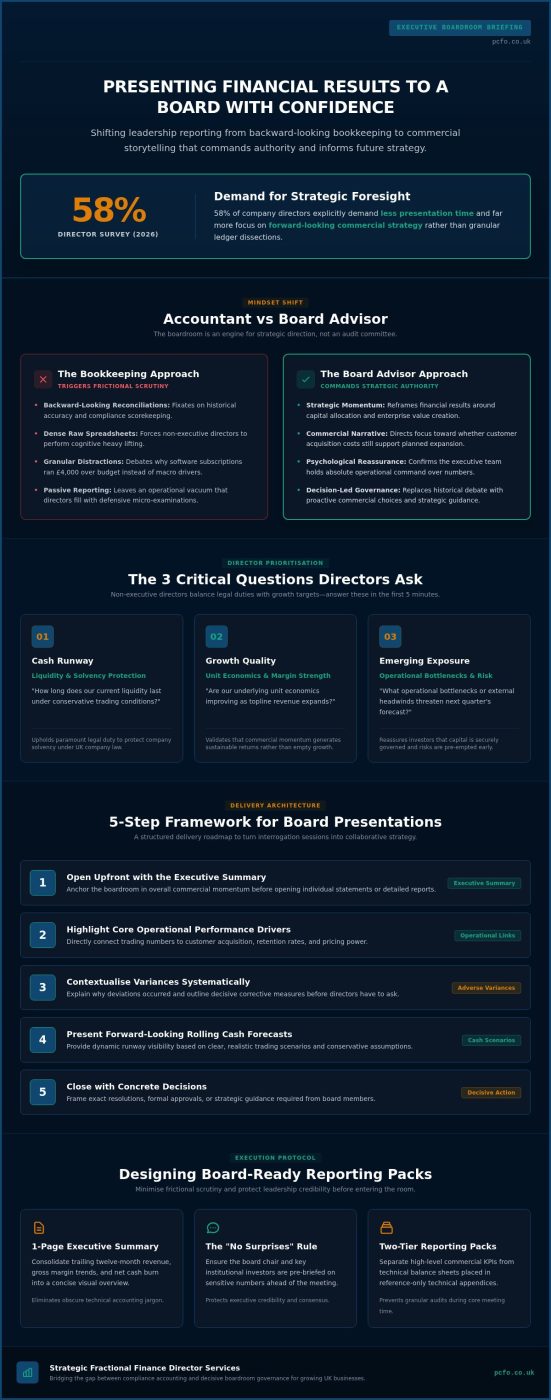
According to a 2026 survey of company directors, 58% explicitly want less presentation time and far more focus on forward-looking strategy. Yet, for many executives, board meetings still descend into granular cross-examinations over minor ledger line items. When non-executive directors fixate on dense spreadsheets rather than commercial momentum, it stalls decision-making and damages leadership credibility. Successfully presenting financial results to a board with confidence is not about proving bookkeeping precision; it is about reframing raw numbers into strategic foresight.
You already understand the frustration of watching hard work dissolve into defensive debates over adverse variances. This guide reveals how to master the executive art of translating complex financial numbers into strategic narratives that command boardroom authority and inspire investor trust. Ahead, you will discover how to produce concise financial packs directors actually read before meetings, pre-empt probing queries with clear commercial context, and steer discussions towards decisive, high-value growth.
Key Takeaways
- Mastering the art of presenting financial results to a board with confidence requires shifting from backward-looking bookkeeping to commercial storytelling that directly informs future strategy.
- Structure board presentations around an upfront executive narrative that clarifies the operational drivers behind adverse variances before directors ask.
- Eliminate boardroom friction by designing concise reporting packs that separate high-level commercial KPIs from reference-only technical appendices.
- Protect executive credibility by applying the “no surprises” rule, ensuring the chair and key investors are pre-briefed on sensitive numbers ahead of the meeting.
- Bridge the gap between compliance accounting and boardroom leadership by utilising experienced fractional Finance Director services for strategic governance.
The Boardroom Mindset: Why Most Financial Presentations Fall Flat
Board presentations fail when presenters treat the boardroom as an audit committee rather than an engine for strategic direction. The primary objective of presenting financial results to a board with confidence is psychological reassurance. Directors need certainty that the executive team has complete operational command over the numbers and clear vision for what lies ahead. When a management team simply reports historical figures without context, directors naturally step into the vacuum, dissecting minor line items out of sheer anxiety.
Raw spreadsheets inevitably trigger cognitive fatigue. Non-executive directors review dozens of board papers each quarter; handing them dense balance sheets forces them to do the analytical heavy lifting themselves. This friction invites defensive post-mortems. Grounding your presentation in robust corporate governance principles means shifting from compliance-led scorekeeping to commercial intelligence. Decision-focused board packs present clear operational choices, moving the room from backward-looking reconciliations to proactive governance.
The Crucial Difference Between an Accountant and a Board Advisor
Accountants focus on historical accuracy and compliance. A board advisor, by contrast, focuses on strategic momentum, capital allocation, and risk mitigation. Board members do not need to know that software subscriptions ran £4,000 over budget; they need to understand whether customer acquisition costs still support your planned headcount expansion. Understanding the strategic role of a Finance Director allows leadership teams to bridge this divide, turning accounting data into commercial insight that protects and accelerates enterprise value.
Understanding What Non-Executive Directors and Investors Really Want
Every non-executive director sits around the table balancing legal duties with growth targets. Under UK company law, their duty to protect solvency and act in the best interests of shareholders is paramount. Consequently, directors continuously filter financial packs through three specific questions:
- Cash runway: How long does our current liquidity last under conservative trading conditions?
- Growth quality: Are our unit economics improving as revenue expands?
- Emerging exposure: What operational bottlenecks or external headwinds threaten next quarter’s forecast?
When presenting financial results to a board with confidence, you must answer these three questions within the first five minutes. Highlighting the commercial consequences of variances, rather than merely documenting that they happened, reassures directors that their capital is securely governed.
Presenting Financial Results to a Board: 5-Step Framework
Mastering a structured delivery transforms financial presentations from interrogation sessions into collaborative strategy discussions. Following proven expert tips for presenting data ensures that leaders communicate clearly without losing the room to granular technicalities. This five-step architecture provides a dependable roadmap for presenting financial results to a board with confidence:
- Open upfront with the executive summary: Anchor the room in overall commercial momentum before opening individual statements.
- Highlight core operational performance drivers: Link trading numbers directly to customer acquisition, retention, and pricing power.
- Contextualise variances systematically: Explain why deviations occurred and outline corrective measures immediately.
- Present forward-looking rolling cash forecasts: Provide dynamic runway visibility based on clear trading scenarios.
- Close with concrete decisions: Frame exact resolutions, approvals, or strategic guidance required from the directors.
Crafting the One-Page Executive Summary
Your opening slide or executive summary sheet dictates the tone for the entire meeting. Consolidate your trailing twelve-month revenue, gross margin trends, and net cash burn into a clean visual dashboard. Strip out obscure technical accounting labels that mask underlying operational health. Pair these figures with three or four short bullet points summarising overall commercial momentum, progress against strategic milestones, and prevailing market headwinds.
Framing Variances with the What, Why, and What Next Model
Unfavourable variances draw immediate scrutiny from investors. Rather than offering defensive excuses, control the narrative using a simple three-part discipline:
- What: State the exact variance clearly (e.g. gross profit lagged budget by 4.2% in Q2).
- Why: Isolate the root cause, distinguishing temporary operational delays from persistent cost increases.
- What Next: Outline the corrective action underway, including timeline and expected financial recovery.
This approach demonstrates command. It transforms an uncomfortable discussion about missed targets into an operational plan that protects shareholder value.
Forward-Looking Financials: Transitioning from Past to Future
Static annual budgets quickly lose relevance during volatile economic conditions. Replacing outdated static targets with integrated three-way financial forecasting; linking the profit and loss, balance sheet, and cash flow statement; provides realistic runway visibility. Embedding scenario planning allows leadership teams to model downside trading conditions alongside growth targets. If you need support embedding these forward-looking frameworks into your regular governance cycles, engaging an experienced advisor for strategic business planning UK can provide the required commercial rigour.
Designing Board-Ready Reporting Packs That Minimise Frictional Scrutiny
Frictional scrutiny occurs when board packs confuse rather than clarify. When directors struggle to extract meaning from dense tables, they default to questioning baseline assumptions. A disciplined reporting pack eliminates this friction by adhering strictly to three design principles: conciseness, visual clarity, and layout consistency. Successful leaders present financial results to a board with confidence by creating documentation that directs attention directly toward strategic opportunities.
Distribute the final board pack at least five working days ahead of the scheduled meeting. Circulating documents late signals operational disorganisation and forces directors to review figures during the session itself. When members skim pages in real time, they inevitably focus on isolated errors rather than strategic trajectory. Providing ample reading time allows non-executive directors to absorb underlying trends, formulating constructive feedback rather than reactive questions.
Structuring the Ideal Monthly Board Pack Architecture
An executive pack should span 10 to 15 pages at most. Structuring the document effectively ensures governance requirements do not drown out strategic dialogue:
- Page 1: One-page executive summary and commercial trading snapshot.
- Pages 2-4: Core operational metrics, unit economics, and rolling cash flow runway.
- Pages 5-8: High-level profit and loss, balance sheet, and variance commentaries.
- Pages 9-10: Forward-looking scenario pipelines and strategic capital allocation requests.
- Appendices: Detailed reconciliations, statutory notes, and granular schedules.
Clean inputs are vital. Leveraging professional outsourced accountancy solutions ensures your underlying trial balance and ledger entries remain pristine. Storing technical reconciliations exclusively within marked appendices prevents operational accounting queries from hijacking boardroom time.
Visualising Financial Metrics for Non-Financial Directors
Effective visual hierarchy bridges the gap between commercial directors and non-financial stakeholders. Clean charts should convey trajectory instantly without forcing the viewer to calculate differences manually:
- Use bar and bridge charts for revenue drivers: Illustrate exactly how price increases, churn, and volume shifts affected total top-line growth.
- Avoid cluttered 3D graphics or dual-axis pitfalls: Complex visual formats obscure true margins and inadvertently erode boardroom trust.
- Apply disciplined colour signposting: Use neutral slate tones for baseline trends, reserving green and amber specifically to highlight performance against target.
By presenting financial results to a board with confidence through streamlined visuals, you enable every attendee to grasp commercial reality within seconds, establishing an efficient baseline for high-level governance.
Navigating Difficult Boardroom Dynamics and Delivering Bad News
Every business encounters missed targets, unforeseen cost surges, or contract delays. What defines an executive is how they communicate those setbacks. Presenting financial results to a board with confidence when trading numbers underperform demands radical transparency. Attempting to bury unfavourable figures inside dense footnotes or papering over cash crunches invariably destroys leadership credibility. Once a board suspects concealment, every future projection faces hostile interrogation.
Seasoned finance leaders govern by the “no surprises” doctrine. Disappointing trading updates must never break during the formal board meeting itself. Surprising directors with sudden cash contractions invites defensive reactions and puts management on the back foot. Communicating early preserves trust, shifting the boardroom atmosphere from retrospective blame towards collaborative problem-solving.
Pre-Meeting Alignment: Neutralising Boardroom Friction in Advance
Holding brief, targeted calls with the chair and principal investor representatives 48 to 72 hours before circulating the pack diffuses emotional volatility. Use these touchpoints to walk through adverse numbers, explain the underlying mechanics, and outline the management team’s response plan. Giving key stakeholders space to voice concerns privately allows them to enter the meeting ready to support solutions rather than demand forensic investigations.
Managing Hostile or Granular Cross-Examination from the Floor
Pointed questions are inevitable when commercial targets slip. Maintaining professional composure requires a steady, methodical communication rhythm:
- Acknowledge governance concerns directly: Validate the director’s perspective without defensive hedging (e.g. “You are right to challenge that gross margin erosion; it directly pressures our second-half cash runway”).
- Distinguish strategic trends from isolated noise: Clarify whether the issue stems from an isolated operational hiccup or a structural shift in customer demand.
- Take granular reconciliations offline gracefully: If an investor pursues a detailed ledger debate that consumes valuable time, offer a prompt follow-up: “Let us take the detailed VAT reconciliation offline; I will circulate that exact schedule before noon tomorrow.”
Pivoting from past mistakes to immediate corrective actions reassures the room that executive hands remain firmly on the wheel. If you are experiencing repeated boardroom friction around adverse variances or cash visibility, explore how our dedicated Finance Director Services can help you command authority and deliver bad news with strategic composure.
Elevating Boardroom Impact with Strategic Fractional Finance Leadership
Scaling UK enterprises inevitably reach an inflection point where compliance-led accountancy no longer satisfies sophisticated stakeholders. As funding rounds expand or institutional investors join the register, the demand shifts toward senior executive presence. Presenting financial results to a board with confidence requires more than accurate bookkeeping; it demands commercial fluency, scenario forecasting, and experienced governance leadership. Appointing a full-time Chief Financial Officer carries significant fixed overhead that early-to-mid-market businesses cannot always justify.
Deploying a fractional Finance Director solves this dilemma. An embedded, part-time finance leader brings seasoned boardroom authority directly into your executive team on a flexible basis. They translate raw management information into actionable growth strategies, reassure non-executive chairs, and steer the agenda toward future enterprise value without saddling your balance sheet with permanent executive remuneration.
Traditional Accountant vs Strategic Fractional Finance Director
Traditional accounting services perform an essential role: closing ledgers, balancing accounts, and meeting HMRC compliance obligations. They look backwards. A strategic fractional Finance Director, however, uses those reconciled numbers as the launching point for commercial strategy. Rather than presenting static reconciliations, an experienced finance director delivers dynamic three-way cash modelling, capital allocation frameworks, and downside stress tests. When reviewing the numbers, review our analysis on evaluating fractional CFO pricing and ROI to understand how flexible executive leadership delivers measurable commercial return. Having that level of expertise seated at the boardroom table instils immediate confidence in prospective venture capital or private equity investors.
How PCFO Delivers Boardroom Clarity for Growing UK Enterprises
PCFO delivers high-level fractional CFO and Finance Director Services to scaling businesses across the UK. Drawing on decades of hands-on boardroom experience within high-growth SMEs and scale-ups, our directors integrate seamlessly into your executive structure. We replace disjointed spreadsheets with disciplined reporting packs designed to minimise friction and protect cash runway:
- Executive governance: We manage pre-meeting director briefings and lead board presentations alongside founders.
- Strategic Business Growth Advisory: We align monthly financial reporting directly with scaling goals, margin enhancement, and capital preservation.
- Rapid onboarding: Our proven reporting frameworks immediately raise the quality and clarity of your board packs.
Transitioning from administrative compliance to authoritative leadership transforms your relationship with directors. Contact PCFO today to arrange a confidential review of your board reporting architecture and discover how an experienced fractional Finance Director can elevate your executive presence.
Transforming Boardroom Oversight into Strategic Momentum
Boardroom authority isn’t established by compiling exhaustive spreadsheets; it is earned by providing commercial clarity. Presenting financial results to a board with confidence comes down to strategic interpretation over backward-looking record-keeping. By implementing a disciplined delivery framework, designing concise reporting packs, and adopting the pre-meeting alignment rule, you steer discussions away from defensive variance debates and toward decisive value creation.
You don’t need to carry the fixed overhead of a full-time hire to elevate your governance. Backed by an extensive track record delivering boardroom finance leadership to growing UK businesses, PCFO provides proven reporting frameworks and senior finance directors with deep commercial advisory experience. Speak with a PCFO strategic advisor to transform your board presentations and lead your next executive session with complete authority and calm conviction.
Frequently Asked Questions
How long should an executive presentation of financial results take in a board meeting?
The financial presentation should take no longer than 15 to 20 minutes, leaving the remaining agenda clear for strategic discussion. Non-executive directors expect attendees to have digested the pack beforehand. Spending 45 minutes walking through tables slide by slide creates fatigue and invites micromanagement. Dedicate five minutes to top-level trading and cash runway, five minutes to significant variances, and use the rest to steer debate toward required commercial decisions.
What is the most effective way to present disappointing financial numbers to a board?
The most effective approach combines radical transparency with clear operational solutions. Successfully presenting financial results to a board with confidence during a downturn means acknowledging performance gaps directly without defensive excuses. Apply the “What, Why, and What Next” discipline: isolate the variance, separate one-off shocks from structural margin drag, and outline corrective actions. Never reveal unexpected shortfalls in the room; pre-brief your chair and key investors beforehand.
How far in advance should the financial board pack be circulated to directors?
Financial board packs should be circulated at least five clear working days before the scheduled meeting. Delivering documentation late damages director confidence and disrupts thorough preparation. Non-executive directors typically balance multiple governance commitments and require dedicated time to digest complex performance trends. Providing adequate lead time guarantees directors arrive informed and ready to evaluate forward-looking strategy rather than scanning spreadsheets in real time to spot basic ledger discrepancies.
What key financial metrics must every UK SME board pack include?
Every SME pack must cover cash runway, gross margin percentage, net burn rate, and working capital trends. Beyond statutory profit and loss tracking, directors require operational metrics that expose the quality of growth. Include trailing twelve-month revenue run rates, customer acquisition efficiency, debtor days, and staff cost ratios against gross profit. Crucially, present a dynamic three-way forecast that demonstrates how these operational indicators affect your cash buffer across multiple trading scenarios.
Can a fractional Finance Director present financial results to our board on our behalf?
Yes, an experienced fractional Finance Director can lead the financial presentation alongside your Chief Executive. Partnering with fractional leadership allows SMEs to access seasoned executive presence without full-time overheads. A fractional director handles the preparation of board packs, manages pre-meeting investor alignments, and leads the financial review during the meeting. Their commercial objectivity reassures institutional investors whilst mentoring the internal team on presenting financial results to a board with confidence.
How do you handle a non-executive director who constantly derails the meeting with minor details?
Acknowledge the query immediately, assess its strategic relevance, and offer to take the detailed reconciliation offline. Engaging in defensive arguments gives granular questions undue weight. Instead, respond calmly: confirm the accuracy of the underlying figure, state whether it impacts overall solvency or target margins, and commit to delivering the detailed ledger breakdown within 24 hours. This practice protects the room’s strategic schedule whilst respecting the director’s statutory oversight role.
What is the difference between a board pack and monthly management accounts?
Monthly management accounts provide detailed accounting records, whereas a board pack delivers high-level strategic intelligence. Management accounts concentrate on internal financial control, comprehensive ledger breakdowns, and departmental budget tracking. A board pack synthesises those raw numbers into a concise, 10-to-15 page commercial report. It focuses on enterprise valuation drivers, forward cash runway, downside risks, and the strategic choices facing company directors, delegating granular accounting reconciliations strictly to reference appendices.