

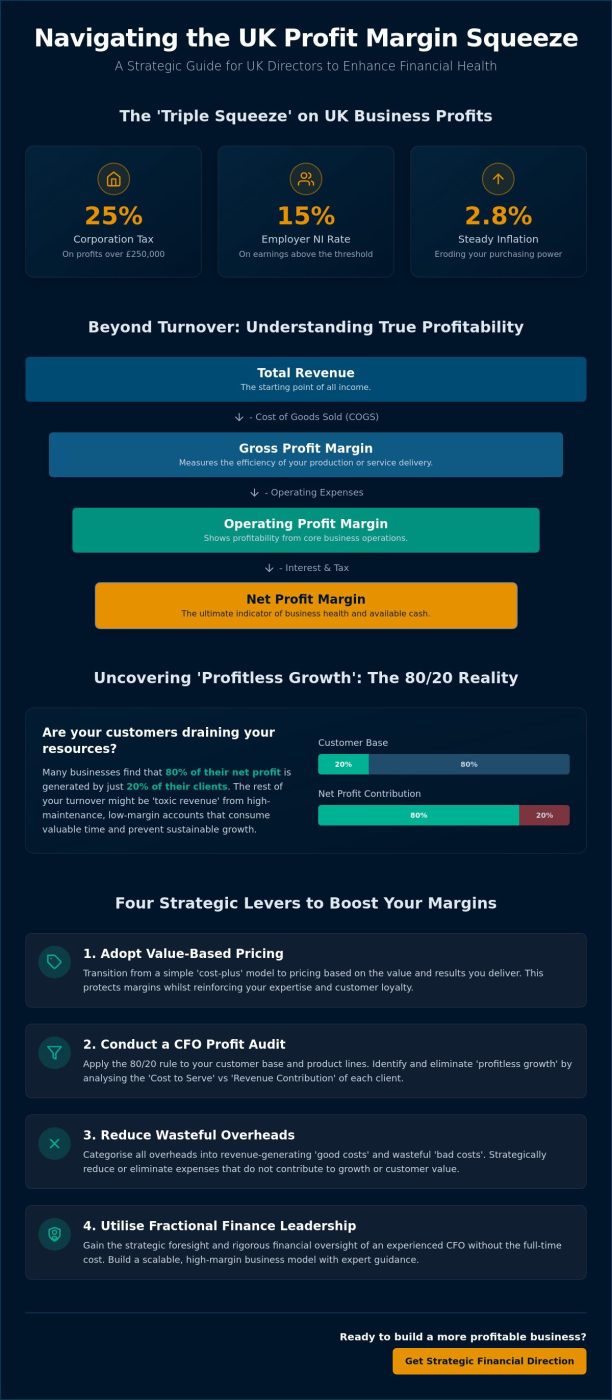
Why does it feel like your business is working harder than ever, yet the bottom line remains stubbornly stagnant? It’s a common frustration amongst UK directors who see turnover climb whilst net margins are squeezed by a 15% employer National Insurance rate and steady 2.8% inflation. Learning how to improve business profit margins uk isn’t just about slash-and-burn cost cutting. It’s about shifting from reactive accounting to the proactive financial leadership required to navigate a 25% Corporation Tax environment.
We understand the pressure of managing price-sensitive consumers alongside rising overheads and the £5,000 Secondary Threshold for NI. You likely suspect that certain products or clients are quietly eroding your capital, but you lack the granular visibility to act with confidence. This guide reveals the strategic frameworks high-growth firms use to protect their earnings and enhance financial health. We will explore how to build a scalable model that increases net profit margins without sacrificing growth, giving you the clarity needed to make informed, strategic decisions.
Key Takeaways
- Distinguish between turnover and true profitability by understanding the critical differences between gross, operating, and net profit margins in the current UK economy.
- Identify and eliminate ‘profitless growth’ by applying the 80/20 rule to your existing customer base and product lines.
- Transition from cost-plus pricing to value-based models to protect your earnings whilst maintaining customer loyalty in a price-sensitive market.
- Discover practical strategies on how to improve business profit margins uk by categorising overheads into revenue-generating ‘good costs’ and wasteful ‘bad costs’.
- Learn how fractional finance leadership provides the strategic foresight and rigorous oversight needed to build a scalable, high-margin business model.
Understanding the UK Margin Landscape: Gross vs Net Profit
High turnover often masks deep-seated structural issues. Whilst a growing top line feels like success, it’s frequently a vanity metric that hides a deteriorating bottom line. For UK SMEs, the path to sustainable growth begins with a granular Understanding Profit Margin and how it actually functions within the British tax and regulatory framework. Focusing on revenue alone ignores the reality that profit is what pays for your staff, your innovation, and your future exit.
Profit isn’t a singular figure. It’s a series of filters. Gross profit measures the efficiency of your production or service delivery. Operating profit accounts for your running costs. Net profit, however, is the only figure that truly dictates your ability to reinvest or pay dividends. In a climate where the main rate of Corporation Tax sits at 25% for profits over £250,000, failing to distinguish between these layers can lead to critical cash flow shortages. Effective financial leadership requires you to look beyond the surface and interrogate the costs sitting between your sales and your bank balance.
The Formula for Strategic Profitability
To calculate your Gross Profit Margin, subtract the Cost of Goods Sold (COGS) from your total revenue, then divide that figure by the revenue and multiply by 100. This percentage tells you how much of every pound earned is available to cover your fixed costs. Whilst gross margin is a useful measure of production efficiency, Net Profit Margin remains the ultimate indicator of business health because it factors in every outgoing, including interest and tax. Operating margin serves as the vital link between your direct sales efficiency and the control you maintain over administrative overheads.
Current Challenges for UK Business Margins
UK firms are currently navigating a ‘triple squeeze’ of volatile energy costs, rising labour rates, and supply chain inflation. The 15% employer National Insurance contribution on earnings above the £5,000 threshold adds a significant layer of complexity to payroll management. These factors make it essential to understand how to improve business profit margins uk through proactive adjustments rather than waiting for year-end accounts to reveal a shortfall.
Margin creep is a silent threat. It occurs when small, incremental increases in supplier costs or minor inefficiencies in service delivery slowly erode your percentage. Without regular oversight, these leaks remain invisible until they compromise your stability. Benchmarking against your specific sector is also vital. A 10% net margin might be excellent in high-volume retail but dangerously low in a specialised consultancy. Identifying where you sit amongst your peers allows you to set realistic, strategic targets for improvement.
Conducting a CFO Audit: Identifying ‘Profitless Growth’
Many UK business owners fall into the trap of pursuing growth at any cost. This often leads to ‘profitless growth’, where rising turnover fails to translate into increased bank balances. A rigorous CFO audit is required to identify where your resources are being drained by activities that provide little financial return. This process involves looking past the total sales figure to understand the true profitability of every individual account and service line.
The 80/20 rule frequently applies here. It’s common to find that 20% of your customer base generates 80% of your net profit. Conversely, a significant portion of your revenue may be ‘toxic’, coming from customers who demand excessive support, request constant revisions, or require bespoke work that hasn’t been priced correctly. For service-based firms, these customisations are margin killers. They consume senior staff time and disrupt standard processes, yet the additional costs are rarely fully recovered.
Understanding how to improve business profit margins uk requires a shift in mindset from volume to value. If you suspect your growth is masking underlying inefficiencies, engaging Business Growth Advisory services can provide the objective analysis needed to recalibrate your operations. By stripping away the noise of high-volume, low-margin work, you create the space necessary for sustainable, profitable expansion.
Segmenting Your Customer Base
Effective segmentation goes beyond simple revenue tiers. You must categorise clients by their ‘Cost to Serve’ versus their ‘Revenue Contribution’. High-maintenance, low-margin clients often prevent you from servicing your most profitable accounts effectively. Once identified, these relationships should be transitioned through price increases or offboarded entirely. This allows your team to focus on profitable niches where your expertise commands a premium without requiring a corresponding increase in marketing spend.
Product and Service Rationalisation
Forensic precision is required when evaluating your Cost of Goods Sold (COGS). Many SMEs find that their ‘mid-market’ offerings suffer the worst margin compression because they lack the scale of budget products and the premium pricing of high-end services. A strategic audit allows you to decide which services to retire and which to scale. By rationalising your portfolio, you ensure that every hour worked and every pound spent contributes directly to a healthier bottom line.
Strategic Pricing Strategies for the UK Market
Pricing is the most sensitive lever for margin improvement. Most UK SMEs rely on cost-plus pricing, adding a fixed percentage to their expenses. This method ignores the perceived value and often fails to account for the 25% Corporation Tax rate or the 15% employer NI contributions mentioned earlier. Strategic pricing requires a shift in perspective. You must price based on the outcome you deliver, not just the hours you record. Understanding how to improve business profit margins uk starts with capturing the full value of your expertise rather than just your overheads.
One effective way to adjust pricing without alienating clients is through bundling or unbundling services. By grouping features together, you can obscure individual price increases whilst offering a premium package that adds genuine value. For UK businesses looking to expand their service offering with integrated financial products, you can learn more about Gemba and how their automated setup guide streamlines this process. Conversely, unbundling allows you to strip back services for price-sensitive clients, protecting your core margins by charging separately for high-resource tasks like bespoke reporting or out-of-hours support.
British B2B clients value stability and risk mitigation. When communicating price changes, focus on how the adjustment ensures the long-term sustainability of the service level they expect. Frame the change as an investment in quality and reliability. This approach aligns with the reassuring nature of a strategic partnership, moving the conversation away from cost and toward mutual success.
Value-Based Pricing vs Cost-Plus
The gap between your production cost and the client’s perceived value represents your potential margin. Communicating this value is essential for premium positioning. For example, a strategic price adjustment that reflects the time saved or risk reduced for a client can transform a break-even service into a high-profit asset. This is a fundamental step in how to improve business profit margins uk without needing to increase your sales volume.
Managing Discounts and Price Sensitivity
Unauthorised discounting is a silent margin killer. It’s often a symptom of a sales team that lacks confidence in the company’s value proposition. To combat this, you must set strict price floors. Empower your team to walk away from deals that don’t meet your margin requirements. Using tiered pricing structures allows you to cater to different budget levels whilst ensuring that your most valuable expertise remains protected by a robust margin.
Strategic Overhead Reduction and Operational Efficiency
Reducing overheads is often misinterpreted as a reactive attempt to save a struggling business. In reality, it’s a disciplined exercise in distinguishing between ‘Good Costs’ that generate revenue and ‘Bad Costs’ that represent operational waste. To effectively address how to improve business profit margins uk, you must move beyond trimming small items like office supplies. Instead, consider a zero-based budgeting approach. This involves justifying every expense from scratch for each new period, ensuring that capital is only allocated to activities that directly support your strategic objectives.
Negotiating with UK suppliers should also evolve beyond a simple focus on the lowest unit price. A lower price often hides a higher ‘total cost of ownership’ if it leads to supply chain delays or poor quality that requires expensive rework. By building collaborative partnerships with key vendors, you can often secure better payment terms or volume rebates that improve your cash position whilst protecting your margin. This proactive approach ensures your supply chain remains an asset rather than a liability.
Optimising Your Labour Costs
Payroll is frequently the largest expense for UK SMEs, especially given the 15% employer NI rate on earnings above £5,000. Optimising this cost isn’t about reducing headcount, but about maximising staff utilisation rates. You must ensure that your team’s time is spent on high-value activities rather than administrative friction. Outsourcing non-core functions can provide the operational flexibility needed to scale without the fixed overhead of permanent staff. A fractional CFO provides the expert oversight needed to restructure your finance team, ensuring your internal resources are aligned with your growth trajectory. If you need help identifying these efficiencies, our Outsourced Accountancy Solutions can provide the necessary clarity.
Technology as a Margin Driver
Manual processes are silent profit leaks. Every hour spent on manual data entry or correcting human errors is an hour of margin lost. Implementing a robust ERP or modern accounting stack provides the real-time visibility required to make agile decisions. Whilst ‘cheap’ software may seem attractive initially, it often lacks the scalability required for growing firms, leading to expensive workarounds later. Investing in the right technology lowers your labour-to-revenue ratio, often through the guidance of specialists like Business Analysis & Solutions who can help align ICT infrastructure with operational efficiency. This creates a more resilient, scalable business model that protects your bottom line during periods of rapid growth.
The Role of Fractional Finance Leadership in Margin Growth
A standard accountant is essential for compliance, ensuring your VAT filings and Corporation Tax returns are accurate. However, they are often insufficient for the complex task of learning how to improve business profit margins uk through strategic realignment. Whilst an accountant looks at the past, a fractional Finance Director focuses on the future. They provide the high-level oversight needed to protect your bottom line by interrogating the structural inefficiencies that standard reporting often misses. This partnership shifts the focus from simple record-keeping to proactive value creation.
The return on investment for fractional leadership is often immediate. A single initiative, such as identifying a loss-making service line or renegotiating a major supplier contract, can frequently cover the cost of the service for the entire year. By developing a bespoke 12-month profitability roadmap, a strategic advisor ensures that every operational decision is filtered through the lens of margin protection. This methodical approach provides business owners with the calm confidence that their growth is both sustainable and profitable, rather than just a source of increased administrative burden.
Engaging a Part-Time Finance Director or Chief Financial Officer allows you to access boardroom-level expertise without the fixed overhead of a full-time executive salary. This flexibility is vital for SMEs navigating the current 25% Corporation Tax environment. It ensures that you have a steady, experienced hand at the helm to guide your financial strategy through every stage of the business lifecycle.
From Reporting to Forecasting
Success in a volatile economy requires moving beyond historical reporting to advanced financial forecasting. You need to know exactly what will happen to your margins if labour costs rise or if consumer price sensitivity increases further. Building robust sensitivity models allows you to stress-test your profitability against various market changes before they occur. Regular board-level advice ensures your growth remains profitable, preventing the ‘profitless growth’ trap where increased turnover merely leads to increased complexity without financial gain.
Preparing for Exit or Investment
Profit margins are the single most important factor in business valuation. Potential buyers or investors look for a clean, high-margin P&L that demonstrates a scalable and resilient business model. A fractional CFO helps you strip away non-essential costs and optimise your service delivery to present the most attractive financial profile possible. We support UK founders in exit strategy planning by ensuring that every aspect of the business is tuned for maximum value, turning a solid company into a premium acquisition target. This strategic navigation is what separates a business that merely survives from one that provides a significant return for its shareholders.
Securing Your Business’s Financial Future
Improving your bottom line is a continuous process of refinement rather than a one-off task. We’ve explored how shifting focus from turnover to net margin and eliminating ‘profitless growth’ creates a more resilient foundation. By implementing value-based pricing and disciplined overhead control, you protect your capital against external pressures whilst ensuring your growth remains sustainable. Mastering how to improve business profit margins uk requires the intellectual rigour and strategic foresight of an experienced financial partner.
At PCFO, we provide expert Finance Directors for hire who are specialists in UK SME growth. Our team has a proven track record in strategic margin improvement, acting as embedded advisors to help you navigate complex tax landscapes and prepare for future investment. Book a consultation with a PCFO Strategic Advisor to audit your margins and discover how a tailored profitability roadmap can transform your business trajectory. Taking control of your financial strategy today ensures a more prosperous and scalable tomorrow.
Frequently Asked Questions
What is a healthy profit margin for a small business in the UK?
A healthy margin varies significantly by sector, but a 10% net profit margin is often considered a solid benchmark for many UK SMEs. High-volume retail businesses might operate on 3% to 5%, whilst specialised consultancy firms often target 20% or higher. It’s essential to compare your performance against sector-specific data to ensure you’re adequately covering costs like the 25% Corporation Tax rate.
How often should I review my business profit margins?
You should review your gross and net margins at least monthly as part of your management accounts process. Quarterly deep dives allow you to identify seasonal trends and the impact of external factors like the 2.8% inflation rate. Waiting for year-end accounts is a reactive approach that leaves your business vulnerable to ‘margin creep’ and unaddressed operational inefficiencies.
Can I improve my profit margin without raising my prices?
Yes, you can improve margins by reducing your Cost of Goods Sold (COGS) or administrative overheads. Focus on increasing operational efficiency through automation or renegotiating supplier contracts to lower the total cost of ownership. Identifying and offboarding high-maintenance clients who consume excessive resources without providing a high return is another effective way to boost profitability without changing your price list.
What is the fastest way to increase net profit margin in a service business?
The most rapid improvement often comes from eliminating ‘profitless growth’ by stopping work on low-margin, bespoke projects that drain senior staff time. Focusing on standardised service packages allows for better utilisation and reduced human error. Implementing strict price floors for your sales team prevents unauthorised discounting, which is one of the most common ways to learn how to improve business profit margins uk quickly.
How do I calculate my gross profit margin correctly?
Subtract your Cost of Goods Sold (COGS) from your total revenue, then divide that result by the total revenue and multiply by 100. COGS must include all direct costs associated with delivering your product or service, such as raw materials and direct labour. Accurate calculation is vital because it reveals the fundamental efficiency of your core business model before fixed administrative overheads are considered.
Why is my revenue increasing but my profit margin decreasing?
This phenomenon usually occurs when your costs are rising faster than your sales or when you’re taking on lower-quality revenue. Rising employer National Insurance contributions and supply chain inflation can erode margins even as turnover climbs. It often indicates that your business is becoming more complex to manage without a corresponding increase in operational efficiency or strategic pricing power.
What are the most common ‘hidden’ costs that erode UK business margins?
Hidden costs often include unbilled ‘scope creep’ in service delivery, high staff turnover leading to recruitment fees, and inefficient manual processes. In the UK, the 15% employer NI rate on earnings above the £5,000 threshold can also be a significant ‘stealth’ cost if not factored into your labour-to-revenue ratios. Regular audits help identify these leaks before they compromise your cash flow.
Is it better to focus on increasing sales or reducing costs first?
It’s generally more effective to optimise your existing margins before aggressively pursuing new sales. If your business model is inefficient, increasing turnover will only scale your losses or operational headaches. Focusing on how to improve business profit margins uk through strategic cost reduction and pricing refinement ensures that every new sale you eventually make contributes a healthy amount to your net profit.