

Cutting costs is often mistaken for a sign of distress, yet for the most resilient UK companies, it’s actually a disciplined act of growth. When your fixed costs create financial anxiety during market shifts, the solution isn’t just to spend less, but to spend with more precision. Implementing a process of strategic overhead reduction allows you to reclaim the margins that bloated subscriptions and inefficient services have slowly eroded over time.
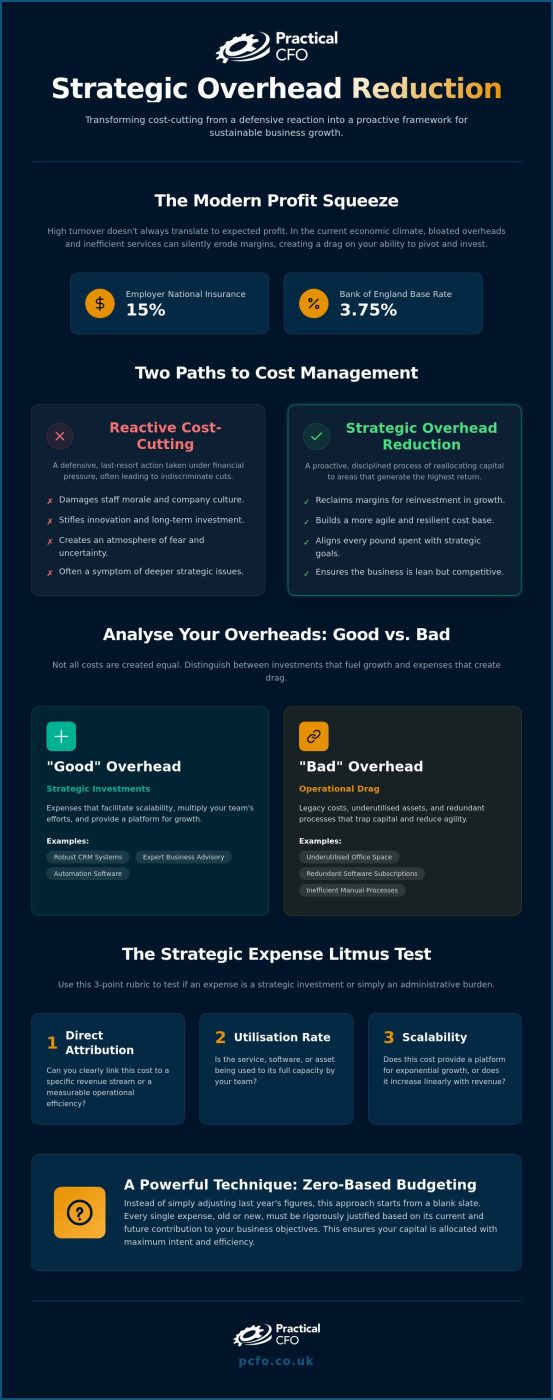
You likely recognise the frustration of maintaining a high turnover that doesn’t translate into the expected profit. With the employer National Insurance rate at 15% and the Bank of England base rate holding at 3.75%, the margin for error has narrowed significantly for even the most established firms. It’s natural to feel that your operational structure has become too heavy for the current economic climate, creating a drag on your ability to pivot or invest.
This article provides a structured framework to move beyond simple budget slashing. You’ll learn how to identify operational waste and reallocate that capital to the initiatives that actually drive your business forward. We provide a comprehensive checklist to help you audit your outgoings, improve your EBITDA, and ensure that every pound spent is a deliberate investment in your long-term success.
Key Takeaways
- Distinguish between reactive cost-cutting and a proactive approach to strategic overhead reduction that protects long-term business health.
- Master the Zero-Based Budgeting technique to ensure every operational expense contributes directly to your current growth objectives.
- Identify opportunities to replace high fixed costs with agile digital infrastructure and automated workflows to improve scalability.
- Learn to communicate changes effectively to your team, ensuring that leaner operations are viewed as a foundation for future investment rather than a retreat.
- Understand why a fractional Finance Director provides the necessary objectivity to execute an audit without the emotional bias of internal leadership.
Strategic vs. Reactive Overhead Reduction: Defining the Framework
Strategic overhead reduction isn’t a defensive posture. It’s a proactive exercise in capital reallocation. Many UK business leaders view cost-cutting as a last resort, something to be done only when the bank balance looks precarious. This reactive approach often leads to “slash and burn” tactics that damage staff morale and stifle innovation. True strategic reduction, however, involves a methodical review of every pound spent, ensuring your capital is positioned where it generates the highest return.
Overhead often bloats naturally during periods of rapid growth. When you’re scaling quickly, the focus is typically on speed rather than efficiency. You might sign up for software that solves a momentary problem or hire for a role that could have been automated. By 2026, the concept of an “Agile Cost Base” has become essential for SMEs. This means maintaining a structure that can expand or contract without leaving you with crippling fixed expenses during market fluctuations. Understanding and defining business overheads through this lens allows you to stay lean whilst remaining competitive.
The Difference Between “Good” and “Bad” Overhead
Not all costs are created equal. “Good” overhead includes investments that facilitate scalability, such as robust CRM systems or expert business growth advisory uk. These expenses are designed to multiply your efforts. “Bad” overhead, conversely, consists of legacy systems you’ve outgrown, underutilised office space, and redundant processes. You can test if an expense is strategic or purely administrative by using this simple 3-point rubric:
- Direct Attribution: Can you link this cost to a specific revenue stream or a measurable operational efficiency?
- Utilisation Rate: Is the service, software, or asset being used to its full capacity by your team?
- Scalability: Does this cost increase linearly with your revenue, or does it provide a platform for exponential growth?
Why Timing Matters: When to Audit Your Cost Base
Waiting for your annual accounts to review your spending is a mistake. By then, thousands of pounds have already been wasted on unnecessary subscriptions or inefficient vendor contracts. A bi-annual review ensures you’re catching bloat before it impacts your cash runway. These audits should be integrated into your quarterly business financial planning sessions. Your Finance Director plays a critical role here, spotting trends in operational spending that might otherwise go unnoticed. They provide the distance needed to make objective decisions about where to trim and where to double down, ensuring your strategic overhead reduction remains a growth-focused activity.
The Strategic Overhead Audit: A Step-by-Step Checklist
Executing a successful audit requires moving beyond surface-level cost-cutting to embrace a philosophy of strategic cost management. This process begins with comprehensive data collection, followed by a rigorous analysis of every line item in your ledger. By adopting a Zero-Based Budgeting approach, you don’t simply adjust last year’s figures. Instead, you start from a blank slate, requiring every expense to be justified based on its current contribution to business value. This ensures that your strategic overhead reduction efforts are rooted in future growth rather than historical habit.
Reliable data is the foundation of this exercise. Without accurate management accounting services uk, it’s impossible to distinguish between a temporary spike in spending and a systemic inefficiency. These financial insights allow you to identify exactly where capital is being trapped in non-performing assets or services. Engaging outsourced accountancy solutions can provide the high-level clarity needed to execute this audit with surgical precision. We define the “Audit Baseline” as the irreducible sum of capital required to maintain core operations and meet all statutory obligations for a 30-day period.
Step 1: Categorising Fixed and Variable Costs
Begin by dissecting your recurring obligations to identify where flexibility can be introduced. With the Bank of England base rate currently at 3.75%, the cost of debt and fixed commitments remains a significant pressure point for UK SMEs. A robust approach to financial risk management uk ensures that your fixed cost decisions account for potential interest rate shifts and market volatility, not just current conditions. Pairing this analysis with robust strategic budgeting and forecasting ensures that your fixed cost decisions are grounded in forward-looking projections rather than historical assumptions.
- Review rent, utilities, and insurance premiums for market alignment.
- Assess the efficiency of your physical infrastructure; you may explore Mechanical & Electrical Engineering options to ensure that building maintenance and utilities are managed cost-effectively.
- Identify “hidden” fixed costs within long-term service contracts that lack break clauses.
- Explore opportunities to convert fixed costs into variable ones, such as moving from long-term office leases to flexible workspace agreements.
Step 2: The Software and SaaS Stack Review
Digital bloat is one of the most common sources of operational waste. A structured review of your technology stack often reveals overlapping functionalities that drain cash flow without adding utility.
- Audit all active subscriptions to identify redundant tools or seats for departed staff.
- Use usage-based metrics to determine if a “pro” or “enterprise” tier is truly necessary for every user.
- Negotiate with vendors for loyalty discounts or consolidated billing to lower the total cost of ownership.
Step 3: Operational Process and Labour Efficiency
Labour is typically the largest overhead for any service-based business. With the employer National Insurance rate at 15%, optimising how your team spends their time is a financial necessity. Administrative bottlenecks often increase your cost-per-acquisition, quietly eroding profit margins.
- Audit manual processes for “time-theft” caused by outdated workflows or duplicate data entry.
- Evaluate the cost-benefit of maintaining niche in-house roles versus utilising specialised outsourced support.
- Identify bottlenecks where administrative friction prevents fee-earners from focusing on high-value tasks.
Leveraging Technology and Outsourcing for Operational Efficiency
Modern efficiency is no longer about working harder; it’s about leveraging infrastructure that scales without a linear increase in cost. For many UK SMEs, the transition from physical “bricks and mortar” assets to a cloud-based digital infrastructure represents a significant opportunity for strategic overhead reduction. By reducing the reliance on permanent office space and the associated utilities, businesses can reallocate capital toward growth-focused talent and market expansion. This shift creates a leaner, more agile organisation that’s better equipped to handle economic fluctuations.
The traditional model of hiring full-time executives or large junior administrative teams often creates a rigid and expensive cost base. Instead, the “fractional” model allows you to access high-level expertise at a fraction of the cost of a permanent hire. Similarly, choosing outsourced accountancy solutions often provides a higher standard of data and strategic insight than a junior in-house team could offer. This approach ensures you aren’t paying for “down-time” or the significant overheads associated with employer National Insurance, which currently sits at 15% on earnings above the secondary threshold.
The ROI of Automation in the Back Office
Automation should be viewed as a capital investment with a measurable payback period. Whilst the initial set-up of AI-driven customer support or automated invoicing software requires an upfront cost, the long-term saving on manual labour is substantial. “Cheap” manual labour is frequently more expensive when you factor in the cost of human error, slow processing times, and the management oversight required. Implementing cloud-based payroll and automated debt collection systems can reduce administrative cycles from days to hours. When calculating the ROI, consider the reclaimed time your senior team can now spend on strategic initiatives rather than basic data entry.
Outsourcing Non-Core Functions
Functions like IT, HR, and finance are essential for stability but don’t always contribute directly to your unique value proposition. Outsourcing these to specialist agencies allows for “on-demand” scaling. You only pay for the capacity you use, which is particularly beneficial for businesses with seasonal demand or those in a rapid growth phase. This strategic move improves your focus on primary revenue drivers. It ensures your internal energy is spent on the activities that define your brand and satisfy your customers, rather than managing the friction of back-office operations.
Protecting Growth Whilst Reducing Fixed Costs
The primary objection to cost-cutting is the fear that it will stifle innovation or alienate a talented workforce. However, strategic overhead reduction is actually a mechanism for protection. By removing the financial friction of underutilised resources, you create a buffer that allows the business to remain resilient during economic shifts, such as the current 2.8% inflation rate. This approach fosters “Lean Growth,” where revenue scales faster than expenses, ensuring that your profit margins expand rather than contract as you find success. Strategic cost reduction should never impact the customer experience or product quality.
Communicating these changes to your team requires a shift in narrative. Instead of framing the audit as a response to scarcity, present it as a deliberate investment in the company’s future. When you eliminate waste, you’re essentially “unlocking” capital that can be redirected into high-impact areas like product development or market expansion. This transparency builds trust and aligns the entire organisation with a culture of efficiency rather than one of austerity.
Maintaining Morale During Cost Optimisation
Transparency from the board and the Finance Director is essential for maintaining stability during an audit. If staff understand the “why” behind a decision, they’re far more likely to support it. You can further engage your team by incentivising them to identify waste within their own departments. High-performing employees are often the first to notice redundant processes that slow them down. It’s vital to avoid “penny-wise, pound-foolish” cuts, such as removing small staff perks that have a negligible impact on the balance sheet but a significant impact on daily morale. Focus instead on the larger, systemic inefficiencies that truly move the needle, perhaps reinvesting a portion of the savings into unique rewards where you can discover Fun Flying Aviation Ltd and their microlight experience flights.
The Relationship Between Overhead and Business Valuation
A lean, well-managed cost base does more than just improve monthly cash flow; it directly increases the terminal value of your business. In the UK market, company valuations are heavily influenced by EBITDA and the perceived sustainability of profit margins. By demonstrating a track record of efficient capital management, you present a much more attractive proposition to potential investors or buyers. Preparing for an eventual transition requires you to show that your growth isn’t dependent on ever-increasing fixed costs. If you’re considering the long-term trajectory of your firm, our exit strategy planning services provide the framework needed to align your current overhead with your future valuation goals.
Our Chief Financial Officer Services can help you navigate this balance, ensuring your cost base supports your growth ambitions without creating unnecessary risk.
The Role of a Fractional CFO in Sustaining Profitability
SME owners often find themselves too embedded in daily operations to view their cost base with complete objectivity. Emotional ties to long-standing vendors or legacy processes can cloud judgement, leading to missed opportunities for strategic overhead reduction. A Fractional CFO brings a necessary level of professional distance. They rely on data rather than sentiment to identify which expenses are truly serving the business’s long-term objectives. This external perspective is often what transforms a standard cost-cutting exercise into a sophisticated reallocation of capital.
This “Fractional Advantage” allows your business to access the strategic weight of a seasoned Finance Director without the commitment of a full-time executive salary. By reviewing fractional cfo pricing uk, it’s clear that the ROI on such a hire is often realised within the first few months of identifying operational waste. A part-time CFO doesn’t just cut costs once; they implement the rigorous financial architecture required to ensure that overheads don’t quietly creep back up as your turnover grows. They act as a steady hand, ensuring that your financial strategy remains aligned with your operational reality.
Implementing Continuous Financial Oversight
Sustaining a lean operation requires moving away from the “annual audit” mindset toward real-time visibility. An experienced FD implements dashboards that track key performance indicators daily, allowing for immediate corrective action when spending deviates from the plan. They also take the lead in high-level negotiations with major suppliers and lenders. With the Bank of England base rate currently at 3.75%, having a professional negotiator at the helm can significantly reduce the cost of capital and service contracts. Setting “Guardrail Metrics” is a central part of this strategy. These are automatic triggers that alert leadership the moment overheads exceed a predetermined percentage of revenue, forcing a strategic review before the issue impacts your cash runway.
Building a Scalable Financial Roadmap
Your finance function should be viewed as a profit centre that enables growth, rather than just another administrative overhead. PCFO specialises in helping businesses navigate the complex transition from a startup to a mature scale-up by embedding lean practices into the very fabric of the organisation. We ensure that your financial roadmap is flexible enough to adapt to market shifts whilst remaining focused on profitability. This proactive mindset is essential for future-proofing your business against external shocks.
Strategic overhead reduction is the foundation of a resilient, high-value business. It’s the process of ensuring that every pound in your budget is working as hard as you are to secure the future of your firm. By partnering with a fractional expert, you gain the intellectual rigour and strategic foresight needed to turn efficiency into your greatest competitive advantage.
Building a Resilient Foundation for Growth
Transforming your cost base from a source of anxiety into a strategic engine requires more than just a spreadsheet. It demands a shift in perspective where every expense is scrutinised for its contribution to your long-term vision. By adopting a methodical audit process and leveraging modern automation, you ensure that your capital is always positioned for the highest return. Implementing a process of strategic overhead reduction isn’t a one-off event; it’s a continuous discipline that separates stagnant firms from those ready to scale.
Maintaining this level of financial rigour can be challenging whilst managing day-to-day operations. Our fractional Finance Director services offer the high-level expertise you need to drive better EBITDA and prepare for a successful exit, all at a fraction of the cost of a full-time hire. We specialise in helping UK SMEs navigate complex growth cycles through precise capital reallocation and expert business growth advisory. You’ve built a strong business; now it’s time to ensure its financial structure is as lean and agile as your ambitions.
Book a consultation with a PCFO Finance Director to optimise your cost base today
Frequently Asked Questions
What is the difference between overhead and operating expenses?
Overhead refers to the indirect costs required to maintain your business operations, such as rent, insurance, and administrative salaries. Operating expenses is a broader term that includes these fixed overheads as well as the variable costs directly linked to your day-to-day production or service delivery, such as raw materials or direct labour.
How often should a UK SME perform a strategic overhead audit?
A bi-annual review is typically the most effective cadence for established firms. However, if your business is in a rapid growth phase, a quarterly audit ensures that strategic overhead reduction remains a proactive habit. Regular reviews prevent operational bloat from eroding the margins gained during periods of high turnover.
Can cutting overheads actually help a business grow faster?
Reallocating capital from operational waste to high-growth initiatives is a proven way to accelerate scaling. When you eliminate “bad” overhead, you free up the cash flow necessary to invest in marketing, research, and development. This shift ensures that every pound spent is actively contributing to your competitive advantage in the market.
What are the most common “hidden” overhead costs in service businesses?
Hidden costs often manifest as “zombie” SaaS subscriptions for departed staff or long-term service contracts that lack flexibility. In service-based firms, the most significant hidden overhead is often the “time-theft” caused by manual administrative processes. These bottlenecks prevent your high-value fee-earners from focusing on revenue-generating activities.
Is it better to cut headcount or software subscriptions first?
It’s generally more effective to audit your software stack and vendor contracts before considering headcount changes. Digital subscriptions and underutilised services represent “quick wins” that improve your EBITDA without the significant legal costs or morale damage associated with redundancies. With the employer National Insurance rate at 15%, optimising your digital tools is often the more sustainable first step.
How do I know if my overhead costs are too high for my industry?
You should monitor your EBITDA margins and compare your overhead-to-revenue ratio against industry benchmarks. If you find that your turnover is increasing but your net profit remains stagnant, it’s a clear indicator that your cost base is disproportionately high. A professional financial review can provide the external data needed to confirm where you sit relative to your peers.
What role does a Finance Director play in cost reduction?
A Finance Director provides the objective, data-driven distance needed to execute a strategic overhead reduction plan. They lead vendor negotiations, implement real-time financial dashboards, and set “guardrail” metrics to prevent cost creep. Their role is to ensure that cost-cutting is a disciplined exercise in capital reallocation rather than a reactive response to a crisis.
How can I reduce overheads whilst maintaining employee satisfaction?
Transparency from the board is essential for maintaining trust during any cost-optimisation exercise. Focus on removing the “friction” costs that frustrate your team, such as outdated legacy systems or redundant reporting tasks. By involving staff in identifying operational waste, you empower them to suggest improvements that make their own daily work more efficient and rewarding.