

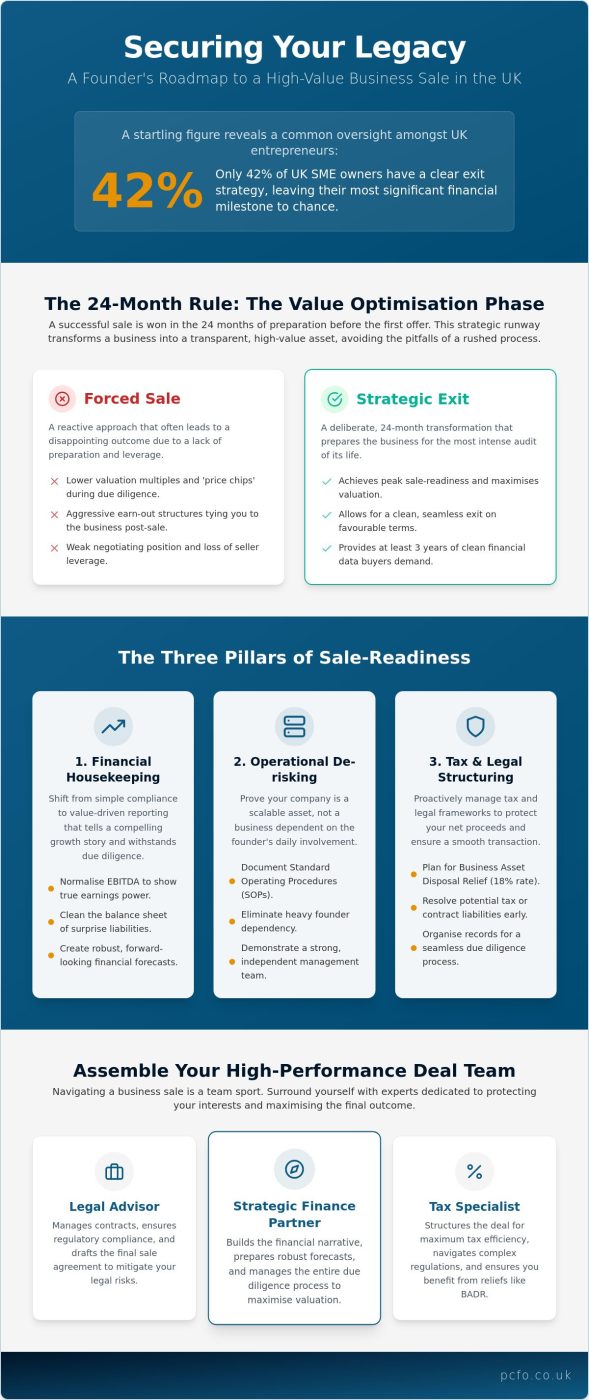
Did you know that only 42% of UK SME owners have a clear exit strategy in place, even though the sale of their company represents their most significant financial milestone? It’s a startling figure that highlights how many founders leave their legacy to chance. When you begin preparing for business sale uk, the difference between a disappointing offer and a high-value exit often comes down to the quality of your financial narrative. A successful sale is won or lost in the 24 months of preparation preceding the first offer.
We understand the weight of this transition. You’ve spent years building your enterprise, yet the complexity of 2026 tax regulations and the fear of failing due diligence can feel overwhelming. It’s common to worry that your records don’t tell the full story of your growth or that your business is too dependent on your daily involvement. You deserve a process that reflects your hard work without the fear of hidden skeletons surfacing during a buyer’s audit.
This article provides the strategic roadmap you need to secure the value you deserve. We’ll outline how to optimise your financial architecture, manage the impact of the 18% Business Asset Disposal Relief rate, and present a scalable model that appeals to sophisticated buyers. We’ll preview the essential steps to ensure your accounts are robust, your tax liabilities are minimised, and your exit is as seamless as possible.
Key Takeaways
- Understand the 24-month rule for cleaning up balance sheets and optimising EBITDA to ensure your business reaches peak sale-readiness.
- Learn how to normalise your earnings when preparing for business sale uk by identifying one-off costs that could otherwise suppress your true market valuation.
- Discover how to de-risk your operations by documenting standard operating procedures to eliminate founder dependency and prove your company is a scalable asset.
- Identify the essential members of a high-performance deal team required to protect your net proceeds and navigate complex 2026 tax regulations.
- See how fractional CFO services provide the strategic financial architecture needed to manage due diligence and secure a seamless, high-value exit.
What Does Preparing for a Business Sale in the UK Involve?
Preparing for a business sale in the UK is a rigorous process of alignment. It requires your financials, operations, and legal frameworks to work in perfect harmony. True sale-readiness isn’t just about finding a willing buyer; it’s a deliberate transformation that turns a private company into a transparent, attractive asset. When you begin preparing for business sale uk, you’re essentially preparing your business for the most intense audit of its life.
Many owners believe they can decide to sell and be on the market within weeks. This approach often leads to a ‘forced sale’ where the seller lacks leverage. A ‘strategic exit’ is different. It relies on the 24-month rule, a period dedicated to cleaning up balance sheets and optimising EBITDA to ensure the business is seen at its highest potential value. Identifying primary reasons why sales fail is a key part of this initial phase:
- Inaccurate or messy financial data that fails to withstand due diligence.
- Heavy founder dependency where the business cannot function without the owner’s daily input.
- Surprise liabilities, such as unresolved tax issues or poorly structured employment contracts.
During this preparation phase, we often review your eligibility for Business Asset Disposal Relief. With the 18% tax rate for qualifying disposals in 2026, early tax planning is essential to protect your net proceeds and ensure the deal structure is as tax-efficient as possible.
The Strategic Timeline: Why 24 Months?
The 24-month preparation window is known as the ‘Value Optimisation Phase’. Buyers typically demand at least three years of clean, consistent financial data to establish confidence in your growth story. If you rush the exit, you risk lower valuation multiples and aggressive earn-out structures that keep you tied to the business for years post-sale. A longer runway allows us to resolve operational friction and prove that your profitability is sustainable whilst preparing for business sale uk.
Setting Your Objectives and Exit Goals
Your roadmap depends entirely on your desired destination. Are you looking for a full trade sale to a competitor, a management buy-out (MBO), or perhaps a private equity investment to fuel further growth? Each path requires a different financial narrative. You must align your personal financial needs with a realistic business valuation for exit. Establishing your ‘walk-away’ number early in the process prevents emotional decision-making during the heat of negotiations. It ensures that when the final offer arrives, you know exactly whether it meets your long-term requirements.
Financial Housekeeping: The Pre-Sale Checklist
Financial housekeeping is the foundation of a successful exit. When preparing for business sale uk, you must shift your perspective from simple compliance to value-driven reporting. Buyers aren’t just looking for historical accuracy; they’re looking for evidence of a high-performing financial engine. This begins with an internal audit of your management accounts to ensure they reflect a true and fair view of profitability. Any discrepancies found during due diligence can lead to ‘price chips’ or, in the most difficult cases, a total withdrawal of the offer.
A critical task is normalising your EBITDA. This involves identifying one-off costs or personal expenses that won’t continue under new ownership. Perhaps you’ve invested in a non-recurring brand refresh or carry directors’ salaries that sit above market rates. Highlighting these adjustments allows you to present a more accurate picture of the company’s underlying earnings power. Simultaneously, tightening your working capital cycles demonstrates cash flow efficiency. A business that collects cash quickly and manages inventory effectively is always more attractive to investors.
Management Accounts and Financial Projections
Historical statutory accounts tell the story of where you’ve been, but buyers are more interested in where you’re going. Robust, forward-looking forecasts are essential for justifying your valuation. A strategic finance director plays a pivotal role here, translating raw data into a defensible growth story. They ensure that revenue recognition policies are consistent and that your projections are backed by verifiable pipeline data. This level of detail builds the institutional trust required for a smooth transaction. If you need to strengthen your financial leadership before a sale, our outsourced accountancy solutions can provide the necessary oversight.
Tax Efficiency and Capital Gains Planning
Tax filings must be impeccable. In 2026, with mandatory iXBRL filing and increased scrutiny from Companies House, any administrative oversight can become a red flag. You should consult the official government guidance on selling your business to understand your statutory obligations. Early tax structuring is vital to protect your proceeds when preparing for business sale uk, particularly regarding Business Asset Disposal Relief. Since the relief rate increased to 18% in April 2026, ensuring you meet the qualifying criteria for the £1 million lifetime limit is a priority. Identifying potential tax ‘skeletons’ now allows you to resolve them on your own terms, rather than under the pressure of a buyer’s investigation.
Operational De-risking: Moving Beyond Founder Dependency
Operational de-risking is often the most overlooked stage when preparing for business sale uk. A buyer is not just purchasing your current profits; they’re purchasing the certainty that those profits will continue after you leave. If your business relies on your personal relationships, technical expertise, or daily decision-making to function, it’s a high-risk asset. We recommend conducting a ‘three-month test’: if the business cannot operate smoothly for a full quarter without your presence, your valuation will suffer significantly.
To transform your company into a ‘plug-and-play’ asset, you must document every critical workflow through Standard Operating Procedures (SOPs). These documents prove to a buyer that the business has a repeatable, scalable system that does not depend on any single individual. Beyond processes, you must address legal hygiene. This includes securing key employee contracts with appropriate notice periods and non-compete clauses. You should also formalise all customer and supplier contracts, ensuring they contain ‘change of control’ clauses that allow for a seamless transfer of ownership.
In addition to operational and legal readiness, the physical condition of your business premises should be considered. For companies with a physical footprint, engaging a specialist such as CFS group Limited for property maintenance and refurbishment ensures that your facilities reflect a well-managed enterprise, removing any visual ‘red flags’ that could arise during a buyer’s site inspection.
Succession Planning and Management Strength
Investors pay a premium for businesses with a capable second-tier management team. Building this layer of leadership ensures that the strategic vision remains intact post-completion. A strong, autonomous team directly increases the ‘multiple’ a buyer is willing to pay because it reduces their post-acquisition workload. For a deeper look at protecting your legacy, see our guide on succession planning for founders, which details how to transition authority whilst maintaining operational stability.
Customer Concentration and Revenue Quality
Buyers are highly sensitive to customer concentration risk. If a single client accounts for more than 15% to 20% of your total revenue, it creates a perceived ‘single point of failure’ that can derail a deal. When preparing for business sale uk, you should implement strategies to diversify your client base and reduce this exposure. Furthermore, the quality of your revenue matters. Recurring revenue models, such as subscriptions or long-term service contracts, are valued far more highly than one-off transactional sales because they provide predictable future cash flows that simplify the buyer’s financial modelling.
Assembling Your Deal Team: Legal, Tax, and Strategic Finance
Selling a business is the most complex transaction a founder will ever undertake. It is rarely a solo effort. Success depends on the collective expertise of a specialised deal team, each playing a distinct role in protecting your interests. A corporate lawyer is essential for drafting the Share Purchase Agreement (SPA) and managing the warranties that protect you after completion. Your tax advisor focuses on optimising net proceeds, ensuring the structure of the deal is efficient and compliant with current 2026 regulations. Meanwhile, an M&A broker or corporate financier identifies potential buyers and manages the ‘beauty parade’ to drive competitive tension. Engaging dedicated m&a support for sellers ensures you have the financial expertise to level the playing field with experienced acquirers throughout this process.
The strategic finance director acts as the internal project manager for the entire sale process. Whilst your legal and brokerage teams focus on the external transaction, the FD ensures your internal financial machinery remains robust. They coordinate with all parties to keep the deal moving whilst you focus on what matters most: maintaining the performance of the company. If you are preparing for business sale uk, having this strategic oversight is the difference between a chaotic exit and a controlled, high-value transition.
The Role of Strategic Finance in Due Diligence
Due diligence is often the most stressful phase of a transaction. Your FD prepares the digital ‘Data Room’, which is the digital repository of every document a buyer will request, from historical tax filings to employee contracts. By organising this repository early, you demonstrate a level of professional rigour that builds buyer confidence. An experienced FD anticipates buyer questions and addresses them before they lead to ‘price chipping’ negotiations. Their presence allows the founder to maintain ‘business as usual’ operations, ensuring that company performance does not dip whilst the leadership is occupied with deal negotiations.
Choosing the Right Advisors for Your Sector
Industry-specific knowledge is vital in M&A. You should evaluate advisors based on their track record of successful UK exits within your specific niche. They must understand the nuances of your sector’s valuation multiples and regulatory environment. For many scaling companies, implementing outsourced accountancy solutions provides the high-level oversight required for sale-readiness without the overhead of a full-time executive. If you need a partner to act as the architect of your exit, book a consultation with PCFO to explore our strategic exit support.
Maximising Your Exit Value with PCFO
Success in the M&A market requires more than just a profitable company. It demands a level of financial sophistication that many SMEs struggle to maintain whilst managing daily operations. By implementing fractional Chief Financial Officer services, you gain access to the intellectual rigour of a seasoned professional who has navigated numerous high-value transactions. This model provides big-firm expertise without the prohibitive cost of a full-time executive, making it a highly efficient solution for preparing for business sale uk.
Our approach to exit strategy planning services focuses on turning raw financial data into a compelling investment narrative. Acquirers, particularly private equity firms and institutional investors, look for patterns of scalability and resilience. We don’t just report your numbers; we contextualise them, explaining the ‘why’ behind your growth and the ‘how’ of your future potential. This proactive mindset alleviates the anxieties of the sale process, providing the steady hand needed to navigate both the emotional and technical hurdles of a transaction.
Readying the Business for a Premium Multiple
To secure a premium valuation, your internal reporting must mirror the expectations of sophisticated buyers. We implement Key Performance Indicators (KPIs) and management reporting frameworks that provide immediate transparency into your business health. This often involves strategic overhead reduction to boost the bottom line in the years preceding the sale, ensuring your EBITDA is as lean and robust as possible. Within this process, PCFO acts as the strategic bridge between the owner’s vision and the buyer’s requirement for empirical evidence.
Next Steps: Your Sale-Readiness Review
The most effective exits are planned years in advance. Even if you don’t intend to sell for another 36 months, the decisions you make today regarding your financial architecture will directly impact your final sale price. We recommend beginning with a comprehensive financial health check to identify any gaps in your current reporting or operational structure. This audit allows us to resolve potential red flags long before a buyer’s due diligence team discovers them. If you are preparing for business sale uk and want to ensure you don’t leave value on the table, we invite you to contact PCFO for a confidential discussion on your exit roadmap.
Securing Your Legacy Through Strategic Financial Planning
A successful exit is the result of meticulous planning rather than fortunate market timing. By treating the 24-month window as a value optimisation phase, you transform your company from a founder-led enterprise into a scalable, high-value asset. We’ve explored how professional financial housekeeping and operational de-risking create the transparency that institutional buyers demand. These strategic steps don’t just protect your valuation; they ensure a smooth due diligence process without the risk of late-stage price chipping.
When you’re preparing for business sale uk, having an experienced partner at the helm of your financial strategy is vital. PCFO provides specialists in UK SME exit strategies and expert fractional CFOs with deep M&A experience to guide you through every technical hurdle. We offer comprehensive financial health checks for sale-readiness to ensure your business is positioned for a premium multiple from the outset. Our role is to act as your authoritative strategic partner, navigating the complexities of the 2026 tax landscape whilst you focus on maintaining peak company performance.
Book a Strategic Consultation for Your Exit Planning to begin your journey toward a seamless, high-value exit. You’ve worked hard to build your business; now is the time to ensure you secure the legacy you deserve with a partner you can trust.
Frequently Asked Questions
How long does it typically take to sell a business in the UK?
The transaction itself usually takes between six and twelve months from the moment you go to market. However, the most successful exits involve a preparation phase of at least 24 months. This longer runway is necessary to clean up balance sheets, normalise earnings, and ensure your financial data tells a consistent growth story that buyers can trust.
What is the most important factor in determining a business sale price?
Maintainable EBITDA is the primary driver of valuation for most UK SMEs. Buyers apply a sector-specific multiple to your adjusted earnings to reach a headline price. Factors like recurring revenue quality, management team strength, and low customer concentration can significantly increase this multiple, whilst high founder dependency will almost certainly decrease it.
Do I need to tell my employees I am preparing for a sale?
Confidentiality is typically maintained until the later stages of a transaction, often after a Letter of Intent or Heads of Terms is signed. Whilst you may need to involve key senior management early to assist with data collection, most owners wait until due diligence is well underway. You must also consider your legal obligations under TUPE regulations regarding employee transfers post-sale.
What is due diligence, and how can I prepare for it?
Due diligence is the buyer’s intensive investigation into your company’s financial, legal, and operational health. Preparing for business sale uk involves creating a digital Data Room containing at least three years of clean, iXBRL-formatted accounts, employee contracts, and supplier agreements. Being proactive with this documentation prevents the ‘price chipping’ that often occurs when buyers discover inconsistencies late in the process.
Can I sell my business if it is currently loss-making?
Yes, businesses can be sold for their strategic value, intellectual property, or ‘acqui-hire’ potential even without current profits. In these cases, the valuation is based on the buyer’s ability to integrate your assets into their existing infrastructure to generate future returns. You must present a clear, data-backed roadmap that demonstrates how your technology or market position provides immediate value to an acquirer.
What is the difference between an asset sale and a share sale in the UK?
A share sale involves the buyer purchasing the entire company entity, including all its assets and liabilities. This is often the preferred route for sellers as it can be more tax-efficient, particularly when qualifying for Business Asset Disposal Relief. An asset sale involves the buyer picking specific parts of the business, such as equipment or customer lists, whilst the original company structure remains with the seller.
How much does it cost to hire professional advisors for a business sale?
Total professional fees for a UK business sale typically range between 8% and 15% of the final sale price. This usually includes broker or corporate finance fees of 3% to 12%, legal fees of approximately 1%, and specialist accountancy or CFO fees between 0.5% and 1%. It is also worth considering the long-term Asset-Based Management and Advisory Fees that will apply as you transition your business capital into a managed investment portfolio. These costs are an investment in securing a higher valuation and protecting your net proceeds from unnecessary tax liabilities.
Should I use my regular high-street accountant for my business sale?
High-street accountants are excellent for statutory compliance, but preparing for business sale uk requires a different set of strategic skills. You need specialists with specific M&A experience who understand how to package a business for institutional buyers. A fractional CFO or strategic finance director provides the high-level oversight needed to manage complex due diligence and negotiate the financial aspects of the Share Purchase Agreement.