

Why does your bank balance often feel lighter even as your sales figures climb? It’s a frustrating paradox facing many of the 5.68 million SMEs across the UK; revenue is rising, yet true financial stability remains elusive. You’ve likely experienced the strain of stagnant profits despite your team’s best efforts, or perhaps you’ve navigated a cash flow crisis whilst trying to scale. We recognise that sustainable expansion requires more than just a busier sales pipeline. It demands the steady, experienced hand of a business growth consultant to align your ambitions with financial reality.
In this guide, we’ll explore how fractional leadership bridges the gap between high-level sales targets and long-term value. You’ll discover how to move away from reactive management and towards a proactive strategy that restores control over your operations. We’ll outline a clear roadmap for profitable growth, ensuring your company is future-proofed and prepared for an eventual exit. This isn’t just about getting bigger; it’s about building a more resilient, valuable organisation.
Key Takeaways
- Understand why many UK SMEs stall at the £1m to £5m turnover mark and how a business growth consultant provides the framework to break through this plateau.
- Identify the hidden risks of overtrading and learn how to implement cash flow forecasting that supports increased overheads during periods of rapid expansion.
- Evaluate the benefits of the fractional leadership model, which offers high-level financial expertise without the significant cost of a full-time executive hire.
- Recognise the warning signs of profitless growth and founder burnout to reclaim strategic control over your daily business operations.
- Learn how to align your current scaling activities with long-term exit planning to maximise the ultimate value and saleability of your organisation.
What is a Business Growth Consultant and Why Do UK SMEs Need One?
A business growth consultant is a specialist advisor tasked with identifying profitable opportunities and building the structural frameworks required for scaling. Unlike generalists, these experts focus on the mechanics of expansion, ensuring that every step forward is backed by robust financial logic. The field of management consulting has evolved to offer SMEs more than just broad advice; it now provides specific, fractional leadership that addresses the unique pressures of the UK market. By acting as a strategic partner, a consultant helps you navigate the transition from a founder-led startup to a professionally managed organisation.
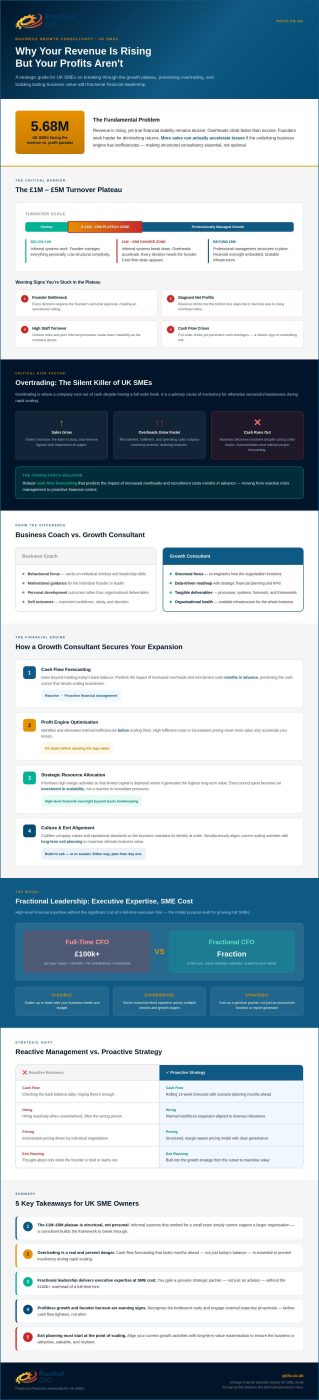
Many UK businesses hit a visible wall between the £1m and £5m turnover mark. This growth plateau occurs because the informal systems that worked for a small team can’t support a larger organisation. At this stage, founders often find themselves working harder for diminishing returns. Revenue might be climbing, but if your overheads are rising faster, you’re merely scaling a problem. A business growth consultant identifies these structural weaknesses before they lead to a full-scale crisis.
The Difference Between Strategic Advisory and General Coaching
It’s easy to confuse a business coach with a growth consultant, but their functions are distinct. Coaching is primarily behavioural, focusing on the individual’s mindset and leadership skills. Consultancy is structural. While a coach might offer motivational guidance, a consultant delivers a data-driven strategic business planning UK roadmap. You aren’t just getting advice; you’re receiving tangible deliverables that re-engineer how your company functions. This shift from individual focus to organisational health is what makes consultancy so effective for scaling firms.
When is the Right Time to Engage a Growth Specialist?
Timing is everything. You don’t need to wait for a crisis to seek external expertise; in fact, waiting until cash flow is tight is the most expensive way to grow. Look for specific signals like high staff turnover, stagnant net profits, or the “founder bottleneck,” where every decision requires your personal approval. Engaging a specialist proactively allows you to build the foundations before the weight of expansion causes cracks in your operations. It’s about moving from a reactive state to a proactive strategy; to learn how specialists help organisations navigate these phases, you can visit Top7 for strategic guidance.
Expansion isn’t just a numbers game. A consultant helps align your company culture with your new goals. If your team doesn’t understand the “why” behind the growth, you’ll face internal resistance that can derail even the most profitable opportunities. By codifying your values and operational standards, you ensure the business maintains its identity whilst it gets bigger.
The Financial Engine: How a Growth Consultant Secures Your Expansion
Most business leaders view growth through the lens of sales targets and market share. However, a business growth consultant views it through the lens of capital efficiency. Expanding too quickly without the right financial infrastructure leads to overtrading. This is a dangerous state where a company runs out of cash despite having a full order book. It remains a primary cause of insolvency for otherwise successful UK SMEs during periods of rapid scaling.
To prevent this, a consultant establishes robust cash flow forecasting. This goes beyond tracking what is in the bank today. It involves predicting the impact of increased overheads and recruitment costs months in advance. They also work to optimise your profit engine. Before you pour capital into sales and marketing, you must ensure your internal processes aren’t leaky. If your fulfilment costs are too high or your pricing is inconsistent, more sales will only accelerate your losses. Identifying and eliminating these inefficiencies ensures that your growth is both profitable and sustainable.
Strategic Resource Allocation and Budgeting
Scaling requires moving beyond basic bookkeeping into high-level strategic financial oversight. You need to understand how to scale a business without compromising its underlying stability. A consultant helps you prioritise high-margin activities, ensuring that your limited capital is deployed where it generates the highest long-term value. This methodical approach to budgeting ensures that every pound spent is an investment in future scalability rather than a reactive cost.
Managing Working Capital Whilst Scaling
Rapid expansion often creates a cash gap. This occurs when you pay for inventory, new hires, or equipment long before the revenue from those investments arrives. Effective working capital management involves negotiating better terms with suppliers and rigorously improving your debtor days to keep cash moving. Working capital is the lifeblood of any high-growth UK SME. By aligning your financial strategy with the UK government’s plan for SMEs, you can better position your firm for resilience and national support. If you’re concerned about the financial strain of your current expansion, exploring fractional CFO services can provide the strategic clarity you need.
Comparing Growth Consultancy Models: Finding Your Strategic Fit
Selecting the right business growth consultant involves more than just checking credentials. You must decide between a generalist management consultant and a specialist financial growth advisor. Generalists often focus on broad cultural or marketing shifts, which are valuable but can sometimes lead to a form of Marketing Myopia, where the business loses sight of its core strategic purpose in favour of short-term sales. Specialist financial advisors, conversely, ground every growth initiative in fiscal reality. They ensure that your expansion isn’t just a vanity project but a calculated move towards a higher company valuation.
The choice between a “contractor” and a “partner” is equally vital. A contractor typically delivers a specific project and then exits. A partner becomes an embedded part of your leadership team. This collaborative approach is particularly effective for UK SMEs that lack the internal capacity to manage complex scaling phases. By choosing an embedded advisor, you gain access to institutional knowledge and a proactive mindset that a distant contractor simply cannot provide. When evaluating potential models, consider these three structural differences:
- Broad vs. Deep: Generalists look at the whole company; specialists focus on the financial engine.
- Contract vs. Partnership: Contractors solve a single task; partners solve for the long-term future.
- Full-time vs. Fractional: Fractional models offer elite expertise at a fraction of the executive cost.
The Fractional FD as a Growth Consultant
The fractional model has gained significant traction amongst UK SMEs for good reason. It allows you to access the expertise of a seasoned finance director without the overhead of a six-figure salary. This part-time arrangement provides the board-level financial oversight necessary for navigating high-stakes decisions. Because the consultant works with multiple organisations, they bring an objective, unbiased perspective that’s often missing in internal hires. It’s a flexible solution that adapts as your company’s needs evolve.
Fixed-Project vs. Retained Advisory
You must also weigh the merits of fixed-project audits against ongoing retained support. A one-off growth audit can identify immediate inefficiencies, but long-term success usually requires a retained partnership. This is especially true in business scale up consultancy, where the challenges change as the company grows. Ongoing advisory ensures that your strategy remains agile and that you have a steady hand at the helm during turbulent market shifts. A transparent, retainer-based relationship builds a deeper foundation of trust and intellectual rigour than a transactional model.
Key Indicators Your SME is Ready for a Growth Advisor
Recognising the exact moment to engage a business growth consultant is often the difference between a successful scale-up and a costly retreat. For many founders, the first sign is a personal one: burnout. If you remain the primary bottleneck for every operational decision, your business has outgrown its current management structure. A company that cannot function without its owner’s constant intervention is a job, not a scalable asset. Professionalising the board through a business growth advisory UK service allows you to step back from the daily minutiae and focus on high-level strategy.
Another critical indicator is the “profitless growth” trap. You might see revenue climbing steadily, yet your bottom line remains flat or, worse, begins to fall. This is frequently a symptom of overtrading. As discussed earlier, overtrading occurs when the costs of fulfilling new orders outpace the cash coming in. If your bank balance is dwindling whilst your sales team celebrates record months, your financial engine is misfiring. A consultant diagnoses these systemic issues, ensuring that every new contract adds genuine value rather than just more work.
The Transition from Small Business to Scalable Enterprise
Preparing for External Investment or Debt
If your roadmap includes Series A funding or securing a major bank loan, your financial records must be impeccable. Investors and lenders conduct rigorous due diligence that goes far beyond basic accounting. A business growth consultant prepares your “Data Room,” ensuring every financial statement, contract, and forecast stands up to intense scrutiny. By positioning your business as a low-risk, high-reward opportunity, you significantly increase your chances of securing the capital required for your next phase of expansion. If you recognise these symptoms in your own organisation, it may be time to book a strategic consultation to explore your options.
Driving Sustainable Value: The PCFO Approach to Growth
At PCFO, we believe that financial health is the non-negotiable foundation for all expansion. Scaling a business with weak financial controls is like building on sand; the larger the structure, the more likely it is to collapse. As your business growth consultant, we don’t just look at how to increase your turnover. We focus on protecting your margins, optimising your tax position, and ensuring your cash reserves can withstand the pressures of rapid change. Our “Embedded Advisor” model means we aren’t just giving advice from the sidelines. We’re invested in your trajectory, working alongside your leadership team to ensure every decision adds long-term value to your organisation.
We succeed when you scale. This collaborative partnership is built on intellectual rigour and a proactive mindset. Unlike transactional consultants who deliver a report and disappear, we stay to oversee the execution of your strategy. We provide the steady hand needed to navigate the complexities of the UK market, allowing you to focus on your core strengths whilst we handle the strategic financial navigation.
Aligning Growth with Your Ultimate Exit Goals
Successful founders always keep the end in mind. Every strategic decision you make today should increase the eventual saleability and market value of your organisation. By integrating our growth strategy with exit strategy planning services, we help you build a company that is “sale-ready” at any moment. This doesn’t mean you have to sell tomorrow. It means your business is so well-structured and profitable that it commands a premium valuation whenever you choose to step away. We provide absolute transparency regarding our engagement, ensuring that our fractional CFO pricing UK models are clearly linked to the ROI we deliver for your firm.
Your First 90 Days with a PCFO Growth Consultant
The initial 90 days of our partnership are structured to move your business from a state of reactive management to proactive strategic control. This process follows a methodical progression:
- Phase 1: The Deep Dive Audit. We perform a forensic analysis of your current financial health. This uncovers the hidden constraints, such as inefficient capital structures or “leaky” operational processes, that are currently throttling your progress.
- Phase 2: The Strategic Roadmap. Once we understand the landscape, we establish clear, measurable targets for the coming year. We define the specific KPIs that will track your success and ensure every department is aligned.
- Phase 3: Execution and Oversight. Strategy is only as good as its implementation. We provide the ongoing board-level oversight required to navigate change, ensuring your roadmap stays on track whilst adapting to new market opportunities.
Your journey towards sustainable, profitable growth starts with a single step. We invite you to begin with a strategic audit to identify exactly where your business stands today and where it could be tomorrow. By building a robust financial engine now, you ensure your company’s future is both scalable and secure.
Secure Your Company’s Future Through Strategic Scaling
Scaling a business is a complex transition that requires more than just increased sales. It demands a robust financial engine and the structural foresight to avoid common pitfalls like overtrading or profitless growth. By engaging a business growth consultant, you gain the board-level oversight necessary to professionalise your operations and protect your margins during rapid expansion. This strategic alignment doesn’t just improve your current performance; it builds long-term value that prepares your organisation for a successful eventual exit.
At PCFO, our expert fractional Finance Directors provide national UK strategic advisory services tailored specifically for the challenges of SME scaling and exit planning. We work as your embedded partners, ensuring your financial strategy is as ambitious as your growth targets. Whether you’re preparing for external investment or looking to restore operational control, we provide the intellectual rigour needed to navigate your path with confidence.
Ready to take the next step? Book a Strategic Consultation with PCFO to Scale Your Business and begin building a more resilient, valuable organisation today. Your company’s most successful chapter is waiting to be written.
Frequently Asked Questions
What exactly does a business growth consultant do on a daily basis?
A business growth consultant focuses on the strategic mechanics of your organisation by analysing financial performance, refining operational workflows, and monitoring key performance indicators. Their daily activities involve moving between high-level board advisory and the granular details of process optimisation to ensure your company remains on its scaling trajectory. They act as an embedded partner, working closely with your leadership team to execute the roadmap established during the initial audit phase.
How much does it cost to hire a business growth consultant in the UK?
Investment levels vary based on the seniority of the advisor and the complexity of your business needs. Most consultants operate on either a day-rate basis for specific projects or a monthly retainer for ongoing strategic support. The fractional model is often the most cost-effective route for SMEs, as it provides access to elite executive expertise without the significant overhead of a full-time salary and benefits package.
How is a growth consultant different from my current accountant?
Your accountant is primarily responsible for historical reporting, tax compliance, and statutory filings. In contrast, a business growth consultant is forward-looking and focuses on strategic navigation and future-proofing. Whilst an accountant tells you what has already happened in your business, a consultant identifies the structural changes and financial strategies required to reach your next turnover milestone.
Can a consultant help if my business is currently losing money?
Engaging a consultant is often most critical when a business is facing financial strain or stagnant profits. By performing a deep dive audit, they can identify the leaky processes and capital inefficiencies that are draining your resources. Their role is to stabilise your cash flow and re-engineer your profit engine before refocusing the organisation on sustainable expansion.
What is the typical ROI I can expect from growth consultancy?
The return on investment is measured through tangible improvements in net profit margins, increased company valuation, and the restoration of founder control. By professionalising your board and implementing scalable systems, a consultant helps build a more resilient organisation. This strategic oversight aims to deliver long-term value that significantly outweighs the cost of the engagement.
Do I need to hire a consultant full-time to see real results?
Full-time executive hires are rarely necessary for SMEs to achieve their scaling goals. The fractional leadership model allows you to access board-level expertise on a part-time basis, providing the same strategic impact as a permanent hire. This flexible approach ensures you only pay for the high-level oversight you need whilst maintaining the agility of your organisation.
How long does a typical growth consultancy engagement last?
Engagement lengths depend on whether you require a one-off project or ongoing strategic partnership. A diagnostic audit might last a few weeks, whilst a comprehensive scale-up phase typically requires twelve to eighteen months of consistent oversight. This duration ensures that new processes are fully embedded and that the leadership team is equipped to maintain the momentum independently.
Will a growth consultant help me secure bank funding or investment?
Preparing your business for external capital is a core function of a strategic advisor. They ensure your financial statements are robust and prepare the necessary documentation to withstand the rigours of due diligence. By positioning your company as a low-risk, high-reward opportunity, they significantly improve your chances of securing favourable terms from lenders or investors.