

Most aspiring directors believe that a lack of personal wealth is the primary barrier to acquiring a company, but the real risk often lies in the structural fragility of the deal itself. You’ve likely spent years mastering your industry and now feel ready to take the helm, yet the fear of a post-acquisition cash flow collapse or complex UK tax implications often keeps you stationary. It’s a daunting transition to move from the security of a salary to the strategic weight of ownership. Securing the right management buy-in financial support uk is less about finding a lender and more about architecting a deal that protects your professional future.
We understand that the leap from employee to owner requires a fundamental shift in mindset and financial strategy. This guide will help you master the complexities of management buy-ins and buyouts with expert advice on valuation, funding structures, and post-deal leadership. You’ll gain a clear roadmap for navigating the current 3.75% Bank of England base rate and leveraging the Growth Guarantee Scheme to secure the capital you need. We’ll preview the essential steps to ensure your acquisition leads to lasting financial stability rather than immediate operational strain, providing the calm confidence needed to lead your new venture effectively.
Key Takeaways
- Identify the strategic differences between MBOs and MBIs in the current 2026 UK market to choose the most effective path for business ownership.
- Master valuation methodologies like EBITDA multiples and “normalised” earnings to ensure you are paying a fair price for the company’s true underlying value.
- Explore diverse options for management buy-in financial support uk, including how to use vendor-deferred consideration to bridge the gap when personal capital is limited.
- Understand how to navigate 2026 Capital Gains Tax rates and qualify for Business Asset Disposal Relief to protect the financial outcomes of the deal.
- Learn how fractional financial leadership provides the board-level reporting and cash flow management necessary to sustain growth whilst repaying acquisition debt.
The Management Buy-In (MBI) and Buyout (MBO) Landscape in 2026
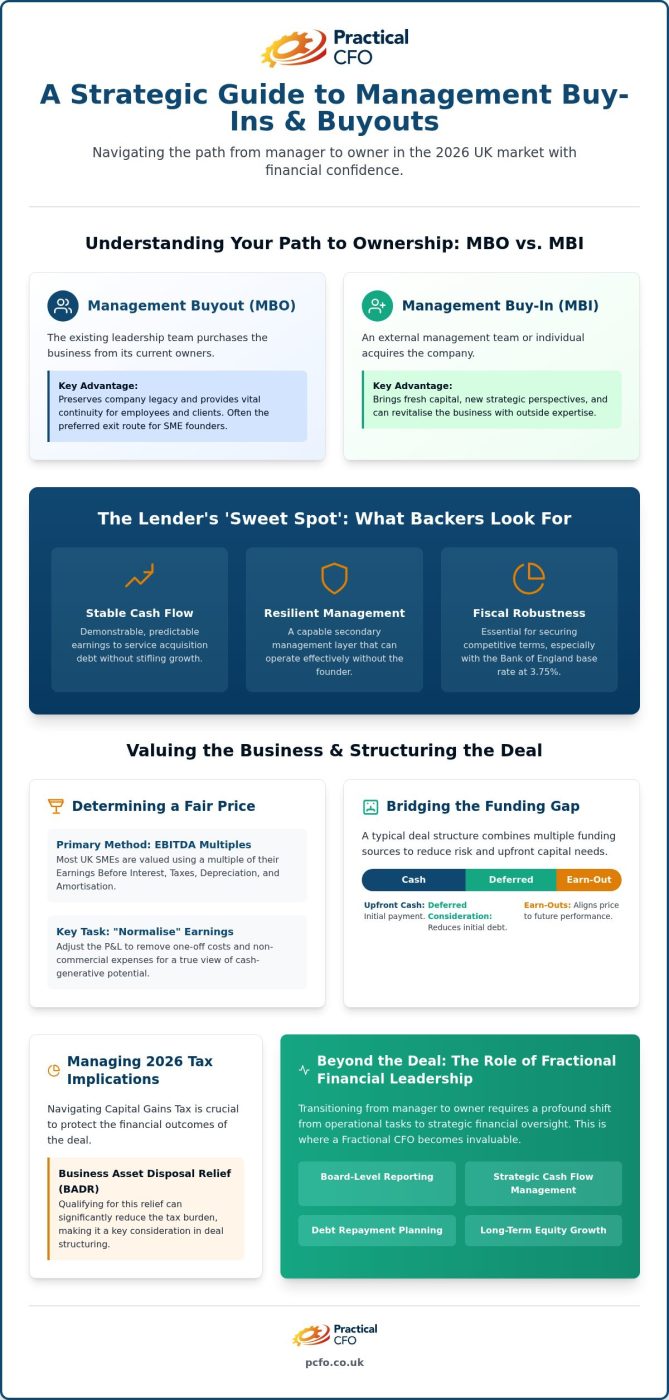
The UK market in 2026 presents a sophisticated environment for ownership transitions, with a clear distinction between internal and external acquisitions. A Management Buyout (MBO) occurs when the existing leadership team purchases the business from its current owners. Conversely, a Management Buy-In (MBI) involves an external management team or individual acquiring the company, typically bringing fresh capital and new strategic perspectives. For many SME founders, an MBO remains the preferred exit route. It preserves the company’s legacy and provides vital continuity for employees and clients, which often makes it a more palatable transition than a trade sale to a competitor.
Successful deals in the current climate typically occupy a specific “sweet spot” that appeals to lenders. This includes a business with stable, predictable cash flow and a capable secondary management layer that can function effectively without the original founder. When seeking management buy-in financial support uk, investors look for these indicators of resilience. Stable earnings ensure that the debt taken on to fund the acquisition can be serviced without stifling future growth. In an era where the Bank of England base rate sits at 3.75%, demonstrating this fiscal robustness is essential for securing competitive terms.
The Strategic Shift: From Manager to Owner
Transitioning from a senior manager to a business owner requires a profound psychological evolution. You move from following budgets to creating value and managing risk. Operational excellence is no longer sufficient; you must develop strategic financial oversight. Engaging professional finance director support is often the catalyst for this change. It helps the management team establish board-level behaviours, moving beyond day-to-day tasks to focus on long-term equity growth and fiscal responsibility. This shift is vital for maintaining the confidence of your financial backers post-acquisition.
Why Management Teams Require Independent Financial Advice
Management teams must secure their own advisors rather than relying on the vendor’s existing accounting firm. This avoids conflicts of interest and ensures the team receives an objective assessment of the company’s future runway. Independent advice is crucial when applying for management buy-in financial support uk. It establishes credibility with commercial banks and private investors, proving that the team has conducted rigorous due diligence. An external advisor provides the intellectual rigour needed to challenge the vendor’s valuation and identify potential cash flow bottlenecks before they become critical issues.
Evaluating Company Value and Structuring the Transaction
Determining the correct purchase price is the most critical hurdle in any acquisition. In the 2026 UK market, most SMEs are valued using a multiple of EBITDA, though Discounted Cash Flow (DCF) models are increasingly applied to businesses with high intellectual property or subscription-based revenue. A Finance Director’s primary task is to “normalise” the earnings. This involves adjusting the Profit and Loss statement to remove one-off costs, excessive owner salaries, or non-commercial expenses that won’t continue under your leadership. This transparency is vital when seeking management buy-in financial support uk, as lenders require an accurate view of the company’s true cash-generative potential.
Deal structures significantly impact the effective price and your post-acquisition risk profile. A mix of upfront cash and deferred consideration is standard. By deferring a portion of the payment, you reduce the initial debt burden and ensure the seller remains motivated during the handover period. A well-prepared data room, managed by an experienced financial lead, facilitates rigorous due diligence. It provides the evidence needed to justify the valuation to external backers and proves that the business can support the proposed debt levels.
Bridging the Valuation Gap
Sellers often maintain an optimistic view of their company’s worth that exceeds a management team’s immediate funding capacity. To resolve this, you can use “earn-outs” to align the final purchase price with the company’s future performance over the first 12 to 24 months. In the context of a 2026 SME buyout, normalised EBITDA is the adjusted operating profit of a business, stripped of non-recurring items and personal owner expenses, to reflect the true, sustainable cash flow available to new owners. This technical approach is a cornerstone of any professional guide to management buyout, ensuring you don’t overpay for historical anomalies.
The Importance of a Three-Way Forecast
Lenders and investors require more than just a simple profit forecast; they demand a robust three-way model. This model integrates the Profit and Loss, Balance Sheet, and Cash Flow statements into a single, cohesive framework. Utilising outsourced accountancy solutions is often the most efficient way to produce these high-level models with the credibility required by commercial banks. By simulating “worst-case” scenarios, such as a sudden increase in the 3.75% base rate or a decline in key client retention, you can protect your personal liability and ensure the deal’s long-term viability. If you’re currently assessing a potential target, our business planning consultants can help you stress-test your assumptions before you sign a Letter of Intent.
Overcoming the Funding Gap: Financing Your MBI
- Step 1: Personal Contributions. Lenders require “skin in the game” to align your interests with theirs. Typically, this involves a meaningful personal investment that reflects your commitment to the company’s long-term success.
- Step 2: Vendor-Deferred Consideration. Negotiating a portion of the price to be paid over several years reduces your initial borrowing requirements. It effectively turns the seller into a junior lender.
- Step 3: Commercial Senior Debt. We approach high-street and challenger banks for term loans. In 2026, the Growth Guarantee Scheme remains a vital tool, providing a 70% government guarantee on commercial loans up to £2 million for eligible SMEs.
- Step 4: Equity Partners. For larger transactions, search funds or Private Equity (PE) firms can provide the heavy lifting. This capital is permanent but comes at the cost of equity dilution.
- Step 5: Asset-Based Lending (ABL). If the target company has a strong balance sheet, you can secure funding against accounts receivable, inventory, or machinery to unlock immediate liquidity.
The Funding Mix: Balancing Debt and Equity
Choosing the right balance between debt and equity is a strategic decision that dictates your future cash flow. High debt levels provide cheaper capital and preserve your ownership, but they demand rigorous monthly repayments. Conversely, equity partners reduce your financial pressure but require a seat at the table. In mid-market UK transactions, Mezzanine Finance often fills the void between these two. It is a hybrid form of capital that sits behind senior debt; it carries a higher interest rate and often includes warrants that allow the lender to convert debt into equity if certain conditions aren’t met.
Vendor Financing: The SME Secret Weapon
A vendor loan note is often the most flexible component of management buy-in financial support uk. It allows you to structure repayments that match the company’s projected growth curve, ensuring you don’t stifle the business in its first year of new ownership. We focus on managing these interest rates carefully to ensure they stay competitive against the 3.75% base rate. It’s vital to remember that whilst deferred debt is a powerful tool, it does appear on your balance sheet. This can impact the company’s future credit rating and its ability to secure additional working capital for growth initiatives.
Managing Risks and Tax Implications in 2026
Focusing solely on the headline price is a common pitfall for management teams. In 2026, the true success of a transaction is measured by its tax efficiency and the robustness of its risk mitigation strategies. For outgoing founders, Capital Gains Tax (CGT) planning is paramount to protecting their legacy. With the 2026 to 2027 annual exempt amount set at £3,000 and CGT rates for higher earners reaching 24% on non-residential assets, ensuring the deal qualifies for Business Asset Disposal Relief (BADR) is essential. Qualifying for the 10% BADR rate can significantly increase the seller’s net proceeds, often making them more flexible during price negotiations.
For the incoming team, the challenge lies in structuring equity to reward future performance without triggering immediate tax charges. We often utilise “Growth Shares” or “Sweet Equity” to align management incentives with long-term capital growth. These instruments allow you to benefit from the value you create post-acquisition whilst keeping initial tax liabilities manageable. However, you must navigate these structures carefully to avoid HMRC scrutiny regarding “disguised remuneration”. If the shares are issued at a significant undervalue, HMRC may treat the gain as employment income, subject to much higher tax brackets. Professional management buy-in financial support uk is vital here to ensure your equity remains a capital asset rather than an income liability.
Mitigating Personal and Professional Risk
Protecting your future requires more than just a firm handshake. You must insist on comprehensive Warranties and Indemnities within the purchase agreement. These legal safeguards protect the new owners from undisclosed historical company liabilities, such as tax disputes or pending litigation. A “NewCo” structure is typically utilised for UK MBOs to provide a clean legal vehicle for securing debt and to ring-fence the purchasing team from the target company’s historical risks. This ensures that the debt used to fund the acquisition is held by a separate entity, protecting your personal assets if the business faces unforeseen headwinds.
The Role of Due Diligence
Due diligence must be a proactive exercise led by the management team. Whilst financial due diligence confirms the accuracy of historical reporting, commercial due diligence identifies “hidden” overheads that could threaten your post-deal profitability. This includes assessing the durability of client contracts and the state of the company’s infrastructure. Many sellers now use exit strategy planning services to clean up their operations before a sale, but you must still verify every assumption. If you are currently evaluating a target, our Chief Financial Officer services can provide the objective, board-level analysis needed to identify these risks before they become your responsibility.
Beyond the Deal: The Role of a Fractional CFO in Post-MBO Success
Completing the transaction is a significant milestone, but the true test of your leadership begins once the ink is dry. Many new owners discover that the management buy-in financial support uk they worked so hard to secure requires rigorous ongoing management to remain sustainable. You must implement professional board-level reporting from Day 1 of your ownership to maintain the confidence of your lenders and investors. This involves transitioning your finance function from simple historical reporting to strategic foresight. By anticipating cash flow needs months in advance, you ensure the business can comfortably meet debt repayment schedules whilst simultaneously funding the growth initiatives that justified the acquisition in the first place.
Strategic financial leadership is about more than just keeping the books in order; it’s about future-proofing the business for its own eventual secondary buyout or exit. A disciplined approach to financial management from the outset builds a track record of reliability that will be invaluable when you eventually seek to realise the value you’ve created. Whether you are managing the 3.75% base rate’s impact on your variable debt or navigating the complexities of 2026 tax regulations, having a steady hand at the helm of your financial strategy is non-negotiable for long-term stability.
The First 100 Days: Establishing Financial Control
The initial three months are critical for setting the tone of your ownership and establishing a new baseline for performance. A fractional CFO is typically more cost-effective than a full-time hire during this period, providing high-level expertise at a fraction of the permanent executive cost. We focus on optimising your overhead structure to reflect the new era of ownership, identifying efficiencies that may have been overlooked by the previous founders. It’s about building a culture of financial accountability amongst the wider team. When every department head understands how their spending impacts the company’s ability to service its acquisition debt, the entire organisation becomes aligned with your strategic goals.
Scaling the New Venture
Once stability is achieved, your focus must shift toward expansion and market penetration. Utilising business growth advisory uk allows you to identify market opportunities that align with your new vision for the company. We help you refine the business plan to ensure it reflects current market realities rather than the assumptions made during the due diligence phase. As the business grows in complexity and revenue, you’ll eventually need to decide when to transition from a fractional FD to a full-time CFO. Preparing for this evolution now ensures that your management buy-in financial support uk remains a foundation for growth rather than a constraint on your ambition.
Architecting Your Strategic Acquisition
Navigating the path to business ownership requires more than just industry expertise; it demands a sophisticated approach to financial architecture. You’ve seen how “normalising” earnings and utilising vendor-deferred consideration can bridge the gap between your ambition and the final purchase price. Success in 2026 relies on balancing competitive debt with strategic equity whilst maintaining the operational control necessary to drive growth. We focus on ensuring your transition is built on a foundation of intellectual rigour and fiscal transparency.
Securing the right management buy-in financial support uk is only the first step in a much longer journey toward sustainable ownership. By integrating fractional CFO expertise from the outset, you protect your personal liability and ensure your new venture has the board-level foresight needed to thrive post-acquisition. We provide the specialist MBO financial advisory required to turn a complex transaction into a long-term success story. If you’re ready to transition from manager to owner, discuss your MBO strategy with a PCFO expert. Our team is here to provide the steady hand and strategic navigation your business deserves. Your future as a business leader starts with a well-structured plan.
Frequently Asked Questions
What is the typical timeframe for completing a management buyout in the UK?
A typical MBO or MBI in the UK takes between six and nine months to complete from the initial proposal to final completion. This duration allows for comprehensive due diligence, securing management buy-in financial support uk, and finalising complex legal documentation. Deals involving multiple lenders or regulatory hurdles from the CMA may extend beyond twelve months.
How much personal money do I need to contribute for a management buy-in?
Lenders generally expect management teams to contribute a meaningful amount of personal capital, often referred to as “hurt money,” to demonstrate commitment. Whilst there is no fixed rule, this typically equates to approximately one year’s gross salary per individual. In larger transactions, this might represent between 10% and 20% of the total equity portion of the deal.
Can we complete an MBO if the current owner does not want to retire yet?
You can certainly complete a buyout even if the current owner isn’t ready for a full exit. This is often structured as a “phased exit” where the founder retains a minority stake and remains active for a defined period. This approach provides continuity for the business and allows the management team to transition into full ownership gradually over several years.
What happens to my current employment contract during a management buyout?
Your current employment contract will typically be superseded by a new Director’s Service Agreement once the deal completes. This new document reflects your shift from employee to owner-manager and includes specific clauses regarding equity, performance incentives, and restrictive covenants. It’s a vital step in establishing the professional board-level behaviours required for long-term success.
Is an MBO better for the business than selling to a third-party trade buyer?
An MBO is often superior for preserving company culture and employee morale because it avoids the disruption of an external acquisition. Whilst a trade buyer might occasionally offer a higher initial price, an MBO can be completed more discreetly. It also minimises the risk of sensitive commercial data leaking to competitors during the due diligence phase.
What are the main financial risks for a management team in a buy-in?
The primary financial risks involve the servicing of acquisition debt and the potential for personal guarantees required by high-street banks. If post-deal cash flow doesn’t meet projections, the management team faces the pressure of repaying loans whilst trying to fund daily operations. Securing robust management buy-in financial support uk and maintaining a cash reserve is essential to mitigate these exposures.
How is the value of a company determined in an MBO transaction?
Valuation is primarily driven by a multiple of the company’s maintainable EBITDA, adjusted for the specific sector and current market conditions. We also consider the quality of the balance sheet and the reliability of recurring revenue. In 2026, lenders are placing greater emphasis on “normalised” profit figures that reflect the sustainable cash flow available under new ownership.
Do we need to hire a new accountant if the company already has one?
You should appoint your own independent financial advisor even if the business has a long-standing relationship with an accountancy firm. The vendor’s accountant often has a conflict of interest because they’re focused on maximising the exit price for the seller. Having your own advisor ensures you receive objective due diligence and unbiased advice on the most sustainable funding structure.