

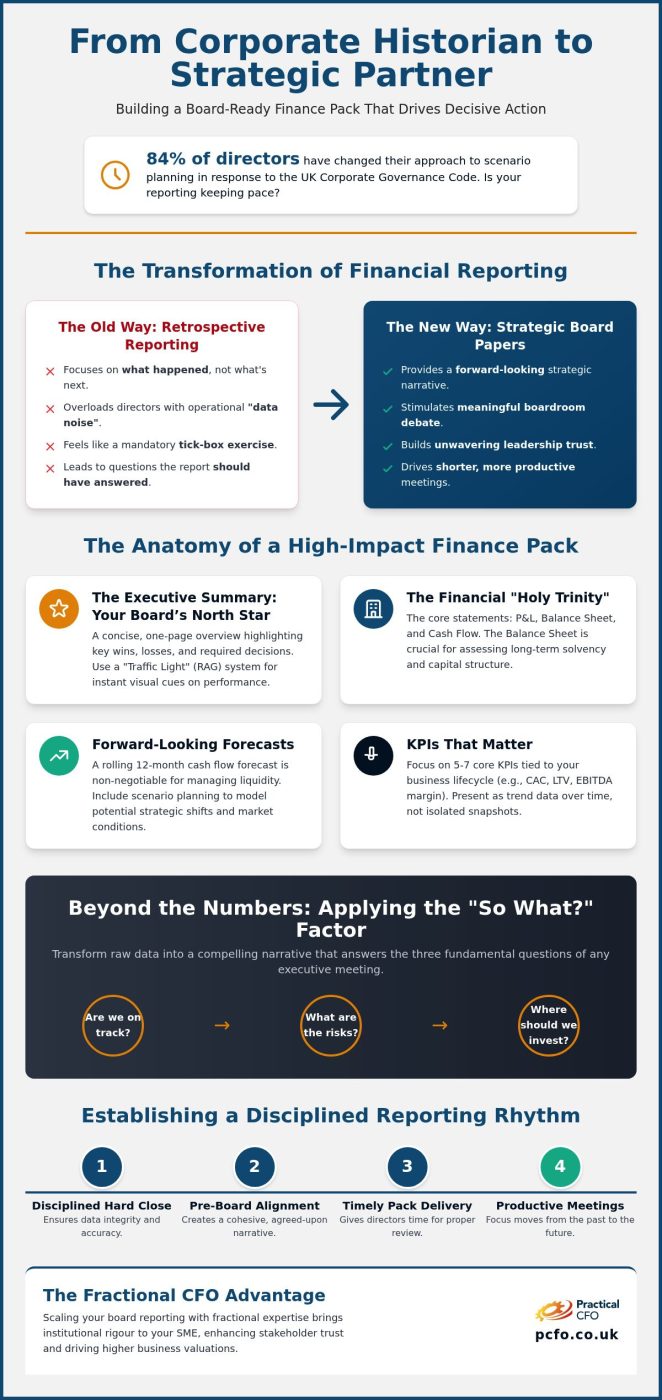
84% of company directors report having changed their approach to scenario planning in response to the updated UK Corporate Governance Code, yet many Finance Directors remain trapped in a cycle of retrospective reporting. You likely spend days wrestling with complex spreadsheets, only to face a room of stakeholders asking questions your report should have already answered. It’s frustrating when reporting feels like a mandatory tick-box exercise rather than a tool for genuine influence. Mastering the art of building a board-ready finance pack is the vital transition from being a corporate historian to becoming a strategic partner.
This guide will help you create high-impact board papers that drive strategic decisions and build unwavering leadership trust. We will explore the essential components of a forward-looking pack, the impact of the 2026 regulatory shifts, and a clear roadmap for business growth. By the end, you’ll have the framework to lead shorter, more productive board meetings that focus on the future of the business.
Key Takeaways
- Transform your monthly reporting from a retrospective exercise into a strategic tool that stimulates meaningful boardroom debate and professional governance.
- Discover why building a board-ready finance pack requires a focus on forward-looking KPIs and a concise one-page executive summary that respects your directors’ time.
- Learn to apply the “So What?” factor to your data, providing the narrative depth needed to address business risks and growth opportunities proactively.
- Implement a structured reporting rhythm, including a disciplined hard close and pre-board alignment, to ensure your financial narrative is both accurate and cohesive.
- Explore how fractional CFO expertise can bring institutional rigour to your SME reporting, enhancing stakeholder trust and driving higher business valuations.
What is a Board-Ready Finance Pack and Why Does Your SME Need One?
A board-ready finance pack is far more than a monthly data dump. It acts as the primary stimulus for boardroom conversation, ensuring that every director is looking at the same version of the financial truth. While standard management accounts often focus on what happened in the previous period, building a board-ready finance pack is about facilitating strategic governance. It provides the intellectual rigour required to answer the three fundamental questions of any executive meeting: Are we on track? What are the risks? Where should we invest our capital?
Building trust with external investors and non-executive directors depends entirely on the integrity of your data. High-quality board papers must be audit-proof, offering a clear trail that withstands professional scrutiny. This level of transparency is often formalised in the director’s report, which provides the essential narrative on the company’s financial health and regulatory compliance. When stakeholders see a structured, narrative-driven pack, they gain the confidence that the business is being steered by a steady hand.
The Difference Between Management Accounts and Board Papers
Management accounts are designed for the engine room. They are granular, line-item heavy, and focused on departmental performance. In contrast, board papers zoom out to the big picture. A common governance failure in UK SMEs is overloading the board with operational minutiae. This “data noise” prevents directors from seeing long-term trends or identifying threats to viability. Strategic board reporting prioritises KPIs that indicate where the business is going, rather than just where it has been.
Why 2026 Demands More Than Just a P&L
As we navigate 2026, the expectations for financial reporting have evolved beyond simple profit and loss statements. Modern boards require visibility on ESG metrics, real-time cash runway, and sophisticated macro-economic risk assessments. With the Bank of England rate sitting at 3.75% as of July 2026, capital allocation decisions are more critical than ever. Professional reporting also has a direct impact on business valuation during exit planning, as it demonstrates a level of maturity that investors will pay a premium for. A board-ready pack serves as the business’s strategic compass, guiding every executive decision with precision and foresight.
The Essential Components of a High-Impact Finance Pack
Building a board-ready finance pack requires a shift from reporting raw data to delivering actionable insight. You must curate information that allows the board to focus on high-level strategy rather than operational minutiae. This process is similar to learning how to prepare a comprehensive annual report, where the narrative and future-looking statements are just as vital as the historical numbers. A high-impact pack gives directors the confidence to make bold decisions based on a clear financial story.
The Executive Summary: Your Board’s North Star
The executive summary is the most read part of any pack. It should be a concise one-page summary that highlights key wins, losses, and specific decisions required from the directors. Using a “Traffic Light” (RAG) status provides immediate visual impact, allowing the board to identify areas of concern instantly. This summary must align directly with your overall business growth strategy to ensure every discussion moves the company towards its long-term goals.
Financial Statements and Forward-Looking Forecasts
The “Holy Trinity” of financial reporting remains the core: the P&L, Balance Sheet, and Cash Flow. For UK SMEs in 2026, a rolling 12-month cash flow forecast is non-negotiable. It provides the foresight needed to manage liquidity amongst fluctuating economic conditions. The Balance Sheet is often overlooked, but it’s essential for assessing long-term solvency and capital structure. You should also include scenario planning to demonstrate how potential strategic shifts might affect future performance under different market conditions.
KPIs That Actually Matter to the Board
Boards don’t need fifty metrics. When building a board-ready finance pack, selecting 5-7 core KPIs tied to your specific business lifecycle is much more effective. These might include Customer Acquisition Cost (CAC), Lifetime Value (LTV), or EBITDA margin. Present these as trend data over time rather than isolated monthly snapshots to show the direction of travel. An ideal KPI is one that triggers a specific strategic question from a director, leading to a productive boardroom debate.
Effective variance analysis explains the “why” behind the numbers. If revenue is down 10%, tell the board if it’s a market shift or an internal execution failure. If you’re struggling to distil these insights into a professional format, our Finance Director services can help you refine your reporting cycle and build trust with your stakeholders.
Beyond the Numbers: Crafting Narrative and Strategic Insight
Numbers tell you what happened, but narrative tells you why it matters. When building a board-ready finance pack, the Finance Director must act as a translator, turning raw data into actionable boardroom intelligence. This is where you address the “So What?” factor. If your gross margin has compressed by 2%, the board doesn’t just need the figure; they need to understand if this is a permanent shift in supplier pricing or a temporary logistical hurdle. Addressing the elephant in the room before it is pointed out builds immense credibility. It signals that you are in control of the details and possess the foresight to manage them.
Effective reporting balances transparency with confidence. Reporting bad news is often the moment an FD truly earns their seat at the table. By presenting a challenge alongside a clear set of options, you move the conversation from anxiety to problem-solving. This approach facilitates healthy boardroom debate, allowing the directors to focus their collective expertise on strategic pivots rather than searching for explanations that should have been in the papers. Your role is to guide the board through the complexity, ensuring they feel supported rather than overwhelmed.
The Art of Financial Commentary
Strong financial commentary avoids the trap of simply repeating what the tables already show. Instead, it connects financial outcomes to operational behaviours and shifting market conditions. For example, if debtor days have increased, link this to a specific change in credit control policy or a trend amongst a particular customer segment. Use an “Executive Briefing” style that is efficient, information-rich, and direct. Your goal is to provide the board with the maximum amount of insight in the minimum amount of time, respecting their schedule whilst delivering deep value.
Addressing Risk and Mitigation
Every board pack should explicitly identify the top three financial risks facing the business in the current quarter. These might range from currency volatility to unexpected shifts in the UK inflation rate, which stood at 2.6% in June 2026. However, identifying a risk is only half the task. You must detail clear mitigation strategies to reassure the board that these variables are being managed. Accessing expert board level financial advice transforms risk from a looming threat into a calculated variable within your strategic plan. This proactive mindset ensures the board remains focused on growth rather than being paralysed by uncertainty.
A Step-by-Step Process for Organising Your Reporting Cycle
Discipline is the foundation of effective governance. Building a board-ready finance pack requires a methodical approach that prioritises accuracy and timeliness. Without a structured cycle, you risk delivering a pack that is either late or riddled with errors; both outcomes quickly erode boardroom trust. Establishing a “hard close” deadline for management accounts each month is the first step in regaining control. This ensures your team isn’t still chasing receipts whilst you’re trying to craft a strategic narrative for the directors.
Establishing the Reporting Timeline
A standardised reporting rhythm allows the board to prepare mentally for the session. Following a strict internal calendar ensures the pack is never a rushed production. Aim for this structure:
- Day 1 to 5: Focus on data collection and month-end reconciliation to lock the numbers.
- Day 6 to 8: Create the draft pack and perform initial variance analysis to find the “why” behind the data.
- Day 9: Conduct the strategic review and polish the narrative with the executive team.
Building a board-ready finance pack also involves a vital pre-board review between the CEO and FD. This alignment ensures the executive team speaks with one voice during the meeting. Once the pack is finalised, distribute it at least five working days before the meeting. Busy directors need this window to digest the information and prepare informed, high-level questions.
Data Integrity and Readiness for Scrutiny
Boardroom arguments often stem from conflicting data sets. A single source of truth is vital for maintaining authority and keeping the conversation focused on strategy. Many growing businesses utilise outsourced accountancy solutions to ensure their ledgers remain clean and ready for professional review. This external rigour prevents the FD from becoming a data entry clerk and allows them to focus on high-level advisory. For more technical directors who enjoy the details, prepare a “Deep Dive” appendix. This holds the granular detail without cluttering the main strategic overview.
If your current reporting process feels like a monthly crisis rather than a strategic exercise, implementing a professional reporting framework can restore confidence across your leadership team.
Scaling Your Board Reporting with a Fractional CFO
While technology speeds up data processing, it cannot replace the strategic judgement of an experienced leader. A fractional CFO brings “Big 4” rigour to an SME environment, ensuring your papers meet the highest standards of corporate governance. Building a board-ready finance pack under this guidance transforms your reporting from a passive record into a proactive leadership tool. It’s the difference between merely presenting figures and providing the intellectual depth required to navigate complex growth cycles. Expert leadership ensures that every page of your pack serves a specific strategic purpose.
The Investment in Strategic Leadership
Many business owners worry about the cost of high-level expertise. However, understanding fractional CFO pricing uk reveals a significant ROI compared to a full-time hire. You gain access to a seasoned expert for a fraction of the cost, benefiting from an objective, unbiased view of your company’s health. This external perspective is vital for identifying blind spots that internal teams might overlook. Our leaders leverage deep institutional knowledge to foster long-term success, acting as an embedded advisor rather than a distant contractor. We focus on future-proofing your business through methodical, steady navigation.
Preparing for Exit or Investment
Professional reporting is a critical asset when seeking capital or planning a sale. A history of high-quality board packs serves as a powerful evidence base during due diligence, proving that the business is managed with discipline. These exit strategy planning services rely on the foundations laid by consistent, board-ready reporting. Investors look for a professional, scalable entity; your reporting standards are the clearest indicator of that maturity. High-quality reporting directly facilitates faster funding rounds and can command higher exit valuations by reducing perceived buyer risk.
Transitioning from messy spreadsheets to board-ready intelligence is a core competency of PCFO. We help you move from being a “scorekeeper” to a “strategic partner” by providing the leadership needed to drive value. By building a board-ready finance pack that addresses both risks and opportunities, you position your business as a sophisticated player in your market. We provide the steady, experienced hand at the helm of your financial strategy, allowing you to make informed, confident decisions about the future of your company.
Mastering the Future of Strategic Board Reporting
The transition from operational reporting to strategic governance is a defining moment for any growing SME. By focusing on forward-looking KPIs and a narrative that addresses the “why” behind the numbers, you empower your board to make decisions with clarity. Establishing a disciplined reporting cycle ensures that this high-level insight becomes a consistent foundation for your business growth. It’s about moving from a retrospective view to a proactive leadership style that commands respect in the boardroom.
Mastering the art of building a board-ready finance pack is not just about compliance; it’s about future-proofing your organisation. Whether you’re preparing for a funding round or refining your exit strategy, the rigour of your papers reflects the maturity of your leadership. Professional guidance can bridge the gap between spreadsheets and strategic intelligence, providing the objective foresight needed to navigate the complexities of 2026.
If you’re ready to move beyond the role of scorekeeper, you can elevate your boardroom strategy with PCFO’s Fractional FD services. We provide national UK coverage with board-level expertise, specialising in strategic growth and exit planning for ambitious SMEs. Let us help you turn your financial data into your greatest strategic asset.
Frequently Asked Questions
How many pages should a standard board-ready finance pack be?
A standard board-ready finance pack should ideally range between 15 and 20 pages. This core document should include:
- A one-page executive summary
- Primary financial statements
- Strategic KPI trend reports
This length respects the schedule of busy directors whilst providing enough depth for strategic debate. If the pack exceeds this, move granular data to an appendix to ensure the discussion remains focused on high-level decision-making.
Should we include every departmental budget in the board pack?
You should avoid including every granular departmental budget in the main board papers. Instead, present a consolidated view that highlights:
- Significant budget variances
- Strategic implications for the business
- Corrective actions already taken
Directors need to understand the big picture impact on cash flow and profitability rather than specific line items. This approach keeps the discussion focused on high-level strategy rather than operational minutiae.
How far in advance should directors receive the board papers?
Directors should receive the finance pack at least five working days before the scheduled meeting. This window allows them sufficient time to digest the narrative, analyse the trends, and prepare thoughtful questions. Providing the pack too late often results in a meeting spent explaining the data rather than discussing its strategic consequences. A disciplined distribution timeline is a hallmark of professional governance and builds significant trust amongst your investor base and non-executive directors.
What is the most important financial metric to show the board?
Whilst the most important metric varies by business lifecycle, a rolling 12-month cash flow forecast is often the most vital component when building a board-ready finance pack. In the current economic climate of 2026, liquidity and cash runway are paramount for strategic planning. This metric answers the board’s most pressing question: do we have the capital to execute our growth strategy? Pair this with EBITDA margin to show both operational health and future solvency.
Can we build a board pack without expensive FP&A software?
You can certainly create a high-impact pack without investing in expensive FP&A software. Many successful SMEs rely on well-structured Excel models and professional reporting templates to deliver strategic insight. The value of the pack lies in the quality of the narrative and the accuracy of the data rather than the complexity of the tool used to generate it. Focus on establishing a disciplined hard close and a clear narrative framework to achieve board-ready standards manually.
What happens if we find an error in the board pack after distribution?
Transparency is essential if you discover a material error after the pack has been distributed. You should notify the board immediately and provide an updated page or section rather than waiting for the meeting. Addressing the mistake proactively preserves your credibility and prevents the board from making decisions based on flawed data. Most directors value honesty and a quick resolution over a perfect report that hides underlying issues in the month-end reconciliation process.
How often should the board pack template be reviewed or updated?
You should review your board pack template at least once a year or following a significant change in business strategy. As your company scales, the metrics that mattered six months ago may no longer be the primary drivers of success. An annual review ensures that your reporting remains aligned with your long-term objectives and regulatory requirements. Building a board-ready finance pack is an iterative process that must adapt to the evolving needs of your stakeholders.
Is it better to use digital board portals or PDF packs?
Digital board portals offer superior security and version control, which is increasingly important for compliance in 2026. These platforms allow directors to annotate papers and access historical reports easily. However, for many smaller SMEs, a well-organised PDF pack remains a functional and professional choice. The priority should always be the clarity of the information and the ease of review for your directors, regardless of the delivery method you choose for your monthly reporting cycle.