

Fundraising is not a search for “free money” but a strategic financial exercise that requires professional board-level leadership to succeed. Many business owners find themselves overwhelmed by the sheer volume of options for fundraising financial support UK wide, often feeling caught between the rigid structures of debt and the long-term implications of equity. It’s natural to feel a sense of hesitation when faced with the prospect of giving away a portion of your company or taking on significant liabilities without a clear vision of the return.
You deserve to approach your next funding round with the confidence that your financial strategy is robust enough to withstand intense scrutiny. This guide will help you discover how to secure the capital required to scale your business with professional financial leadership. We’ll provide a clear roadmap for raising capital, explain how to build professional financial models that stand up to due diligence, and show you how a strategic CFO ensures your board-level decisions are based on data rather than guesswork.
Key Takeaways
- Understand the 2026 economic landscape to position your capital acquisition as a strategic growth lever rather than a reactive measure.
- Evaluate the most effective fundraising financial support UK options by comparing the long-term implications of debt financing versus equity dilution.
- Recognise why a dedicated Finance Director is essential for building investor confidence and securing a favourable valuation during the due diligence process.
- Learn to develop robust financial forecasts and sensitivity analyses that demonstrate your company’s scalability and resilience to potential backers.
- Discover how fractional CFO services offer the board-level strategic oversight needed to lead a successful funding round without the cost of a full-time hire.
Navigating the UK Fundraising Landscape in 2026
Business fundraising is the strategic acquisition of capital specifically designed to fuel growth and enhance enterprise value. It isn’t merely a survival tactic. It’s a deliberate choice to accelerate your company’s trajectory. In 2026, the UK market has entered a period of relative interest rate stability. This offers a more predictable environment for long-term planning compared to the volatility of previous years. This stability allows directors to forecast with greater precision and manage debt serviceability with increased confidence.
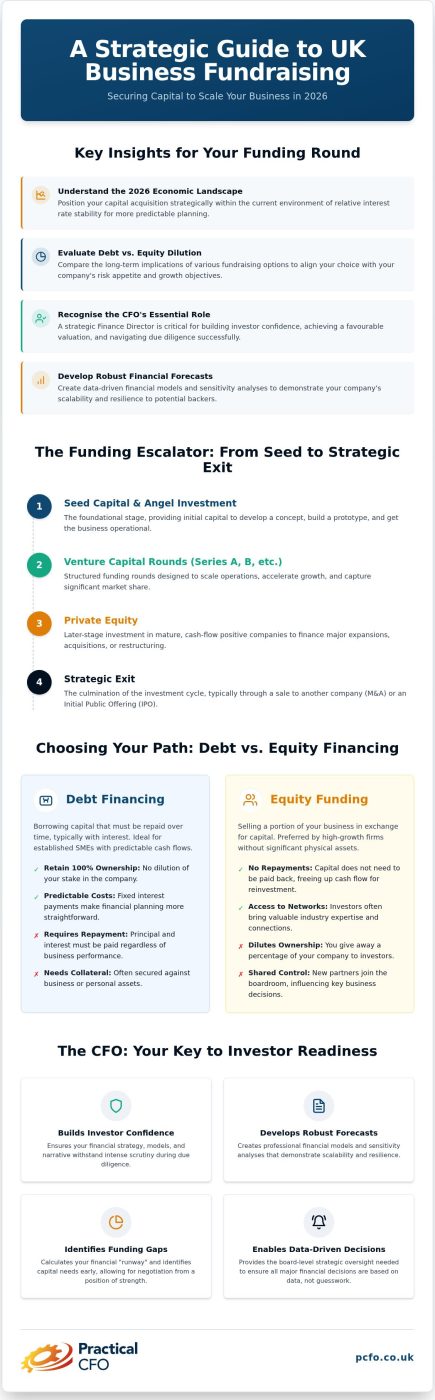
When we discuss fundraising financial support UK businesses need, it’s vital to distinguish this from charitable grants. While grants are often non-repayable and targeted at social impact, commercial financial support usually involves a return for the provider. This might be through interest payments or equity stakes. Understanding your position on the “funding escalator” is the first step. This journey typically begins with seed capital or angel investment, moves through various venture rounds, and eventually leads to private equity or a strategic exit. Each step requires a different level of financial maturity and reporting.
The Evolution of SME Funding in the UK
The current market prioritises sustainable profitability over the “growth at all costs” mindset that dominated previous cycles. Investors and lenders now perform far more rigorous due diligence. They’re scrutinising unit economics and cash flow patterns more than ever. Because of this heightened scrutiny, engaging a professional business growth advisory uk partner has become a standard requirement for scaling SMEs. It ensures your internal systems and strategic narratives are robust enough to meet institutional expectations and stand up to professional scrutiny.
Identifying Your Funding Requirements
Before approaching the market, you must distinguish between your working capital needs and long-term capital expenditure. Working capital covers day-to-day operations; capital expenditure funds major assets or infrastructure that drive future revenue. Both are essential, but they often require different types of funding structures.
Calculating your “runway” is an essential part of this process. This is the amount of time your business can remain solvent before it runs out of cash, based on current burn rates. A funding gap occurs when your projected cash flows are insufficient to cover the investment required for your next expansion phase. Identifying this gap early allows you to secure fundraising financial support UK providers offer before the situation becomes critical. It gives you the leverage to negotiate from a position of strength rather than necessity.
Primary Sources of Financial Support for Scaling Businesses
Selecting the most appropriate fundraising financial support UK providers offer requires a clear understanding of your company’s risk appetite and growth objectives. The choice usually falls between debt, which must be repaid, and equity, which involves giving away a share of your business. It isn’t just about the cash. It’s about the long-term impact on your balance sheet and your autonomy as a founder.
High-growth firms often prefer equity when they lack the physical assets required for traditional bank loans. This route provides the capital needed to scale without the immediate pressure of monthly interest repayments, allowing you to reinvest every pound back into the business.
Equity Funding: Angels, VCs, and Private Equity
Equity involves selling a portion of your business to gain access to significant capital and industry networks. In the British market, funding usually progresses through “Series” stages. Seed rounds get you off the ground, whilst Series A and B rounds are designed to scale operations and capture market share. This provides a clear path for growth but requires you to bring new voices into the boardroom.
It’s vital to have a clear roadmap from the start. Taking on institutional investment changes the nature of your business. You’ll likely need professional exit strategy planning services to ensure your long-term goals align with your new partners’ expectations for a future sale or IPO.
Debt Financing and Commercial Loans
Debt remains a powerful tool for established SMEs with predictable cash flows. Traditional bank facilities and asset-based lending allow you to retain 100% ownership while funding specific projects. In a stable interest rate environment, debt can be highly cost-effective. However, your Finance Director must carefully manage the debt-to-equity ratio to ensure the business remains resilient against market shifts.
The British Business Bank acts as a cornerstone for SME support. It often provides guarantees that make commercial lenders more willing to offer facilities to growing firms. For companies in the technology sector, revenue-based financing has emerged as a flexible alternative. This model allows you to repay capital as a percentage of your monthly revenue, which is particularly useful for SaaS businesses with recurring income.
You might also qualify for non-dilutive support such as R&D tax credits or government innovation grants. These funds are essentially “free” in terms of equity, making them an excellent first port of call before seeking external investors. A Chief Financial Officer can help you navigate these various streams to ensure you choose the best fundraising financial support UK options for your long-term success.
Investor Readiness: The Strategic CFO’s Role in Fundraising
Approaching the market for fundraising financial support UK wide requires more than just a compelling product or service. It requires a financial infrastructure that commands immediate respect in the boardroom. Investors don’t just back innovative ideas. They back a leadership team’s ability to manage and multiply capital. This is where the “CFO effect” becomes a tangible asset. Having a dedicated Finance Director or CFO signals to potential backers that your business is managed with institutional-grade rigour. It immediately boosts investor confidence and can significantly impact your company’s valuation by reducing perceived risk.
Before you engage with any external party, your financial house must be in order. This isn’t just about having your tax returns filed. It’s about transitioning from reactive accounting to proactive strategic finance. You need to demonstrate that you understand your cost drivers, your unit economics, and exactly how every pound of new capital will be deployed to generate a return.
The Difference Between an Accountant and a Strategic FD
It’s a common mistake to assume that a standard accounting function is sufficient for a funding round. While an accountant ensures your business remains compliant with HMRC and statutory filings, a strategic FD focuses on future-proofing your growth. You can explore the strategic role of a finance director to understand how this leadership differs from traditional book-keeping. An FD doesn’t just report historical numbers. They manage the narrative behind them. They explain why certain margin trends exist and how the capital injection will specifically alter the company’s trajectory. This transition is what separates a successful funding round from a missed opportunity.
Due Diligence: Surviving the Forensic Audit
The due diligence process is essentially a forensic audit of your entire operation. A CFO’s primary responsibility during this phase is to ensure there are no deal-breakers hidden within your data. They’ll meticulously organise a virtual data room (VDR) to provide a single source of truth for investors. This typically includes three years of verified accounts, detailed 5-year financial forecasts with sensitivity analysis, and clean statutory records that prove ownership of all assets and intellectual property.
A seasoned CFO anticipates the difficult questions regarding churn, customer acquisition costs, and burn rates before they’re even asked. By cleaning up historical accounts and reconciling discrepancies early, they remove the friction that often stalls negotiations for fundraising financial support UK firms require. It’s a fundamental truth in the financial markets that time kills deals. A proactive CFO ensures the clock stays on your side by being “investor-ready” long before the first meeting takes place.
Structuring Your Business for Successful Capital Injection
Securing the level of fundraising financial support UK investors provide requires a business structure built for scale. It isn’t enough to have a visionary product. You must demonstrate that your internal architecture can handle the weight of institutional capital. This preparation involves a systematic five-step approach to ensure your organisation is ready for a significant capital injection. First, you must develop a robust three-to-five-year financial forecast that includes detailed sensitivity analysis. Second, you should optimise your balance sheet by managing existing liabilities. Third, your pitch deck must speak the language of institutional investors. Fourth, establish clear KPIs and monthly management reporting cycles. Finally, ensure your legal and shareholding structure is transparent and ready for new entries on the cap table.
Financial Modelling and Forecasting
Simple spreadsheets are often insufficient when you’re targeting Series A fundraising or significant commercial debt. Investors expect a multi-dimensional model that accounts for various growth scenarios. Whilst many founders focus on Profit and Loss (P&L) projections, sophisticated backers are far more interested in your cash flow forecasting. They want to see exactly when cash enters and leaves the business to understand your true capital requirements. When deciding how to build these models, many SMEs weigh up the benefits of an fp&a consultant vs software uk based solutions. A professional consultant provides the strategic context that software alone often lacks, ensuring your model reflects the nuances of your specific industry.
The Pitch Deck: Beyond the Visuals
Your pitch deck serves as the visual narrative of your financial potential, but it must be backed by verifiable data. Every claim regarding market share or customer acquisition cost needs to be grounded in reality. The “Use of Funds” slide is arguably the most critical part of your presentation. Investors need to see a granular breakdown of how their capital will be deployed, whether that’s for hiring key talent, expanding into new territories, or investing in R&D. To provide this level of detail, you need access to accurate, real-time data. Implementing professional outsourced accountancy solutions ensures your raw data is clean and ready to be transformed into the strategic insights that investors demand.
By following this structured approach, you move from a position of seeking help to one of offering a high-value investment opportunity. If you’re ready to build a financial framework that stands up to institutional scrutiny, our Chief Financial Officer services provide the board-level expertise required to lead your fundraising strategy with confidence.
Fractional CFO Support: Leading Your Fundraising Strategy
Fractional CFO services bridge the gap between needing executive-level oversight and the constraints of an SME budget. This model provides the board-level expertise required to navigate the complexities of fundraising financial support UK providers offer. You gain access to a seasoned professional who has successfully led multiple funding rounds, bringing a wealth of institutional knowledge to your specific business lifecycle. This isn’t a distant consultancy service. It’s an embedded partnership that scales alongside your ambitions.
PCFO acts as the steady hand at the helm during the high-pressure fundraising period. We don’t just provide reports; we act as the architect of your strategy. Our hands-on involvement ensures that every decision is backed by intellectual rigour and strategic foresight. This proactive mindset helps you avoid the common pitfalls that often derail funding rounds, such as giving away excessive equity too early or failing to address due diligence gaps before they become deal-breakers. By positioning a professional at the head of your financial strategy, you signal to the market that your company is ready for institutional-grade investment.
Cost-Effective Leadership for UK SMEs
The return on investment (ROI) for hiring a fractional CFO for a specific fundraising project is often realised through a significantly reduced “time-to-fund.” By having an expert manage the financial narrative and investor relations, founders can remain focused on operational growth rather than being consumed by spreadsheets. Understanding fractional cfo pricing uk allows you to budget for this expertise as a strategic investment rather than a simple overhead. This flexibility is vital. You can scale the level of Finance Director support up during the intense negotiation phase and down once the capital is secured, ensuring you only pay for the high-level leadership you need.
Your Partner in Strategic Growth
Our commitment doesn’t end when the funds land in your account. PCFO stays invested in your long-term trajectory, ensuring that the capital is deployed effectively to drive the growth promised to your investors. The role of the FD transitions into post-funding reporting and robust governance, maintaining the high level of transparency that professional backers expect. We help you establish the management cycles and KPIs that future-proof your business for the next stage of the funding escalator, whether that leads to further investment rounds or a strategic exit.
Securing the right funding requires a combination of strategic vision and financial precision. If you’re ready to assess your fundraising readiness and build a roadmap for sustainable growth, we’re here to help. Contact us today to arrange a discovery call and learn how our Chief Financial Officer services can lead your business through its next capital injection with confidence.
Leading Your Business to a Successful Funding Round
Navigating the complexities of fundraising financial support UK wide requires more than just a great idea. It demands a level of financial maturity that stands up to the scrutiny of institutional investors and lenders. Preparation is your greatest asset. You’ve seen how professional leadership transforms your accounts from historical records into a strategic roadmap for growth. By focusing on robust financial modelling, you position your business as a high-value opportunity rather than a high-risk venture.
Our experienced Finance Directors bring proven fundraising track records to your boardroom. We offer tailored support for UK SMEs scaling through Series A and beyond, providing the strategic oversight needed to secure capital without the overhead of a permanent hire. Our fixed-fee fractional models ensure you have transparent investment costs whilst accessing top-tier talent at every stage of your journey.
It’s time to move forward with the confidence that your financial strategy is built for scale. Speak to a PCFO expert about your fundraising strategy today and take the first step towards a successful capital injection. Your vision deserves a financial foundation that’s as ambitious as your business goals.
Frequently Asked Questions
What is the difference between a grant and a commercial loan in the UK?
Grants are non-repayable funds provided by government bodies or trusts for specific purposes; commercial loans require repayment of the principal plus interest over a fixed term. Whilst a grant is essentially “free” money, it often comes with rigid reporting requirements and restricted usage. In contrast, commercial loans offer more flexibility in how funds are deployed but create a liability on your balance sheet that must be serviced monthly.
How much equity should I give away in a Series A funding round?
A typical Series A round involves giving away between 10% and 25% of your company’s equity. The exact figure depends on your pre-money valuation and the amount of capital required to reach your next milestone. It’s a delicate balance; you need to provide enough equity to attract high-quality investors whilst ensuring the founding team retains sufficient motivation and control for future funding stages.
Can a part-time Finance Director really lead a multi-million pound fundraising effort?
A fractional Finance Director can absolutely lead a multi-million pound round. These professionals often possess years of institutional experience from larger organisations and bring that wisdom to SMEs on a part-time basis. Their role is to act as the strategic architect of the deal, managing investor relations and due diligence whilst your internal team handles daily operations. This ensures you have board-level expertise without the cost of a full-time executive.
What are the main stages of due diligence for a UK business sale or investment?
Due diligence generally moves through four distinct stages: financial, legal, commercial, and operational. The financial stage involves a deep dive into your historical accounts and future projections to verify accuracy. Legal due diligence examines your contracts, intellectual property, and shareholding structure. Commercial and operational stages assess your market position and the robustness of your internal systems. Preparing your data room early is essential to keep the process moving efficiently.
Do I need an audit before I can raise capital from venture capitalists?
Whilst a statutory audit isn’t always a legal requirement for SMEs, many venture capitalists will insist on one as part of their due diligence process. An audit provides an independent layer of verification that builds significant trust with potential backers. If you haven’t had a recent audit, your Finance Director might suggest a “financial health check” to identify and resolve any discrepancies before you begin the formal fundraising process.
How long does the typical fundraising process take for a UK SME?
The typical fundraising journey for a UK SME takes between six and nine months from initial preparation to cash in the bank. This timeline includes at least two months of internal preparation, several months of active pitching, and a final 8 to 12 weeks for due diligence and legal completion. Starting the process early is vital to ensure you don’t run out of runway before the deal closes.
What is non-dilutive funding and is my business eligible?
Non-dilutive funding refers to capital that doesn’t require you to give up any ownership in your business. Common examples include R&D tax credits, innovation grants, and revenue-based financing. Your eligibility often depends on the nature of your work; for example, R&D credits require you to be solving a specific technical uncertainty. These options are excellent for supplementing fundraising financial support UK companies seek from traditional equity investors.
How do I value my business before seeking financial support?
Valuing an SME is more of an art than a science, especially in the early stages. Common methods include using a multiple of your EBITDA or revenue based on industry benchmarks; alternatively, a Discounted Cash Flow (DCF) analysis can be used for more mature firms. Ultimately, your valuation is a negotiation. You must back up your proposed figure with a robust financial model and clear evidence of your company’s growth potential.