

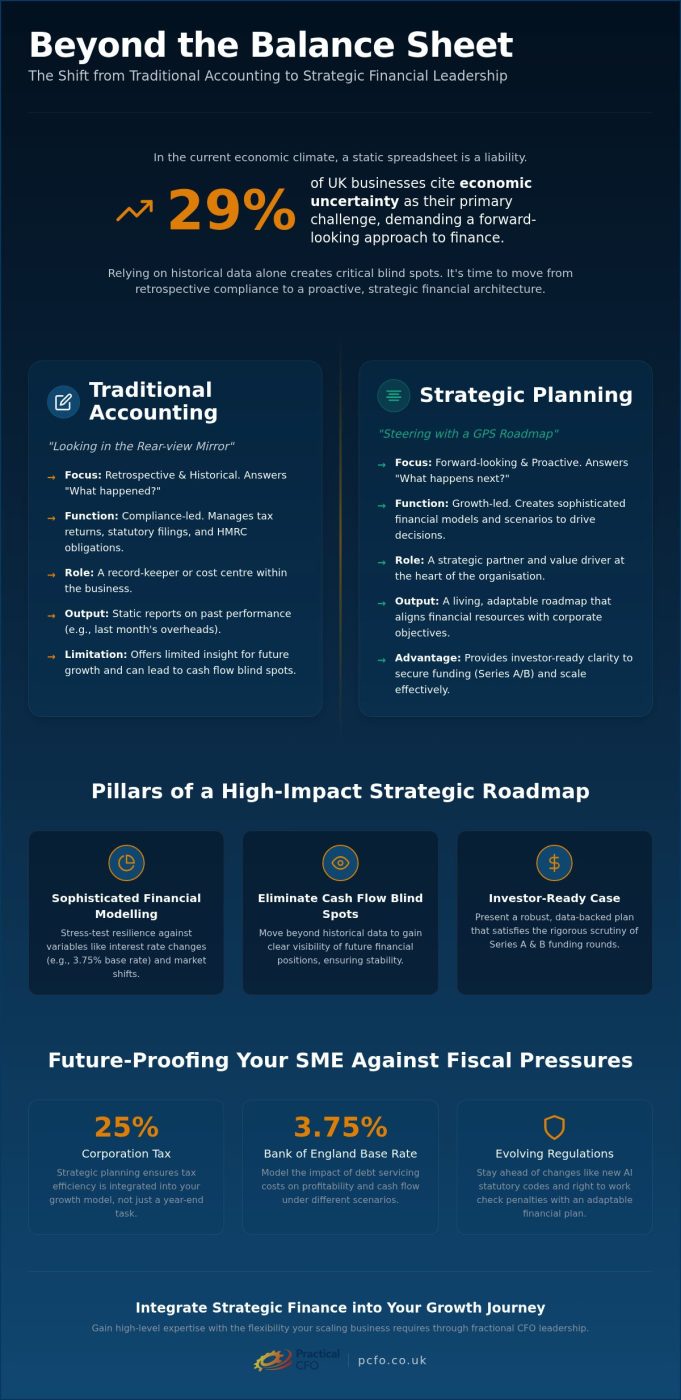
With 29% of UK businesses citing economic uncertainty as their primary challenge in late 2026, a static spreadsheet is no longer a safety net; it’s a liability. You likely recognise that steering a growing SME requires more than just monitoring monthly overheads. It’s difficult to feel confident about securing Series A or B funding when your internal financial modelling for business planning UK lacks the depth required to satisfy sophisticated investors. Without high-level financial expertise on your board, the gap between your current performance and your 2026 growth targets can feel increasingly precarious.
This article demonstrates how expert business planning consultancy transforms fragmented data into a high-growth strategic roadmap. You’ll learn how these professional frameworks enable you to eliminate cash flow blind spots and present a sophisticated, investor-ready case to stakeholders. We’ll examine the specific mechanisms that future-proof your business against the fiscal pressures of the coming years, including the 25% corporation tax rate and evolving employment regulations. By the end, you’ll understand how to bridge the gap between basic accounting and authoritative strategic navigation to ensure your business remains resilient and scalable.
Key Takeaways
- Understand the vital distinction between historical compliance and forward-looking financial architecture designed to drive long-term value.
- Learn how sophisticated financial modelling for business planning UK provides the visibility required to secure Series A or B funding and eliminate cash flow blind spots.
- Discover why commercial experience and strategic foresight are more critical than basic accounting qualifications when selecting a business planning partner.
- Identify the essential pillars of a strategic roadmap that reassures investors and future-proofs your SME against evolving market conditions.
- Explore the benefits of embedding fractional CFO leadership to gain high-level expertise whilst maintaining the flexibility your business requires for growth.
Defining the Role of Business Planning Consultancy in the UK
Business planning consultancy is a high-level strategic partnership designed to create long-term enterprise value. For most UK SMEs, the finance function has historically focused on retrospective reporting; looking at what happened last month rather than what must happen next year. Effective consultancy shifts this perspective toward a forward-looking financial architecture. It positions finance leadership at the heart of the organisation, ensuring every commercial decision is backed by rigorous data and strategic intent. This collaborative approach moves the finance team from a cost centre to a steady, experienced hand at the helm of the company’s growth strategy.
In the current 2026 economic climate, where 29% of businesses report uncertainty as their main challenge, this specialised guidance is essential. It moves beyond basic bookkeeping to provide a proactive framework for growth. By establishing robust financial modelling for business planning UK leaders can transition from reactive survival to deliberate, scalable expansion. This process ensures that capital is allocated efficiently and that the business remains resilient against external shocks, such as fluctuating energy prices or shifts in consumer behaviour.
What Does a Strategic Business Planning Consultant Actually Do?
A consultant identifies the specific levers that drive your profitability. They don’t just record costs; they analyse historical performance to find where a 5% shift in pricing or a 10% reduction in churn could transform your bottom line. They design sophisticated financial modelling for business planning UK scenarios to stress-test your resilience, such as the impact of the 3.75% Bank of England base rate on your debt servicing costs. Crucially, they provide board-level challenge. They act as a supportive partner who isn’t afraid to question a CEO’s assumptions to ensure a comprehensive business plan is grounded in practical reality rather than optimistic speculation.
The 2026 Landscape: Why Static Plans Are No Longer Sufficient
Static documents are obsolete the moment they’re printed. Modern consultancy requires real-time data integration to respond to rapid shifts, such as the increased penalties for right to work checks or new AI statutory codes introduced earlier this year. Consultants help you manage these UK-specific regulatory hurdles whilst maintaining your growth trajectory. They ensure your financial roadmap is a living engine that adapts to market conditions. Business planning consultancy is the alignment of financial resources with corporate objectives.
Strategic Planning vs. Traditional Accounting: Understanding the Difference
A common misconception amongst UK SME owners is that a standard accountant is automatically a strategic planner. Whilst your local firm is likely excellent at managing tax returns and statutory filings, their role is fundamentally different from that of a strategic partner. Traditional accounting is essential for keeping your business compliant, but it rarely provides the proactive insights needed to navigate a complex growth journey. Relying solely on compliance-led reporting to drive your 2026 strategy is a risk that can lead to significant blind spots in your future cash flow.
You might believe your current accountant already handles your growth planning. However, there is a distinct contrast between high-level tax advice and growth-led financial leadership. A strategic consultant doesn’t just record what has happened; they use financial modelling for business planning UK to dictate what happens next. This leadership function requires a data-rich foundation, which is why integrated outsourced accountancy solutions are so valuable. They provide the real-time accuracy required for a strategic advisor to build a reliable roadmap.
Compliance Accounting: Looking in the Rear-view Mirror
Compliance accounting focuses on statutory filings, HMRC requirements, and historical accuracy. It ensures you stay on the right side of the 25% corporation tax rate and meet your MTD obligations. Whilst this is non-negotiable, it’s inherently retrospective. Basic bookkeeping tells you where your money went last month, but it offers limited utility for a business aiming to scale rapidly or secure Series A funding. Traditional accountants often lack the deep commercial experience of a finance director, who understands how to translate a balance sheet into a competitive advantage.
Strategic Planning: Mapping the Road Ahead
Strategic planning is a proactive discipline focused on cash flow forecasting, runway management, and investment readiness. It involves identifying profit leaks and overhead reduction opportunities before they impact your stability. Whilst UK government business plan guidance offers a helpful starting point for the basics, a strategic consultant goes much deeper. They stress-test your business against various economic scenarios to ensure you’re future-proofed. If you’re ready to move beyond basic reporting, you should consider how strategic finance leadership could transform your trajectory.
Core Components of a High-Impact Business Plan for Scaling Firms
A high-impact business plan for 2026 is built on more than just optimistic projections. It requires a robust architecture that integrates every facet of your commercial operation. Whilst a standard Profit and Loss statement is useful, scaling firms require integrated cash flow modelling to truly understand their liquidity. This approach ensures that your strategic roadmap accounts for the timing of payments, tax liabilities, and capital expenditure, rather than just accounting for revenue on paper. It provides the reassurance that your growth is sustainable and that your runway is protected against unforeseen market shifts.
Identifying the right Key Performance Indicators (KPIs) is equally critical for tracking plan execution. These metrics should act as an early warning system, allowing you to pivot before a minor variance becomes a major setback. By utilising professional business growth advisory uk services, you can ensure these targets are aligned with your long-term objectives. Accessing UK government business planning resources can provide additional context for innovation, but the internal rigour of your financial modelling for business planning UK remains the primary driver of successful execution.
Advanced Financial Modelling and Scenario Planning
UK businesses currently face significant market volatility. With 61% of firms expressing concern over energy prices in late 2026, “What-If” analysis has become a necessity. Your financial model should allow you to simulate various scenarios, such as a shift in the 3.75% Bank of England base rate or the impact of expanded right to work checks on your contractor costs. Whether you’re modelling a Series B funding round or a new product launch, the model must be a living tool. It shouldn’t sit in a drawer. You must update it monthly to reflect actual performance against your forecasts to maintain intellectual rigour.
Exit Strategy and Value Maximisation
Value is built years before a sale occurs. Integrating exit strategy planning services into your early-stage roadmap ensures your finance function is always prepared for the rigours of due diligence. In 2026, UK acquirers are looking for firms with strong ESG performance and scalable digital infrastructure. By identifying these value drivers early, you can focus your investments on areas that maximise your eventual valuation. A proactive approach to financial modelling for business planning UK ensures that when the time comes to sell, your data is transparent and your business is attractive to high-level investors.
Evaluating Business Planning Consultants: A Framework for UK Leaders
Selecting a business planning consultant is a decision that impacts your company’s long-term trajectory. Whilst many firms rely on longevity or technical certifications as proof of quality, modern strategic agility requires more than just academic credentials. You need a partner who understands the practical realities of scaling a UK SME in 2026. This means looking for a consultant with deep commercial experience who has successfully steered businesses through funding rounds and market shifts. They should possess the steady, experienced hand required to navigate a landscape where 29% of businesses cite economic uncertainty as their primary challenge.
The financial investment required for consultancy should always be viewed through the lens of Return on Investment (ROI). A high-quality consultant doesn’t just provide reports; they identify opportunities to improve EBITDA and secure capital. By implementing sophisticated financial modelling for business planning UK leaders can quantify the impact of strategic decisions before they’re made. This foresight helps prevent costly missteps and ensures that every pound spent on advisory services translates into measurable enterprise value. It’s a proactive mindset that focuses on future-proofing rather than just historical reporting.
The Fractional Advantage: High-Level Expertise, Scalable Cost
For many scaling firms, a full-time Chief Financial Officer is an unnecessary overhead. The fractional model offers a solution by providing board-level insight at a fraction of the full-time cost. This approach allows you to embed an experienced advisor into your team for a few days a month, scaling their support up or down based on your business lifecycle. When evaluating the cost, reviewing fractional cfo pricing uk helps justify the investment against the potential for high-growth strategic navigation. It’s about accessing elite talent without the burden of a permanent executive salary.
Key Questions to Ask Potential Consultants
Before committing to a partnership, you must ensure the consultant’s expertise aligns with your specific goals. Ask about their experience with businesses at your stage of growth, whether that’s early-stage scaling or preparing for an exit. Inquire about how they’ve used financial modelling for business planning UK to influence a CEO’s decision-making in the past. It’s vital that they don’t just report data but provide the board-level challenge necessary to stress-test your assumptions. Finally, evaluate their ability to integrate with your existing management team. A consultant should feel like an embedded partner rather than a distant contractor.
If you’re looking for a partner who offers intellectual rigour and proactive navigation, you can speak with our strategic advisors today to see how we fit your growth journey.
PCFO: Integrating Strategic Finance into Your Growth Journey
PCFO serves as the authoritative strategic partner for UK SMEs seeking sophisticated financial leadership. We recognise that the transition from a small team to a high-growth enterprise requires more than just administrative support; it demands a steady hand at the helm. By embedding a part-time Chief Financial Officer or Finance Director into your business, we bridge the gap between basic bookkeeping and high-level strategy. This methodology ensures that your board has access to the intellectual rigour typically reserved for large corporations, whilst maintaining the flexibility and cost-efficiency of a fractional model.
Our commitment to future-proofing your organisation is underpinned by a holistic approach to finance. There is a powerful synergy between PCFO’s strategic advisory and the operational support provided by our sister brand, Practical Accounting. Whilst Practical Accounting ensures your data foundation is accurate and compliant, PCFO utilises that data to build a proactive financial modelling for business planning UK framework. This collaboration ensures that your strategic decisions are always grounded in practical reality, allowing you to navigate the 2026 economic landscape with calm confidence.
A Collaborative Approach to Financial Leadership
We move beyond the role of an external contractor to become a deeply invested partner in your long-term success. Our focus is on alleviating the financial anxieties often felt by CEOs by providing clear, composed, and expert guidance. We refuse to offer one-size-fits-all templates. Instead, we develop bespoke financial architecture tailored to your specific business lifecycle. This approach ensures that your strategic roadmap is as unique as your company, designed to identify scalable growth levers and protect your future cash flow through every stage of expansion.
Your Next Steps Towards Scalable Growth
The journey from chaotic growth to methodical, planned expansion begins with a diagnostic financial review. This process identifies immediate opportunities for overhead reduction and profit maximisation whilst highlighting any blind spots in your current model. By refining your financial modelling for business planning UK, we ensure you are investor-ready and prepared for the fiscal challenges of the coming years. You don’t have to navigate these complexities alone. Engage with us for a strategic briefing to discover how our fractional leadership can transform your financial data into a high-growth roadmap.
Securing Your Trajectory for 2026 and Beyond
Transitioning from retrospective accounting to forward-looking leadership is the defining step for any SME aiming to scale in 2026. Sophisticated financial modelling for business planning UK provides the visibility needed to satisfy investors and eliminate cash flow uncertainty. By embedding seasoned Finance Directors into your team, you gain the intellectual rigour required to navigate regulatory shifts whilst maintaining the flexibility your business lifecycle demands.
PCFO stands as your authoritative strategic partner. We offer composed, professional guidance that transforms fragmented data into a bespoke financial roadmap. Our growth advisory services ensure your board-level decisions are backed by commercial experience rather than optimistic speculation. It’s time to replace financial anxiety with a methodical, proactive strategy that future-proofs your enterprise.
Secure your business’s financial future with PCFO’s strategic consultancy.
Your vision for growth deserves a foundation built on precision and partnership.
Frequently Asked Questions
What is the difference between a business planning consultant and a traditional accountant?
A business planning consultant provides strategic leadership focused on future growth, whilst a traditional accountant primarily handles historical compliance and tax filings. Consultants use financial modelling for business planning UK to identify scalable levers and stress-test scenarios. Whilst your accountant ensures you meet HMRC deadlines, a consultant acts as a strategic partner on your board. They bridge the gap between basic bookkeeping and the high-level financial architecture required to drive long-term value.
How much does business planning consultancy cost for a UK SME in 2026?
The investment for business planning consultancy depends on the complexity of your organisation and the specific growth objectives you aim to achieve. Rather than a fixed administrative fee, most UK SMEs view this as a strategic investment measured by its Return on Investment (ROI). Effective consultancy identifies profit leaks and maximises EBITDA, often paying for itself through improved capital efficiency. We recommend a diagnostic review to determine the scope of support your business requires.
When is the right time to hire a business planning consultant?
The right time to engage a consultant is typically when your business outgrows its current financial oversight or faces a significant milestone. This includes preparing for a funding round, planning an exit, or navigating rapid scaling where cash flow becomes complex. With 29% of businesses citing economic uncertainty as a challenge, having a steady hand to future-proof your strategy is essential. Proactive planning ensures you have the financial infrastructure ready before challenges arise.
Can a business planning consultant help my company secure Series A or B funding?
Yes, a consultant is instrumental in securing Series A or B funding by developing the sophisticated models investors demand. They ensure your financial modelling for business planning UK demonstrates a clear path to profitability and a robust understanding of your unit economics. By providing board-level challenge to your assumptions, they help you present an investor-ready case. This reassurance is vital for stakeholders who require evidence that your business is both scalable and resilient.
What should be included in a strategic business plan for a UK company?
A strategic business plan must include integrated cash flow modelling, scenario planning, and clearly defined KPIs. It should move beyond a simple P&L to show how capital is allocated and how the business responds to market volatility. Essential components include:
- Detailed 3-5 year financial roadmap
- Exit strategy considerations
- Stress-testing against interest rate shifts
- Operational alignment with financial targets
This ensures your plan is a living tool for navigation.
How long does the business planning process typically take?
The duration of the process varies based on the maturity of your existing data and the complexity of your goals. A foundational diagnostic review might take a few weeks, whilst building a comprehensive strategic roadmap and embedding leadership often takes several months. It’s a methodical progression rather than a rushed exercise. Taking the time to ensure intellectual rigour at the start builds a stronger foundation for the 5.47 million private-sector businesses operating in the UK.
What is a fractional CFO, and how do they support business planning?
A fractional CFO is a seasoned finance executive who provides high-level strategic leadership on a part-time basis. They offer the same expertise as a full-time hire but at a fraction of the cost, making them ideal for scaling SMEs. They support business planning by designing bespoke financial architecture and providing board-level oversight. This model offers the flexibility to scale support up or down as your business reaches different stages of its growth journey.
Does PCFO provide statutory audit or personal tax services?
PCFO specifically focuses on strategic finance leadership and does not provide statutory audit services or personal wealth management. Our expertise lies in Finance Director and Chief Financial Officer services, business growth advisory, and exit strategy support. For operational accounting needs, we work in synergy with our sister brand, Practical Accounting. This distinction ensures we maintain our position as authoritative strategic partners dedicated to your company’s long-term commercial trajectory and future-proofing.