

Boardrooms rarely reject operational initiatives because the ideas lack merit; they reject them because proposals are presented as departmental expenses rather than strategic investments. When you are tasked with getting budget approval from stakeholders, few experiences are more frustrating than watching a commercially viable plan stall during annual planning cycles simply because technical priorities were lost in translation. You know the operational value of your initiative, yet facing sharp executive scrutiny over cash flow impact and downside risk can undermine even the strongest proposals.
Securing executive sign-off shouldn’t involve months of departmental pleading or defensive spreadsheet battles. This guide details the exact five-step commercial framework required to secure board-level budget approval on your first presentation without endless friction. You will discover how to translate departmental ambitions into robust financial metrics, align project milestones directly with overarching corporate strategy, and use disciplined financial modelling to establish immediate boardroom credibility.
Key Takeaways
- Understand why executive teams reject viable initiatives when operational priorities fail to translate into recognised commercial risk metrics.
- Execute a structured five-step framework for getting budget approval from stakeholders by aligning departmental demands directly with core corporate growth pillars.
- Replace subjective assertions with multi-scenario financial modelling to demonstrate defensible returns and withstand rigorous cash flow scrutiny.
- Pre-empt stakeholder objections regarding capital scarcity and delivery risk by preparing balanced commercial concessions before formal presentations.
- Discover how fractional finance leadership bridges the gap between departmental strategy and board-level governance to secure lasting financial credibility.
Why Budget Proposals Fail: Diagnosing the Stakeholder Disconnect
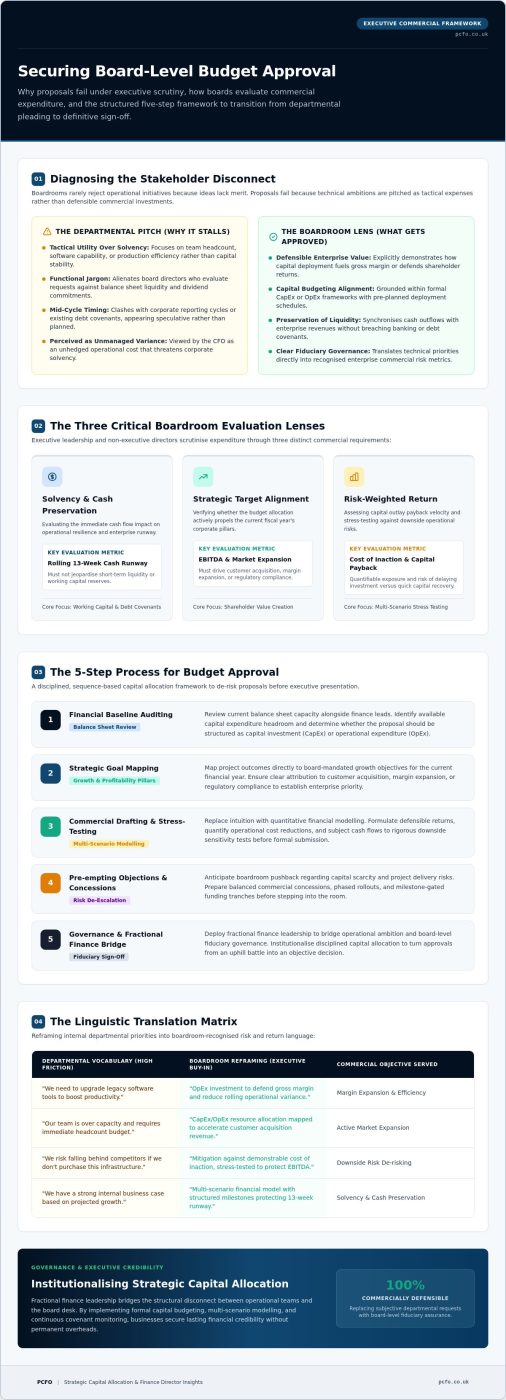
Most rejected business cases don’t fail on operational merit. They stall because the author presents an internal wish list rather than a defensible commercial investment. When department heads struggle with getting budget approval from stakeholders, the breakdown is almost always linguistic and structural rather than functional. Department leads pitch tactical utility; boardrooms evaluate enterprise liquidity, capital preservation, and downside risk. To a Chief Financial Officer, an unverified funding request isn’t an exciting growth project. It represents unmanaged variance that threatens corporate solvency.
Timing introduces another critical layer of friction. Proposals frequently arrive mid-cycle or clash with corporate reporting periods, blind to existing debt covenants or planned dividend distributions. Every pound committed to departmental expenditure must actively defend or enhance shareholder value. If an operational proposal cannot demonstrate how it protects cash reserves or fuels tangible gross margins, executive stakeholders will naturally default to capital preservation.
The Core Friction Between Departmental Ambition and Commercial Risk
Budget friction fundamentally boils down to competing tolerances for financial risk. Whilst operational leaders focus on software capability, team headcount, or production efficiency, the finance desk monitors enterprise cash runways and debt servicing capacity. Functional jargon quickly alienates board directors who need clear financial visibility. An unfunded initiative risks tying up crucial working capital when cash inflows and deployment schedules fall out of sync. Without grounding in a formal capital budgeting process, departmental requests appear speculative rather than commercial.
Identifying What Board-Level Stakeholders Actually Care About
Executive leadership evaluates expenditure through a very distinct commercial lens. Non-executive directors and institutional investors prioritise predictable EBITDA performance, balance sheet resilience, and enterprise liquidity above departmental preferences.
- Solvency and cash preservation: How does this spend affect our rolling 13-week cash runway and working capital?
- Strategic target alignment: Does this allocation accelerate active market expansion or protect core revenue streams?
- Risk-weighted return: What is the demonstrable cost of inaction, and how quickly does the initiative pay back its capital outlay?
Securing sign-off requires presenting your business case within these specific commercial boundaries. Understanding the strategic role of a finance director helps operational leaders reframe tactical goals into robust commercial arguments. When you align departmental outcomes directly with the board’s fiduciary responsibilities, getting budget approval from stakeholders transitions from an uphill battle into an objective investment decision.
The 5-Step Process for Getting Budget Approval from Stakeholders
Successful commercial proposals do not rely on persuasiveness; they follow a disciplined sequence that respects capital constraints. Navigating the path to getting budget approval from stakeholders requires a methodical approach that de-risks the proposition for the board well before the final presentation. By treating your initiative as a structured capital allocation request, you move past departmental lobbying and into commercial partnership.
Steps 1 and 2: Financial Baseline Auditing and Strategic Goal Mapping
Begin by assessing your organisation’s financial capacity. Review the balance sheet alongside your finance team to identify available capital expenditure headroom and determine whether the proposal should be structured as capital investment (CapEx) or operational expenditure (OpEx). Next, map project outcomes directly to board-mandated growth and profitability pillars for the current financial year. If an initiative doesn’t explicitly drive customer acquisition, margin expansion, or regulatory compliance, it will struggle to gain traction.
Step 3: Commercial Business Case Drafting and Financial Stress-Testing
Transform operational goals into tangible financial returns. When you develop a business case, quantify cost reductions, productivity gains, and projected revenue contributions with conservative estimates. Stress-test these metrics against real-world friction:
- Inflation and supply variances: Model a 5% to 10% increase in vendor or implementation costs.
- Deployment slippage: Demonstrate cash flow implications if milestone delivery is delayed by one or two quarters.
- Conservative adoption rates: Calculate the break-even threshold if operational benefits take twice as long to materialise.
For mid-market enterprises navigating complex expansion plans, engaging specialist business growth advisory uk services helps stress-test these assumptions against external market benchmarks before executive review.
Steps 4 and 5: Executive Pre-Wiring and Boardroom Delivery
Never let the boardroom be the first place a stakeholder sees your numbers. Pre-wiring involves scheduling informal, one-to-one discussions with key financial gatekeepers, particularly the Finance Director, weeks prior to the formal vote. Use these conversations to capture feedback, address liquidity reservations, and refine commercial assumptions. When formal sign-off arrives, present a concise executive briefing highlighting strategic return, cash flow timing, and risk governance. Approached this way, getting budget approval from stakeholders becomes a collaborative confirmation of a thoroughly vetted commercial plan.
If you want to ensure your internal proposals meet institutional standards, partnering with an experienced Finance Director can provide the objective financial rigour needed to secure sign-off.
Building an Irrefutable Business Case: Financial Modelling vs Intuition
Emotional appeals and qualitative stories consistently fall flat in corporate governance meetings. When departmental leaders pitch subjective benefits like team morale or general productivity, executive stakeholders see unhedged expense. Defensible financial modelling bridges this gap. It replaces intuition with empirical cash forecasts that withstand forensic scrutiny. In an environment where the cost of capital remains demanding, getting budget approval from stakeholders requires demonstrating exactly how every deployed pound generates tangible shareholder value.
Traditional proposals often rely on simple cost justifications, showing vendor invoices alongside vague efficiency promises. Executive boards expect discounted cash flow analysis, explicit working capital impacts, and sensitivity testing. Presenting a formal financial proposition signals that you understand corporate fiduciary responsibilities.
Core Financial Metrics That Secure CFO and Board Buy-In
Board-level sign-off demands clarity on capital recovery and baseline profitability. To move past subjective speculation, ground your business case in three core commercial pillars:
- Net Present Value (NPV): Disclose future cash inflows discounted against the corporate cost of capital to prove the initiative generates net enterprise value.
- Internal Rate of Return (IRR): Calculate the projected rate of growth to prove the project easily clears internal hurdle rates and outperforms alternative capital uses.
- Payback Period: Define the precise month when the original expenditure is recovered in full.
Payback velocity protects company working capital by rapidly replenishing liquid reserves for subsequent strategic deployments.
Qualitative Strategic Value vs Quantitative Cash Payback
Qualitative factors such as risk reduction, governance compliance, or enhanced operational agility certainly matter to non-executive directors. The mistake lies in treating these qualities as replacements for financial calculations rather than drivers of them. If an operational software upgrade reduces processing delays, you must translate that operational shift into recovered billable hours, deferred headcount requirements, or improved gross margins.
Many growing enterprises struggle to build dynamic models internally. Deciding whether to hire dedicated internal expertise or deploy automated solutions is a common challenge; reviewing an objective analysis of FP&A consultant vs software uk options can clarify how best to structure your planning function. Ultimately, getting budget approval from stakeholders becomes significantly easier when strategic narratives rest upon solid financial engineering.
Managing Stakeholder Objections and Navigating Executive Scrutiny
Executive scrutiny isn’t an outright refusal; it’s an evaluation of governance. Most pushback falls into three distinct commercial buckets: capital scarcity, financial timing conflicts, or execution capability. When getting budget approval from stakeholders, entering the boardroom without pre-planned commercial concessions is a strategic error. Executive directors expect you to defend your figures, but they respect department heads who acknowledge liquidity limits and enterprise opportunity costs upfront.
If another division competes for the same pool of working capital, framing your proposal as a departmental victory won’t work. You need to demonstrate how your project delivers a faster cash payback or higher risk-adjusted return than alternative initiatives across the business.
De-Risking the Proposal: Phased Funding and Break-Even Triggers
Instead of requesting an all-or-nothing capital commitment, restructure the investment into tranches released against verified operational milestones. Incorporate strict kill-switch criteria where funding pauses automatically if preliminary KPIs aren’t achieved. Demonstrating break-even points under both conservative baseline projections and stressed market scenarios provides the board with complete transparency, turning a perceived gamble into a controlled, staged deployment.
Handling the Classic ‘Not in This Financial Year’ Rebuttal
Deferral is the easiest way for an executive committee to shelve a project without saying no. Counter this hesitation by calculating the tangible cost of delay. Departmental inaction frequently compounds inefficiencies, increases legacy maintenance spend, and erodes competitive positioning over time. When cash flow restrictions are genuinely tight, deploy pragmatic financing workarounds:
- Pilot funding: Carve out a small discovery phase financed through current discretionary operational expenditure.
- Vendor terms: Negotiate deferred payment milestones or performance-linked structures directly with external suppliers.
- Reallocated headroom: Identify existing, under-utilised departmental allocations that can be reprioritised to fund initial rollout steps.
Structuring commercial concessions and navigating intense board scrutiny requires seasoned financial oversight. To evaluate your business case against institutional standards, engage PCFO’s fractional Chief Financial Officer services to refine your strategy and secure executive sign-off with confidence.
Institutionalising Strategic Capital Allocation with Fractional Finance Leadership
Scaling UK enterprises inevitably reach a juncture where ad-hoc budgeting breaks down. Operational heads pitch competing initiatives in isolation, while executive management scrambles to safeguard working capital. Yet hiring a permanent C-suite executive often introduces substantial, unnecessary overhead for a growing mid-market firm. Fractional finance leadership solves this dilemma by embedding senior commercial governance on a flexible basis, transforming fragmented requests into an institutionalised capital allocation process.
How an External Finance Director Elevates Departmental Business Cases
An experienced fractional Finance Director acts as an objective arbiter between operational ambition and executive risk tolerance. They stress-test departmental assumptions against active balance sheet commitments, ensuring proposals never compromise enterprise liquidity. By translating complex technical mechanics into board-ready investment cases, an external FD bridges the trust deficit between operational managers and non-executive directors. When supported by reliable outsourced accountancy solutions, leadership gains the pristine historical data needed to validate forecasts, making getting budget approval from stakeholders a predictable routine rather than an annual source of friction.
Transitioning from Reactive Budget Bidding to Strategic Capital Allocation
Moving away from combative annual budget battles requires establishing clear financial transparency across the entire business. Fractional Chief Financial Officers help leadership teams replace static calendar-year budgets with dynamic rolling forecasts that adapt to changing trading conditions:
- Transparent hurdle rates: Establish clear IRR and NPV thresholds across all departmental tiers so managers understand approval criteria before building pitches.
- Strategic alignment: Link quarterly capital allocations directly to current EBITDA targets and working capital requirements.
- Objective validation: Provide internal teams with seasoned commercial mentorship to stress-test their operational proposals prior to executive review.
Adopting this level of fiscal discipline turns reactive expenditure into intentional value creation. When you establish this standard of governance, getting budget approval from stakeholders shifts from a subjective negotiation into a strategic engine for sustainable growth. Partner with PCFO for strategic financial leadership to professionalise your capital allocation framework and support long-term commercial expansion.
Transforming Departmental Proposals into Strategic Boardroom Approvals
Securing executive sign-off rarely comes down to working harder on slide decks; it requires speaking the commercial language of enterprise liquidity, risk mitigation, and verifiable cash return. By grounding your initiative in robust financial modelling, phased funding milestones, and early pre-wiring, you eliminate friction before the boardroom doors even open. Mastered this way, getting budget approval from stakeholders shifts from a stressful annual negotiation into an objective, repeatable driver of corporate growth.
You don’t need to navigate this commercial governance alone. Backed by decades of combined board-level CFO and Finance Director experience, our team provides the strategic insight required to structure high-stakes business cases for growing UK firms. Through flexible fractional engagement models tailored to your specific business lifecycle, you gain elite commercial leadership without full-time executive overhead. Secure strategic board-level financial leadership with PCFO today and take control of your capital allocation with complete confidence.
Frequently Asked Questions
How do I calculate the return on investment when preparing a budget request?
Calculate ROI by dividing the projected net financial benefit by the total upfront and ongoing project costs, expressing the result as a percentage. In formal requests, don’t rely on this simple ratio alone. Pair it with a discounted cash flow calculation that accounts for the company’s cost of capital and specifies the exact payback period. Ensuring figures reflect realistic operational overheads prevents commercial friction during executive reviews.
What should be included in an executive summary for a budget proposal?
An executive summary must state the required capital outlay, expected commercial return, strategic objective, and risk profile in one concise page. Detail the operational problem, the proposed solution, and the net payback period immediately. Board members rarely read dense technical documents first. Providing a transparent commercial snapshot enables directors to quickly assess strategic value and liquidity impact before examining detailed financial schedules.
How do I get budget approval when the company is cutting costs?
Focus your proposal entirely on direct cost reduction, risk avoidance, or immediate efficiency gains that protect enterprise cash reserves. When getting budget approval from stakeholders during defensive cycles, projects must demonstrate near-term self-funding capability. Show how delaying the initiative increases operational expenses or degrades margins. Offering phased pilot releases or negotiating deferred supplier terms proves you respect enterprise capital preservation.
What is the difference between CapEx and OpEx in budget proposals?
Capital expenditure (CapEx) covers long-term investments in fixed assets depreciated over time, whereas operational expenditure (OpEx) reflects ongoing day-to-day running costs deducted within the current financial year. Boards evaluate CapEx through balance sheet liquidity and long-term asset value. In contrast, OpEx directly influences immediate EBITDA and taxable operating profit. Classifying your expenditure correctly ensures your request aligns with annual corporate fiscal planning.
How do I convince a sceptical CFO to release capital for innovation?
Frame the innovation as a controlled risk mitigation strategy rather than an experimental cost centre. CFOs resist open-ended spending, so structure the project into discrete phases with clear stage-gate funding releases and definitive kill-switch triggers. Quantify the explicit commercial cost of inaction, illustrating how legacy processes degrade competitive positioning over time. Validated pilot metrics provide the objective assurance required to unlock broader capital allocations.
Why is pre-wiring executive stakeholders essential before a board meeting?
Pre-wiring eliminates unexpected objections in the boardroom by identifying and resolving specific stakeholder concerns in private, one-to-one discussions. These informal briefings allow you to stress-test your commercial assumptions, assess appetite for risk, and build cross-functional consensus beforehand. When entering the formal governance meeting, the presentation becomes a collaborative ratification of an already vetted business plan rather than a defensive debate.
How can a fractional Finance Director help secure commercial budget sign-off?
A fractional Finance Director acts as an experienced commercial bridge between departmental ambition and board-level fiduciary control. By stress-testing financial models and framing requests around corporate growth pillars, an outsourced director ensures proposals meet investor scrutiny. Their objective financial governance significantly improves the probability of getting budget approval from stakeholders, providing mid-market businesses with elite executive counsel without the fixed commitment of a full-time salary.