

Outsourcing your accounts should help you make better decisions, not leave you wondering what’s happening with your finances. A search for “outsourced accounting services uk” often starts with a practical question: what work can you hand over, and how will you keep oversight?
It’s reasonable to want clear boundaries. Bookkeeping, accounting and broader financial leadership serve different needs, and an outsourced arrangement shouldn’t mean giving up visibility or control. The right scope depends on your business, its stage of growth and the decisions you need to make.
This guide explains what outsourced accounting may cover, how to compare providers beyond headline promises, and what to check before agreeing responsibilities and reporting. You’ll also learn when day-to-day accounting support may be enough, and when your business could benefit from additional financial leadership. The aim is to help you choose support that fits your needs today and can develop as your business grows.
Key Takeaways
- Scope outsourced accounting around your business’s actual needs. There’s no universal package, so confirm exactly what’s included.
- Agree responsibilities, information-sharing and reporting arrangements upfront to support useful decisions and maintain visibility.
- Compare outsourced, in-house and hybrid models against your needs for control, flexibility and internal coordination.
- Before appointing a provider, check the proposed scope, contacts, reporting, access and approvals, as well as credentials, experience, insurance and exit arrangements.
- Use this guide to assess outsourced accounting services uk and whether your business may also need PCFO’s separate Finance Director, CFO or business planning support.
What do UK outsourced accounting services include?
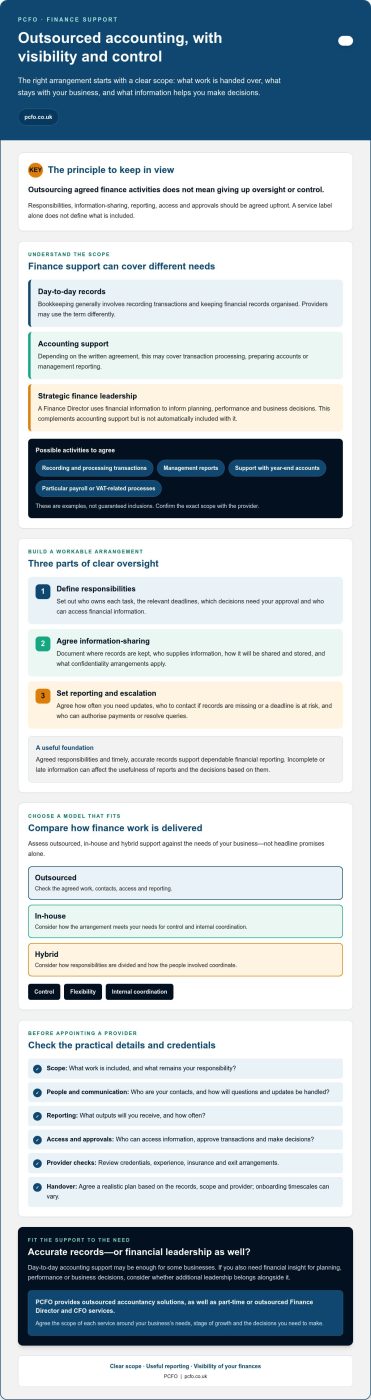
Outsourced accounting is an arrangement in which an external provider carries out finance activities agreed with a business. The scope can range from transaction processing to broader accounting support, but there’s no standard package for every provider or client. As a starting point, Accounting outsourcing describes the transfer of accounting work to an external organisation. The practical responsibilities still need to be defined for each engagement.
Outsourced accounting means an external provider handles agreed finance activities, with responsibilities determined by the engagement’s scope. For businesses comparing outsourced accounting services uk, that distinction matters. A service label alone doesn’t tell you what work will be completed, what information you’ll receive or what remains your responsibility.
Which accounting responsibilities might a business outsource?
Depending on the provider and agreement, businesses may consider outsourcing activities such as:
- Recording and processing financial transactions.
- Preparing management reports or supporting year-end accounts.
- Handling particular payroll or VAT-related processes.
These are examples, not guaranteed inclusions. Confirm the exact scope with any prospective provider, including PCFO, before assuming specific tasks are covered. Agree who owns each responsibility, the relevant deadlines, which decisions need your approval and who can access financial information. Clear boundaries help prevent gaps and keep you involved in decisions that remain yours.
How is outsourced accounting different from bookkeeping or a Finance Director?
Bookkeeping generally means recording day-to-day transactions and keeping financial records organised, although providers may use the term differently. Accounting is broader, but its meaning varies too. It may include transaction processing, preparing accounts or management reporting, depending on the written agreement. Ask what outputs you’ll receive and how often, rather than relying on a service title.
Strategic finance leadership is a different, complementary need. A Finance Director uses financial information to inform planning, performance and business decisions, rather than simply processing transactions. Reliable accounting information can support that leadership, but the two services aren’t automatically bundled. PCFO offers outsourced accountancy solutions as well as part-time or outsourced Finance Director and CFO services. Agree the scope of each around your needs.
If your business needs more than accurate records and accounting support, explore the Finance Director services guide. It can help you assess whether strategic oversight should sit alongside day-to-day finance activities.
How outsourced accounting works: scope, information and financial reporting
A well-managed outsourced accounting arrangement starts with clear expectations, not simply sending records to an external provider. Agree the work to be handled, how information will be shared and what reporting will help you oversee the business. This gives both sides a practical framework and helps protect your visibility of the finances.
Agreed responsibilities and timely, accurate records are the foundation of dependable financial reporting. Incomplete or late source information can affect the usefulness of reports and the decisions based on them. Treat the handover as an ongoing working process, with clear channels for questions and updates.
What should happen during onboarding and handover?
Before work transfers, document how finance activities currently run. Note key deadlines, where records are kept, who supplies information and who makes decisions or approves transactions. Include recurring processes and known bottlenecks so the provider can understand the context behind the figures.
Then agree responsibilities and escalation routes in writing. Identify who should be contacted if records are missing or a deadline may be at risk, and who can authorise a payment or resolve a query. Confirm how information will be accessed, shared and stored, and what confidentiality arrangements apply. Ask the provider to explain how it protects sensitive financial data, including its access controls. Onboarding timescales depend on the records, scope and provider, so agree a realistic handover plan rather than assuming a standard timetable.
What reporting rhythm and visibility should you agree?
Decide how often you need updates, who should receive them and who is responsible for reviewing and acting on the information. The right rhythm depends on your business and the agreed service. Clarify what happens if a report raises a question, and how you can request clarification while keeping ownership clear.
If management accounts or cash flow information are included in scope, agree a format and timing that will make them useful. For example, a business reviewing spending decisions may need current figures and a regular discussion of what has changed. Reports are most valuable when the underlying records are up to date and someone is responsible for interpreting them.
As your business develops, review whether the agreed scope and reporting still match the decisions you face. If you’re considering accounting support alongside wider financial leadership, you can discuss the right fit with PCFO’s outsourced accountancy and finance leadership team.
Outsourced accounting vs in-house support: how to compare your options
The right finance model depends on the work your business needs, how closely it must connect with daily operations and where decisions should sit. Use the comparison below to identify trade-offs, rather than assuming one arrangement will always be more effective.
| Model | Control and visibility | Flexibility | Internal coordination |
|---|---|---|---|
| Outsourced | Agree access and approvals. Oversight depends on reporting and communication arrangements. | Scope can be agreed around current requirements, with changes discussed as needs evolve. | Staff still need to provide records and respond to queries, even when processing is external. |
| In-house | Colleagues are within the business, which can support direct day-to-day oversight. | Capacity depends on the roles and skills available internally. | Finance staff can work closely with other teams and operational processes. |
| Hybrid | Internal and external responsibilities need clear boundaries to maintain oversight. | Can combine internal capacity with agreed external support. | Requires coordination between employees and the provider, with ownership made explicit. |
Accounting execution and strategic financial leadership are connected, but they aren’t interchangeable. An external provider may carry out agreed accounting activities, while a Finance Director or CFO can provide leadership to inform planning and business decisions. Don’t assume one engagement includes both. If strategic oversight is part of your requirement, define it separately and clarify how it will work with accounting support.
When might outsourced accounting suit a growing business?
Outsourcing may be worth exploring if workloads fluctuate, internal capacity is stretched or existing reports don’t give decision-makers the clarity they need. Start by identifying the practical bottleneck: is work accumulating, information arriving too late, or management struggling to interpret the numbers? Match the model to that priority, then confirm what the provider will handle and what remains in-house. There’s no universal company size or turnover threshold that makes outsourcing the right choice.
When might an in-house or hybrid finance team be more suitable?
An in-house presence may suit operations where finance work needs frequent, close coordination with other teams. A hybrid model may be useful if employees hold important operational context while external support covers agreed areas requiring additional capacity or expertise. In either case, document who can approve decisions, who supplies information and who is accountable for each responsibility. This avoids uncertainty where internal and external work meet.
For businesses considering external strategic leadership alongside accounting support, PCFO provides fractional Finance Director and CFO services. Compare outsourced accounting services uk options against your specific needs, rather than headline promises alone. If strategic support is relevant, ask how it would be scoped alongside accounting work.
How to assess a UK outsourced accounting provider before appointing one
Choosing a provider is about more than finding someone to complete finance work. You need a clear agreement on responsibilities, access to information and how you’ll stay informed. Ask each prospective provider the same questions so you can compare their answers against your business’s needs.
Before appointing a provider of outsourced accounting services uk, confirm its professional credentials, relevant experience and insurance directly. Ask about experience with businesses of a similar type or complexity, and request clarification if a claim or service description is unclear.
Questions to ask about scope, accountability and continuity
Request a written scope that specifies what’s included and excluded. For each activity, clarify who prepares the information, who reviews it and which decisions or submissions require your approval. Check how changes to the agreed scope are proposed and confirmed.
- Contacts: Who will manage the relationship, and who should you contact with a routine query?
- Reporting and deadlines: What information will you receive, how often, and when must your business provide records?
- Access and approvals: Who can view or handle financial information, and which actions need your authorisation?
- Continuity: What cover arrangements apply if your usual contact is unavailable, and how are urgent issues escalated?
- Exit arrangements: How will records and access be handled if the engagement ends, and what steps are needed for a handover?
Ask how confidential information is protected and what access controls are used. The provider should be able to explain its approach clearly, without relying on vague assurances.
How to check UK compliance responsibilities without assumptions
Outsourcing work doesn’t automatically transfer every legal responsibility from the business. Map each relevant record or return to the person who prepares it, the person who reviews it, the person who approves it and, where applicable, the person who submits it. Ask the provider to explain its role, then verify the requirements that apply to your company using current HMRC and Companies House guidance.
Making Tax Digital requirements can depend on the type of tax and the business or individual’s circumstances. Ask whether any requirements are relevant to your records and accounting period, then check current HMRC guidance rather than assuming one rule applies to all businesses.
A careful appointment should leave you with written responsibilities, clear access and approval arrangements, and an agreed route for questions or changes. If you’re assessing whether PCFO’s outsourced accountancy solutions fit your needs, review your accounting support requirements with PCFO and clarify the scope before proceeding.
Outsourced accounting services uk: when PCFO may be a fit
The right support depends on the gap you need to address. Start by separating day-to-day accounting requirements from the need for forward-looking financial oversight. Then compare the proposed scope with your priorities, the information you need to make decisions and the responsibilities you want to retain internally. A service label alone won’t tell you whether the arrangement is suitable.
PCFO provides outsourced accountancy solutions, alongside fractional Finance Director and CFO services and business planning support. These are distinct areas of support, not an automatic bundle. If you’re comparing outsourced accounting services uk providers, ask which services are relevant to your circumstances and how each would be agreed.
Signs your business may need accounting support and financial leadership
Recurring reporting gaps, uncertainty about who owns finance tasks or difficulty using financial information in decisions can signal that your current arrangements need review. Consider whether the issue is operational, such as keeping accounting work organised, or strategic, such as planning ahead and assessing the financial implications of a business decision. You may need one type of support or both. Read more about outsourced accountancy solutions for scaling businesses.
What to clarify before starting a conversation with PCFO
A little preparation can make the discussion more focused. Outline your current finance processes, where you’re experiencing pressure and what decisions you want better financial information to support. Share your business goals and explain what you’d like to retain internally. This gives both sides a clearer starting point without presuming a particular service or package is right for you.
Useful questions include:
- Which of your services best match the support we’re looking for?
- What would be included in the agreed scope, and what would remain our responsibility?
- If we need accounting support and strategic oversight, how would those responsibilities be defined?
PCFO can discuss outsourced accountancy, Finance Director or CFO support, and business planning in relation to your needs. Confirm the scope and responsibilities before deciding whether the arrangement fits.
Build finance support around your next stage of growth
Choosing outsourced accounting services uk is about finding the right fit for your business, not transferring work for its own sake. A clear written scope, agreed responsibilities and useful reporting help you retain visibility and assess whether the arrangement supports the decisions ahead.
Consider whether your priority is outsourced accountancy, strategic financial leadership or a combination of both. PCFO offers outsourced accountancy solutions alongside fractional Finance Director and CFO services, but these are distinct services and aren’t automatically bundled. Confirm what’s relevant to your needs and what each engagement would cover.
With a clearer view of your current processes and growth priorities, you can have a more focused conversation about support that may suit your business.
Frequently Asked Questions
What do outsourced accounting services usually include?
Outsourced accounting services cover finance activities a business agrees to delegate to an external provider. Depending on the arrangement, examples might include transaction processing, preparing accounts or management reporting. These aren’t standard inclusions, so ask for a written scope that states what’s covered, what’s excluded and what information you’ll receive. Also clarify which tasks remain with your business, who approves decisions and how responsibilities will be reviewed if your needs change.
Is outsourced accounting suitable for a small UK business?
It can suit a small UK business if external support addresses a specific need, such as limited internal capacity or reporting that isn’t meeting the owner’s requirements. There’s no single size or turnover level that determines whether it’s appropriate. First identify which finance tasks are taking time or causing uncertainty, then compare the proposed scope with your budget, oversight needs and plans. The arrangement should be proportionate to the work and responsibilities involved.
What is the difference between outsourced accounting and bookkeeping?
Bookkeeping usually focuses on recording transactions and maintaining financial records. Outsourced accounting can cover a broader range of agreed activities, potentially including account preparation or management reporting, but providers use these terms differently. Check the written scope rather than relying on the service name. Strategic finance leadership is another distinct area: a Finance Director or CFO may use financial information to guide planning and decisions, rather than simply handling accounting records.
Can outsourced accounting provide financial advice for business decisions?
It can support decisions if the agreed service includes relevant reporting or advisory input, but outsourced accounting doesn’t automatically include strategic financial advice. Accurate, timely records provide a stronger basis for reviewing performance or considering a decision. For forward-looking guidance, clarify whether financial leadership, such as Finance Director or CFO support, is also needed. Ask the provider what decision support is included, who will deliver it and how it relates to the accounting work.
How do I choose an outsourced accounting provider in the UK?
Compare providers by asking for a written scope, clear reporting arrangements, named contacts and defined approval responsibilities. Check how records are accessed and protected, how issues are escalated and what happens if the relationship ends. Confirm each provider’s relevant experience, professional credentials and insurance directly. Also establish who prepares, reviews and submits any relevant records or returns, then verify current HMRC and Companies House requirements for your business’s circumstances.
Will outsourcing accounting transfer my business’s legal responsibilities?
Outsourcing accounting work doesn’t automatically transfer every legal responsibility from your business. The provider may agree to prepare or handle particular records or submissions, but responsibilities depend on the work and your circumstances. Before starting, document who prepares, checks, approves and submits each relevant item. Ask the provider to explain its role, and verify applicable requirements using current HMRC and Companies House guidance or appropriate professional advice.
Can PCFO combine outsourced accounting with CFO or Finance Director support?
PCFO offers outsourced accountancy solutions and fractional Finance Director and CFO services. These are distinct services, so don’t assume they’re automatically combined in one engagement. Discuss what your business needs, whether that’s accounting support, strategic financial leadership or both, and ask which services are appropriate. Confirm the responsibilities and scope for each service before proceeding. This helps ensure the arrangement reflects your priorities without assuming a particular package or outcome.