

Currency volatility has eroded profit margins for 44% of UK SMEs, according to Bibby Financial Services’ Trading Places 2026 report. For a business with overseas customers or suppliers, the challenge isn’t simply predicting where sterling will move next. It’s understanding what a change could mean for future receipts, payments and cash flow. That’s the practical focus of managing currency risk for uk smes.
If you’re unsure how much exposure sits across contracts, forecasts and day-to-day decisions, you’re not alone. Reacting to every exchange-rate movement can add complexity, while doing nothing may leave margins more exposed than expected. A measured approach starts with visibility, not predictions.
This guide explains where currency exposure arises and how it can affect business finances. You’ll learn how to record and forecast exposures, set a proportionate review process, and connect currency decisions to commercial plans. With clear reporting and defined ownership, finance leaders can help the business make informed choices about cash flow and margins without letting exchange-rate movements dictate strategy.
Key Takeaways
- Identify currency exposure across contracts, expected receipts and payments, and overseas business links.
- Assess how exchange-rate changes could affect sterling cash flow, costs and margins, especially when pricing and expenses adjust at different times.
- Compare commercial decisions, natural offsets and financial hedging by their purpose, flexibility and commitments. They are distinct approaches, not interchangeable fixes.
- Build a proportionate process to record exposures, forecast cash flows, assign decision ownership and review changes regularly.
- Managing currency risk for uk smes is part of wider financial leadership: connect currency assumptions with forecasts, KPIs and business plans.
Where UK SME currency risk begins: transactions, contracts and overseas links
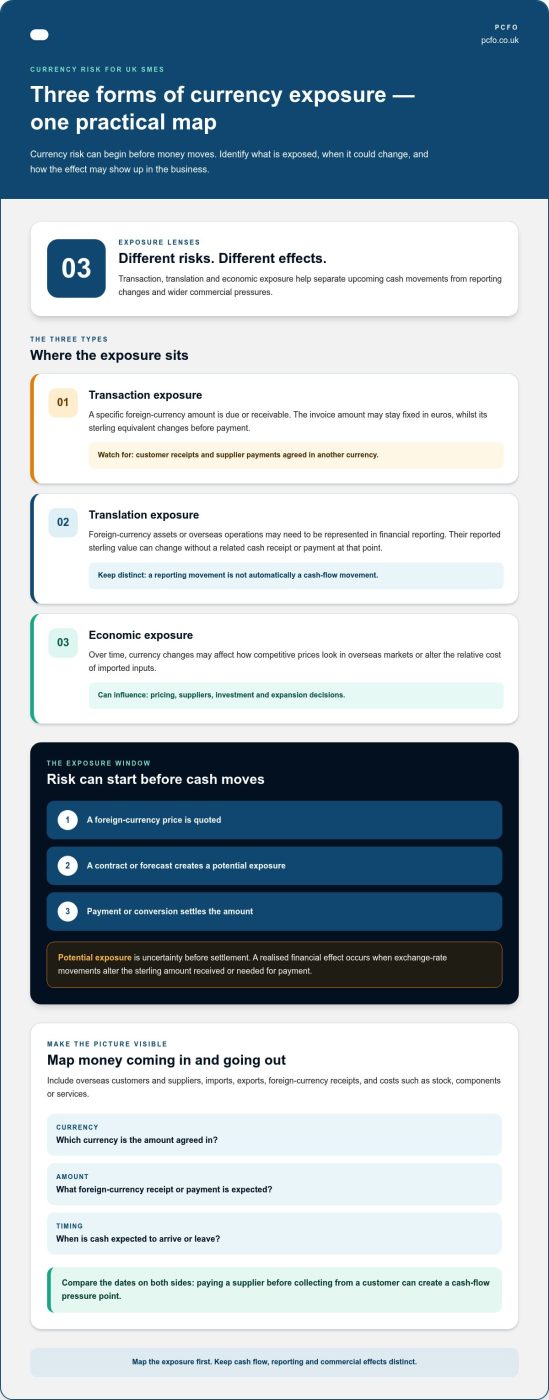
Currency risk is a business’s exposure to exchange-rate changes that may alter the sterling value of foreign-currency income, costs or assets. It can begin well before money moves: a quoted price, signed contract or forecast cash flow in another currency creates a potential exposure. Foreign exchange risk, also known as currency risk, is a financial risk arising from fluctuations in exchange rates.
Overseas trade needn’t be a core activity for this to matter to a UK SME. A business might invoice one international customer, buy specialist materials from an overseas supplier or pay for a service in a foreign currency. These links can sit across different teams and records, so the full picture may be less obvious than a single foreign-currency bank balance suggests. Managing currency risk for uk smes starts with identifying those connections.
What counts as currency exposure for a UK SME?
Map money coming in as well as money going out. Consider exports priced in a foreign currency, imports, overseas suppliers, foreign-currency receipts, and costs such as stock, components or services. Include confirmed contracts and expected cash flows, recording the currency and anticipated timing for each. This makes it easier to distinguish exposures that are certain from those that depend on a sale, delivery or other business event.
Timing is central. If you agree a price in euros today but receive payment later, the sterling value of that receipt can change before settlement. The same applies when a supplier’s invoice is agreed in euros but paid at a later date. Until conversion or settlement, the exposure is potential: it describes uncertainty, not a loss that has already occurred. A realised financial effect arises when exchange-rate movements alter the sterling amount received or needed for payment.
Transaction, translation and economic exposure in plain English
Transaction exposure relates to a specific amount due or receivable in another currency. For example, a UK business agrees a euro-denominated invoice with a customer. The invoice amount stays in euros, but its sterling equivalent may differ by the time payment arrives. A supplier invoice in euros creates corresponding uncertainty about the sterling funds needed for payment.
Translation exposure is a reporting consideration. It can arise when a business has foreign-currency assets or overseas operations that need to be represented in its financial reporting. The reported sterling value may change as exchange rates move, even if there hasn’t been a related cash receipt or payment at that point. The treatment depends on the circumstances, so don’t assume every movement has the same accounting or cash-flow effect.
Economic exposure is broader and longer term. Currency changes can affect how competitive a UK business’s prices appear in overseas markets or change the relative cost of imported inputs. Over time, that may influence decisions about pricing, suppliers, investment or expansion. Mapping all three types helps leaders distinguish an upcoming payment from reporting movements and wider commercial pressures.
How exchange-rate movements can affect SME cash flow, margins and decisions
An exchange-rate movement can change the sterling value of a foreign-currency receipt or the amount of sterling needed to meet a payment. The effect may be felt in cash flow before it becomes clear in reported profit. If a customer pays later than expected, the business may receive a different sterling amount from the one assumed when the sale was agreed. A supplier payment can likewise require more or less sterling at settlement.
For an SME, exposure depends not only on the currency involved, but also on when the price is agreed, when cash moves and how long the business must wait between the two. Payment terms therefore shape the exposure window. A short gap may leave less time for rates to change; an extended payment period can make the final sterling receipt or payment harder to predict. The currency specified on an invoice or contract matters too: if the amount is fixed in euros, its sterling equivalent can move, whereas a sterling-denominated price places the currency uncertainty elsewhere in the commercial relationship.
Why timing and invoice currency matter
Consider a UK business that agrees a sale priced in euros, with payment due after delivery. The agreed euro price may stay the same, but its value in pounds can differ when payment arrives. If the business pays a supplier in euros before collecting from its customer, it may also need to fund that outflow from sterling cash in the meantime. Mapping the dates and currencies on both sides helps reveal pressure points that a sales forecast alone could miss.
Keep the exchange-rate effect distinct from other business changes. A lower sterling receipt might reflect currency movement, reduced sales volume, a changed selling price or a late customer payment. Higher costs might result from supplier pricing or freight changes rather than FX. Separating these factors gives leaders a clearer view of what changed and which decisions could address it.
Connect FX movements to forecasts and management accounts
Make the assumptions visible in the cash-flow forecast. For each expected foreign-currency receipt or payment, record the currency, expected amount, timing and sterling assumption used. The forecast can then show the planned position alongside alternative scenarios, such as a less favourable or more favourable sterling conversion. These are planning tests, not predictions. They help the business assess whether a potential change could affect working capital, planned spending or its ability to meet commitments.
Review actual results against those assumptions through monthly management accounts. Note whether differences came from exchange rates, timing, volumes or underlying costs, and update future forecasts when contract dates or expected cash flows change. This makes currency uncertainty a visible planning issue rather than a surprise discovered after settlement. PCFO’s cash-flow management and financial planning can help connect that analysis to the business’s wider commercial priorities.
Comparing currency risk responses: commercial choices, natural offsets and hedging
There isn’t one response that suits every exposure. A business can adjust how it trades, use existing foreign-currency cash flows to offset one another, or consider financial hedging. These approaches serve different purposes and carry different levels of commitment and flexibility. Managing currency risk for uk smes means matching the response to the exposure, commercial objectives and the business’s tolerance for uncertainty, rather than trying to predict exchange rates.
Compare options by asking practical questions: how much exposure is involved, when is cash expected to move, how certain is the forecast, and what could the decision mean for customer relationships, supplier terms or margins? Operational changes may affect the underlying trade. A natural offset uses business activity already in place. Financial hedging involves a separate financial arrangement. None removes every form of currency or commercial risk.
Operational choices and natural offsets
Commercial choices can include the currency used to price a sale, how prices are reviewed and the payment terms agreed with customers or suppliers. For instance, a business might explore whether a customer can be invoiced in sterling instead of euros. That could shift the exchange-rate uncertainty, but the customer’s willingness to accept the currency and the effect on price competitiveness matter.
A natural offset occurs when foreign-currency receipts and payments align. If a business receives euros from customers and also pays a supplier in euros, using some receipts to meet those costs may reduce the amount exposed to conversion. The match may be incomplete: amounts, timing and certainty can differ, and the funds may be needed elsewhere. Assess any change against supplier relationships, customer expectations, working capital and the margin on the underlying sale. Operational choices can reshape exposure, but shouldn’t be treated as cost-free or automatically suitable.
What forward contracts and options do, and what they do not do
A forward contract is an agreement to exchange a specified amount of currency at an agreed rate on a future date or within an agreed period. It can provide greater certainty about the sterling value of a known future payment or receipt, but it also creates a commitment. If the underlying transaction changes, is delayed or doesn’t happen as expected, that commitment may no longer align with the business’s needs.
A currency option gives the holder the right, but not the obligation, to exchange currency at an agreed rate under specified terms. This flexibility differs from a forward’s commitment, and options can involve a premium or other costs. Terms and risks vary. Neither instrument guarantees a better financial outcome, and neither addresses every exposure, such as longer-term competitiveness or uncertain sales volumes.
Keep the categories separate when weighing a response. Operational decisions change how the business trades; natural offsets draw on existing flows; financial hedging creates an arrangement linked to currency movements. Compare options based on the amount and timing of exposure, the certainty of the underlying cash flow, the commitment involved, available flexibility and the effect on wider plans. A measured decision begins with clear financial oversight, not a product choice made in isolation.
Build a proportionate FX risk management process for your SME
A practical FX process gives your business a consistent way to identify exposure, assess its possible effect and decide who needs to act. It doesn’t require complex systems or an attempt to predict exchange rates. Start with an exposure register that brings information from contracts, sales, purchasing and finance into one working view.
Map exposure and agree decision ownership
For each expected foreign-currency receipt or payment, record the currency, contract or business purpose, expected amount, settlement timing and confidence in the forecast. Note whether the transaction is agreed, expected or still conditional. Include the team responsible for the underlying activity, so finance can follow up when dates, values or terms change.
The register is most useful when ownership is clear. Agree who maintains the information, who reviews the overall exposure and who approves material commercial decisions. Sales may know when a customer contract is likely to change; purchasing may hold the latest supplier terms; finance can bring those details together and assess the implications for cash flow. A decision can then be escalated to the appropriate business leader when it affects pricing, commitments or planned spending.
Choose a review cadence that fits the scale and pace of your overseas activity. A business with frequent foreign-currency transactions may need to refresh its view more often than one with occasional, predictable payments. Review it when a significant contract is agreed or amended, a customer payment is delayed, or a forecast changes. The process should be reliable, not burdensome.
Use forecasts, scenarios and review triggers
Bring register information into the cash-flow forecast, keeping the foreign-currency amount and the sterling assumption visible. Then test alternative exchange-rate assumptions to see how the projected cash position might respond. For example, consider whether a less favourable conversion would affect the timing of planned purchases or leave less headroom for other commitments. These scenarios test resilience; they don’t predict market movements.
Set review triggers that make sense for your business. An illustrative trigger might be a material change to an expected payment date, contract value or forecast sterling receipt. Another could be a scenario showing pressure on planned cash commitments. These are examples, not universal thresholds. Define internally what counts as material, who assesses the change and how the decision is recorded.
Use monthly management accounts to compare actual receipts and payments with the assumptions in the forecast. Explain material differences by separating currency effects from changes in timing, sales activity or costs. Then update the register and forecast so the next review uses current information. This creates a repeatable loop between exposure mapping, cash-flow management and commercial decisions.
PCFO’s finance leadership can help bring exposure reporting, forecasts and wider financial plans together for a growing business.
Make currency risk part of financial leadership and business planning
Currency exposure is easier to manage when it sits within the business’s wider financial decision-making, rather than being treated as a separate treasury issue. Finance leadership can connect expected foreign-currency flows with cash requirements, growth plans and the commercial choices that shape them. That joined-up view helps leaders understand not just what may change, but whether the business can accommodate it.
Bring currency assumptions into wider financial planning
Include currency assumptions in forecasts alongside sales, costs and expected payment dates. Then assess how they relate to working capital, planned investment and funding needs. For example, if an overseas expansion depends on buying stock before customer receipts arrive, the timing and sterling value of those flows can affect the cash available for other commitments. Reviewing the assumptions together makes trade-offs clearer before decisions are made.
Monthly management accounts provide a regular basis for comparing actual results with the plan. Finance leaders can highlight where currency movements, changes in timing or other commercial factors have affected performance. KPIs should reflect the business’s priorities, such as cash conversion, gross margin or forecast accuracy, rather than focusing on exchange rates in isolation. Board-level reporting can then show the exposure, its relevance to current plans and any decisions requiring oversight.
A Finance Director can help bring this information into commercial discussions and establish clear ownership of assumptions. For a broader view of that role, explore the strategic role of a Finance Director. This wider perspective is central to managing currency risk for uk smes: currency decisions should support the business plan, not replace it.
When outsourced finance leadership can help
Growing businesses may need senior financial oversight before they need a permanent executive in post. Flexible outsourced Finance Director or CFO support can help leaders improve visibility across cash flow, forecasts, performance and commercial decisions. PCFO provides this support on a flexible, part-time basis, with an initial discovery phase to understand the business’s priorities and where financial oversight can add value.
That support can also help connect forecasting methods with the decisions they need to inform. When considering analysis and systems, start with your reporting needs, the information available and your planning process. Tools are most useful when leaders understand the assumptions behind their outputs and use them consistently.
With clear assumptions, relevant KPIs and regular reporting, currency exposure becomes part of a broader financial picture. If you’d like to discuss how senior finance support could strengthen that picture for your business, book a free strategy session.
Make currency oversight part of your next business decision
As your business grows internationally, currency assumptions can influence more than individual invoices. They may shape how confidently you plan investment, manage working capital and pursue new opportunities. Treating this exposure as part of financial leadership helps keep decisions grounded in the business’s objectives, rather than short-term exchange-rate movements. That is the practical value of managing currency risk for uk smes.
Senior finance support can help turn that principle into consistent oversight. Flexible outsourced Finance Director and CFO support gives growing businesses access to senior financial leadership, with monthly management accounts and board-level reporting to inform decisions. It can also connect currency considerations with cash-flow management, business planning and KPI setting, without requiring a permanent executive appointment.
If you’re ready to bring greater clarity to your financial planning, book a free strategy session. PCFO can help connect currency exposure with your cash flow, business plan and commercial decisions.
Frequently Asked Questions
Can currency risk affect a UK SME that sells only in pounds?
Yes. Sterling sales don’t automatically remove currency exposure if the business has overseas-linked costs, suppliers, competitors or operations. A direct contractual exposure might be a payment due in euros, while an indirect commercial effect could arise if imported materials become more expensive or competitors’ prices shift. For example, a UK business may invoice customers in pounds but rely on components priced abroad. Map the wider operating picture, not just sales invoices.
Is currency risk the same as exchange-rate volatility?
No. Exchange-rate volatility describes rates moving over time; currency risk is the possibility that those movements affect a business’s finances or commercial position. The same market movement can have different effects across SMEs. A company with foreign-currency costs but sterling income may face a different impact from one receiving overseas payments. The outcome depends on the currencies involved, contract terms, timing and how the business operates.
What happens if a customer pays an invoice in a different currency?
The sterling value received depends on the exchange rate and payment arrangements in place when conversion happens. If a customer settles a euro invoice, for instance, the business should be able to trace the original invoice currency and the date the payment arrived. Record the expected payment date and how conversion is handled in your finance processes. This creates a clearer record without assuming a particular accounting treatment.
Can a small business manage currency risk without predicting exchange rates?
Yes. A business can identify where foreign currencies enter its operations, make assumptions visible in forecasts, review relevant commercial terms and agree who owns decisions. These steps help leaders judge potential effects on cash commitments without relying on market timing as a dependable strategy. A practical starting point for managing currency risk for uk smes is improving visibility, not trying to call the next exchange-rate move. No process guarantees a particular rate or removes all uncertainty.
Does a forward contract eliminate currency risk?
No. A forward contract can set an exchange rate for a future transaction, but it doesn’t eliminate every business risk. The underlying sale or purchase could change, be delayed or not proceed as expected, leaving the arrangement misaligned with the business’s needs. Suitability depends on the exposure and the contract terms. Understand the specific contractual obligations before making a decision.
How should a UK SME start reviewing its foreign-currency exposure?
Start with a simple inventory of foreign-currency receipts, payments, contract currencies and expected dates. Include recurring commitments as well as individual customer or supplier transactions, so regular costs aren’t overlooked. Note which team holds each piece of information, then connect expected cash movements to your cash-flow forecast. This first snapshot gives finance leaders a useful basis for deciding what needs closer attention, without requiring a complete risk-management framework on day one.