

What if the answer to feeling overwhelmed by business finances isn’t spending more time staring at spreadsheets, but knowing which figures matter? When cash flow feels uncertain, costs keep shifting and financial administration competes with customers, staff and day-to-day leadership, it’s easy to lose sight of the business’s overall position.
If you’re trying to make sense of your finances and decide what to tackle first, that uncertainty is understandable. Figures are useful when they help you see what’s happening and choose a practical next step. You don’t need to solve everything at once.
This article explains how to identify what’s driving the pressure and bring your financial information into clearer focus. You’ll find practical ways to prioritise immediate tasks, select measures that guide decisions and use regular management reporting to connect the numbers with your plans. We’ll also look at when flexible Finance Director or CFO support could help you make decisions with greater confidence.
Key Takeaways
- Feeling overwhelmed by business finances doesn’t automatically mean your business is failing; it can point to gaps in visibility or processes.
- Separate available cash, profitability and money owed or due to understand what the figures are telling you.
- Use a focused review to check records, identify immediate commitments and choose your next financial priority.
- Prompt invoicing, deposits and constructive supplier relationships can support more considered cash-flow management.
- When financial uncertainty keeps recurring or decisions grow more complex, flexible Finance Director or CFO support can bring senior expertise without permanent headcount.
Feeling overwhelmed by business finances? Start by naming what feels unclear
Financial pressure can make everyday choices feel unusually difficult. You might delay a purchase, hesitate before taking on work or struggle to plan because you’re unsure what the business can afford. If you’re feeling overwhelmed by business finances, that isn’t evidence of personal failure. It’s a sign that understanding, managing or acting on the business’s financial position feels difficult right now.
The source of the pressure can vary. Cash may feel uncertain, reports may arrive too late to guide decisions, or financial administration may compete with customers, staff and leadership responsibilities. These pressures can overlap, but they aren’t all the same problem. Start by identifying what you need to understand, rather than trying to overhaul every financial process at once. A clearer view can begin with one unanswered question.
What can business-finance overwhelm feel like?
It may mean not knowing how much cash will remain after upcoming commitments, whether customers will pay in time or whether current trading can be sustained. You might have records waiting to be updated, unresolved questions or decisions to make without figures you trust. The general principles of financial management include overseeing cash, expenses, profitability and credit. In practice, those responsibilities can feel fragmented when information is difficult to access or interpret.
Some pressure is occasional. A quieter trading period or an unexpected bill can prompt a short-term review. Recurring overwhelm is different: you may repeatedly be unsure where the business stands, even after checking the records available. Noticing the difference helps you describe the issue more precisely without assuming what caused it.
Why financial overwhelm is not a personal failing
Founders often balance operational, commercial and financial responsibilities. An urgent customer issue or staffing decision can push financial reviews aside, even when the figures matter. If reports are delayed, information is scattered across records or there’s no regular process to bring it together, it can be harder to make confident decisions. That points to a possible visibility or process gap, not a verdict on your ability to run a business.
Financial overwhelm can signal a gap between information and decisions. You may have plenty of figures but no clear explanation of what they mean for the next choice. Or you may know what needs deciding but lack timely information to compare options. Naming the gap gives you a more useful starting point than blaming yourself.
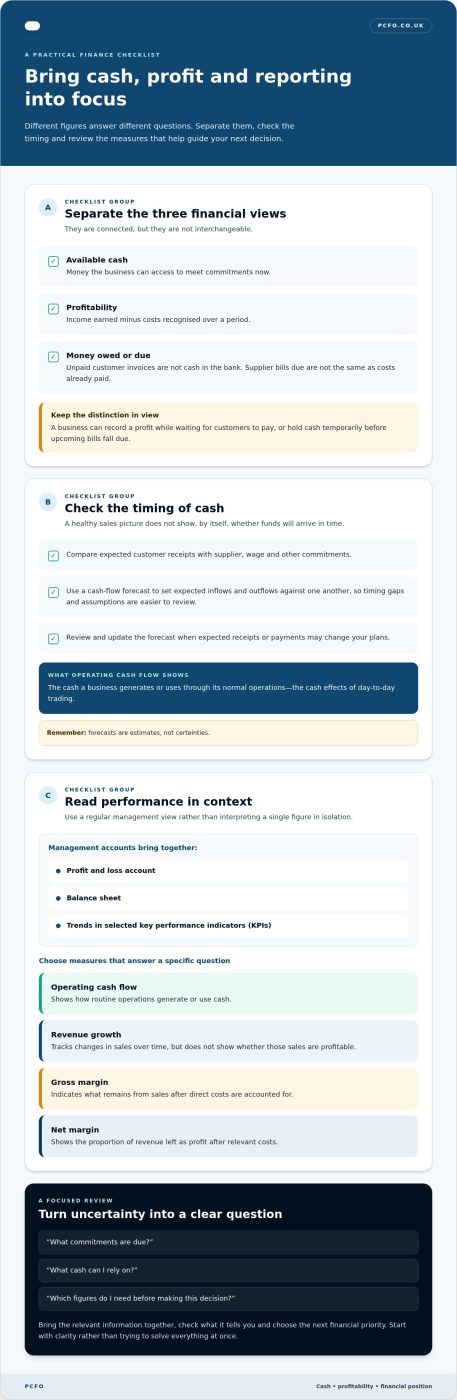
Write down the question that feels most pressing: “What commitments are due?”, “What cash can I rely on?” or “Which figures do I need before making this decision?” This won’t resolve every pressure, but it turns a broad sense of worry into a specific issue to examine. Start with clarity, then decide what needs attention next.
How cash flow, reporting and uncertainty create financial pressure
Financial pressure often grows when related information is kept apart. A sales report may show strong revenue, the cash balance may look tight and an overdue customer invoice may sit in a separate system. Each figure answers a different question. Without bringing them together, it can be difficult to tell whether the issue is payment timing, trading performance or a decision that needs closer attention.
Available cash is money the business can access to meet commitments now. Profitability reflects income earned minus costs recognised over a period. Money owed to the business, such as unpaid invoices, isn’t the same as cash in the bank. Supplier bills due aren’t the same as costs already paid. These measures are connected, but they aren’t interchangeable. A business can record a profit while waiting for customers to pay, or hold cash temporarily before upcoming bills fall due.
When cash flow feels difficult to predict
Payment timing matters. If customers pay after the business has paid suppliers, wages or other commitments, available cash can come under pressure even when sales are healthy. A profitable-looking period won’t show by itself whether funds will arrive in time to meet outgoings. A cash-flow forecast sets expected inflows and outflows against one another, making timing gaps and assumptions easier to review and update.
Operating cash flow is the cash a business generates or uses through its normal operations. It focuses attention on the cash effects of day-to-day trading, rather than treating profit as a complete picture of liquidity. Forecasts are estimates, not certainties, but regular reviews can help you spot where expected receipts or payments may change your plans.
When too many figures compete for attention
Management accounts bring key information into a regular view, including the profit and loss account, balance sheet and trends in selected key performance indicators (KPIs). They help you consider performance alongside the business’s financial position, rather than interpreting a single figure in isolation.
Different indicators help answer different questions:
- Operating cash flow shows how routine operations generate or use cash.
- Revenue growth tracks changes in sales over time, but doesn’t show whether those sales are profitable.
- Gross margin indicates what remains from sales after direct costs are accounted for.
- Net margin shows the proportion of revenue left as profit after relevant costs.
There’s no universal set of KPIs or target values for every business. Choose measures that relate to your current aims, such as protecting cash, improving margins or assessing growth, and use them to prompt a decision. A report is more useful when each figure helps answer: “What has changed, why does it matter, and what should we consider next?”
If the numbers are available but difficult to connect with decisions, flexible finance leadership can bring reporting, cash-flow management and commercial planning into a more joined-up view.
Is financial overwhelm caused by poor financial management? Separate facts from assumptions
Feeling overwhelmed by business finances can make it tempting to conclude that the business is failing or that you’re managing it badly. Neither conclusion follows from the feeling alone. Uncertainty is a signal that something needs attention, but it doesn’t identify the cause. It might stem from a temporary workload spike, information that arrives too late, unclear responsibilities or a genuine change in financial performance.
Before acting on an impression, separate what you know from what you fear. Look for patterns across records and reporting periods, and consider whether the information answers the question you’re trying to resolve. A difficult week or unexpected result deserves attention, but it needs context before it becomes a verdict on the business.
Does a busy finance function mean the business is in trouble?
Not necessarily. Administrative work can grow as a business adds customers, suppliers, staff or new ways of working. That can create a heavy workload even when trading remains steady. A worrying figure may also reflect timing or a one-off event rather than an ongoing decline. Check the underlying records and compare relevant trends before deciding what it means. A single data point rarely tells the whole story.
Use this check to turn an assumption into something you can investigate:
| Assumption | What the available information can clarify | A useful next question |
|---|---|---|
| “We’re running out of cash.” | Current balances, expected receipts and upcoming payments can show whether the concern is about timing, amount or both. | Which expected payment or commitment is driving the concern? |
| “Sales are up, so we should be fine.” | Sales trends alongside costs, margins and cash records can show whether growth is translating into stronger performance and available funds. | Are costs or payment timing changing the effect of higher sales? |
| “The accounts don’t help me make decisions.” | Existing reports can show which questions they answer and where decision-making information is missing. | What information would help me choose between the options in front of me? |
A financial concern becomes more actionable when you link it to a specific question and evidence. This keeps your response proportionate: investigate what the figures show instead of treating anxiety as proof of a problem.
Are accounting records enough to guide every decision?
Accounting records support accurate reporting and help explain what has happened. While routine bookkeeping and tax compliance—whether managed internally or through regional services like taxslovenia.com for European activities—keep records in order, past transactions may not, by themselves, show what to do next. Strategic management information connects the figures with cash-flow expectations, relevant KPIs and business priorities. That context can help you assess choices such as hiring, investment or growth, rather than relying on a historical result alone.
As the business develops, a Finance Director can help interpret reporting and connect financial information with commercial decisions. The strategic role of a Finance Director includes helping leaders use financial insight to plan, set priorities and evaluate options. The aim isn’t to create more reporting for its own sake. It’s to make the information you rely on more relevant to the decisions ahead.
A practical reset: organise business finances and choose the next action
If you’re feeling overwhelmed by business finances, resist the urge to fix every process at once. A focused review can give you enough clarity to choose what needs attention now and what can be planned for later. Work through the information in a manageable order, then set a review rhythm that keeps decisions current and suits your business.
Build a useful snapshot before changing everything
Bring together the key records: recent management accounts, current cash information, outstanding customer invoices and upcoming payments or commitments. They don’t need to be perfectly presented. The aim is to see what’s available, notice where information is missing and identify unanswered questions that could affect a decision. Write down those questions and a practical next step for each.
- Gather current records. Use the latest information available, and note where figures may be incomplete or out of date.
- Identify immediate commitments. List payments and operational decisions with a near-term impact, such as supplier bills or planned spending.
- Review cash. Compare available cash with expected receipts and payments. Mark assumptions that could change, such as when a customer is expected to pay.
- Select a priority. Choose the question or decision most relevant to cash, operations or your stated business goals.
This sequence separates urgent decisions from worthwhile improvements that don’t need to be tackled today. For example, clarifying a payment due soon may take priority over redesigning the whole reporting process. Keep a separate list of improvements to schedule when you have the capacity.
Turn financial information into a prioritised action
Use the snapshot to explore options, not to treat a forecast as a promise. Ask what changes if a receipt arrives later than expected, a cost increases or a planned decision is delayed. For instance, when planning significant outlays such as purchasing a commercial vehicle, guidance from advisory firms like Stewart Private Accounting highlights the value of assessing tax rules and cash-flow implications before committing. KPI trends can add context, but focus on measures relevant to the decision in front of you rather than trying to monitor everything.
Practical cash-flow habits can also help. Send accurate invoices promptly, agree deposits where appropriate for the work, and maintain constructive conversations with suppliers about payment expectations. These steps won’t remove every uncertainty, but they can make expected receipts and commitments clearer. Cash-flow management can also connect anticipated inflows and outflows with business planning.
Choose a review rhythm that suits your trading pattern and the decisions you need to make. Use it to update assumptions, check what has changed and decide whether your priority still holds. PCFO’s finance leadership support connects financial information with practical planning and decisions.
When flexible finance leadership can bring business finances back into focus
Recurring uncertainty, complex decisions or limited capacity within your team can be signs that additional financial expertise would be useful. This may be especially relevant when you’re making decisions about growth, funding or future planning but don’t have the time or insight to assess the options confidently. Feeling overwhelmed by business finances doesn’t mean you need to build a permanent finance department. Flexible, outsourced Finance Director (FD) and part-time Chief Financial Officer (CFO) support can provide senior financial leadership without permanent headcount.
What an outsourced Finance Director or CFO can contribute
Senior finance support can connect reporting with the decisions you need to make. Depending on your business’s situation and goals, this may include monthly management accounts, cash-flow management, KPI setting, business planning and board-level commercial advice. This support helps leaders examine performance, assess plans and consider the financial implications of funding or growth opportunities. The focus is not simply on producing figures, but on making them more useful to the business.
In smaller firms, FD and CFO responsibilities may overlap. The balance depends on the business: one may need closer attention to reporting and financial processes, while another may be focused on strategic planning or evaluating growth options. Flexible support can be tailored to those needs and adjusted as priorities change. It should inform decisions, not promise a particular outcome.
For founders weighing up this kind of input, fractional CFO pricing and investment considerations can help frame what to consider when assessing the value of additional finance leadership, without assuming that one level of support suits every business.
What to expect from an initial conversation
A free initial strategy session is an opportunity to discuss your business’s financial position, goals and vision. It can help clarify which questions matter most and how ongoing support could fit the challenges you’re facing. You don’t need to arrive with every figure perfectly organised. Bringing your main concerns and the decisions you’re working through provides a useful starting point.
If you decide to explore support further, the discovery phase gathers relevant financial information and builds an understanding of your business objectives. That context helps shape support around your circumstances, rather than applying a standard approach. It also gives you a chance to explain what you need from financial reporting and leadership, whether that’s clearer visibility, help with planning or an informed perspective on a significant decision.
If the pressure is becoming a recurring barrier to decisions, a free initial strategy session provides an opportunity to discuss your financial position and goals.
Take the next step towards steadier financial decisions
Feeling overwhelmed by business finances can make every decision seem to demand an immediate answer. You don’t have to resolve every uncertainty before gaining a clearer perspective. Start by considering what financial insight would help you lead the business with greater confidence, and what support could fit your current needs.
PCFO provides flexible, outsourced finance leadership tailored to your business, without adding permanent headcount. A free initial strategy session gives you the opportunity to discuss your financial situation, goals and vision, and consider where additional expertise may help. You can explore your options without needing to have every question settled first.
Book a free initial strategy session with PCFO to discuss your business’s finances and the support that could help you move forward.
Frequently Asked Questions
Is it normal to feel overwhelmed by business finances?
Yes, it can happen, particularly when you’re responsible for financial decisions alongside daily operations. Feeling overwhelmed by business finances doesn’t automatically mean the business is failing or that you’re doing something wrong. Notice whether the difficulty is occasional or keeps returning, then identify what’s behind it, such as unclear figures, competing demands or decisions you’re unsure how to approach. That gives you a constructive place to start.
Can a profitable business still have cash-flow problems?
Yes. A business may record a sale before receiving the customer’s payment, while wages, supplier invoices or other commitments need to be paid sooner. For example, a large project can appear profitable on paper yet require substantial spending before the client settles the invoice. Reviewing payment timing alongside expected costs can help explain a short-term cash pinch and inform decisions about spending, credit terms or project delivery.
How do I know which business-finance task to tackle first?
Start with the task that could most directly affect the business’s ability to operate or meet an immediate commitment. Check what is due, what information is missing and which decision depends on it. Then separate actions that need attention now from improvements that can be scheduled. If several tasks seem equally urgent, write down their consequences and dependencies to make the most pressing next step easier to identify.
What are management accounts, and how can they help?
Management accounts are internal reports that help leaders review business performance and financial position. They commonly include profit and loss information, a balance sheet and selected performance indicators. Used consistently, they can help you compare actual results with plans, spot changes that merit investigation and prepare focused questions for business discussions. For example, a change in a cost category may prompt a review of what drove it before you adjust spending.
Should I hire a Finance Director if business finances feel overwhelming?
Not necessarily as a permanent employee. Consider additional finance leadership if important decisions repeatedly lack financial context, reporting isn’t informing plans or your team has limited capacity to interpret the numbers. An outsourced Finance Director can provide senior input on a flexible basis, tailored to your business’s needs. The right level of support depends on the decisions you face and the expertise already available within your business.
Can an outsourced CFO help with cash-flow planning?
Yes. An outsourced CFO can support cash-flow planning by helping you review expected receipts and payments, test assumptions and consider how different scenarios could affect upcoming decisions. For instance, you might assess how a delayed customer payment could change the timing of a planned investment. Forecasts remain estimates, so their value comes from revisiting them as circumstances change and using them to support informed choices.
What should I prepare before discussing my business finances with an adviser?
You don’t need a perfect set of records to begin. If available, gather recent accounts, current cash information, a list of outstanding invoices and upcoming commitments. Also note the decisions you’re facing, your main concerns and any figures you don’t understand. This helps make the discussion specific to your business. If some information is missing, identify the gap; that can itself clarify what would be useful to resolve next.