

The SME Confidence Index fell to 51% in the first quarter of 2026, reflecting a cautious shift amongst UK founders who are questioning how to scale a business in a tighter economy. You’ve likely felt this tension yourself. While your turnover is increasing, the operational bottlenecks and cash flow volatility make it feel as though you’re losing grip on the company you built. It’s a common frustration to find that “more” doesn’t always mean “better” or “easier”.
Transitioning from a growing company to a truly scalable enterprise requires a shift from reactive management to strategic foresight. This guide provides the essential financial and operational roadmap you need to future-proof your organisation this year. We’ll explore how to build a robust engine for sustainable, profitable growth that prepares you for Series A or B funding while finally restoring your work-life balance through improved systems.
Key Takeaways
- Learn the fundamental difference between linear revenue growth and exponential scaling to ensure your business model is built for sustainable expansion.
- Identify the critical gaps in standard accountancy and why real-time management data is essential for navigating high-growth phases.
- Discover how to scale a business by evolving your leadership structure from a flat team to a functional, process-driven hierarchy.
- Evaluate your funding options and capital requirements to determine whether bootstrapping or external investment best supports your next strategic milestone.
- Understand the role of fractional finance leadership in providing the high-level foresight needed to overcome common operational bottlenecks.
Growth vs Scaling: Defining Your Strategic Intent
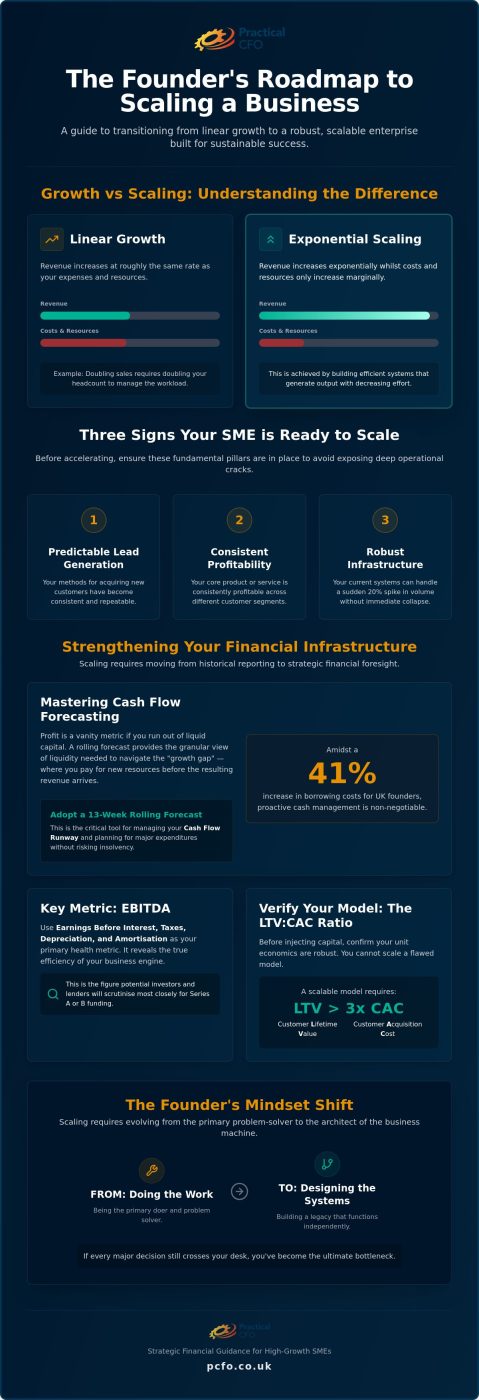
Many founders use the terms “growth” and “scaling” interchangeably, yet they represent two distinct financial realities. Growth is a linear process where revenue increases at roughly the same rate as your expenses. If you double your sales but have to double your headcount and office space to manage them, you’ve grown, but you haven’t scaled. Scaling is the art of increasing revenue exponentially whilst costs only increase marginally. This distinction is vital for any Scaleup company looking to move beyond the startup phase. Understanding how to scale a business requires a shift in focus from simply doing more to doing things more efficiently.
This transition demands a fundamental change in your business planning. You’re no longer just chasing the next invoice; you’re building a machine that generates invoices with decreasing effort. You’ll know your UK SME is ready to make this leap when you see three specific signs. First, your lead generation has become predictable and repeatable. Second, your core product or service is consistently profitable across different customer segments. Third, your current infrastructure can handle a 20% spike in volume without immediate collapse. If these pillars aren’t in place, rapid expansion will likely expose deep-seated operational cracks.
The Scalability Mindset for Founders
For many entrepreneurs, the biggest obstacle to expansion is their own behaviour. You’ve likely spent years being the primary problem solver, but scaling requires you to move from “doing” the work to “designing” the systems that do the work. If every major decision still crosses your desk, you’ve become the ultimate bottleneck. Engaging with business growth advisory uk can help you step back and view your organisation as a series of interconnected functions rather than a personal passion project. It’s about building a legacy that functions independently of your daily presence.
Assessing Product-Market Fit for Expansion
You cannot scale a flawed model. Before you inject capital into expansion, you must verify that your “unit economics” are robust. This involves a cold, hard look at your Customer Acquisition Cost (CAC) versus the Lifetime Value (LTV) of that customer. In a scalable model, the LTV should ideally be at least three times the CAC. If your margins are thin or your churn is high, increasing your sales volume will only accelerate your losses. True scalability is found when you’ve perfected a repeatable sales process that delivers high-margin results consistently. This is the foundation of how to scale a business without compromising your long-term financial stability.
Strengthening Your Financial Infrastructure for High Growth
Scaling a company is a test of financial resilience. While a standard high-street accountant ensures you meet statutory deadlines, they rarely provide the strategic foresight required for rapid expansion. To understand how to scale a business effectively, you must move beyond historical reporting. Real-time management accounting gives you the clarity to make decisions based on what’s happening today, not what happened three months ago. This visibility is vital for establishing robust internal controls that prevent financial leakage as transaction volumes increase. Without these controls, small errors in invoicing or procurement can quickly snowball into significant losses during a growth spurt.
You should use EBITDA (Earnings Before Interest, Taxes, Depreciation, and Amortisation) as your primary health metric. By stripping out non-operational variables, EBITDA reveals the true efficiency of your business engine. This is the figure potential investors or lenders will scrutinise most closely when you seek Series A or B funding. It allows for a transparent comparison of your operational performance against competitors, regardless of your capital structure or tax position. Securing professional Finance Director services can help you track these metrics with the precision required for high-level boardroom decisions.
Mastering Cash Flow Forecasting
Profit is a vanity metric if you run out of liquid capital during a growth spurt. Many founders face a “growth gap” where they must pay for stock or new hires before the resulting revenue hits the bank. To navigate this, you should adopt a 13-week rolling forecast. This provides a granular view of your liquidity, helping you manage the 41% increase in borrowing costs cited by many UK founders in 2026. Your cash flow runway represents the number of months your business can continue to operate at current spending levels before exhausting its available liquid capital. Managing this runway is the difference between a controlled expansion and a forced liquidation.
Implementing Scalable Financial Systems
Efficiency is the bedrock of scalability. You should automate your finance function to remove manual bottlenecks and integrate your CRM with your accounting software to create a single source of truth. These essential tactics for scaling ensure your systems don’t buckle under the weight of new orders. If your current setup requires manual data entry for every sale, it’s a liability, not an asset. You need a platform that handles increased transaction volumes without a corresponding increase in headcount. This allows your team to focus on high-value analysis rather than repetitive administrative tasks.
Building Scalable Operations and Leadership Structures
Scaling operations requires a departure from the “all hands on deck” mentality that characterises early-stage growth. As you explore how to scale a business, you’ll find that your organisational structure must evolve from a flat, founder-centric model into a functional hierarchy. This shift allows specialised expertise to flourish in departments like sales, operations, and finance. Without this structure, the complexity of managing a larger team will inevitably lead to operational bottlenecks. Implementing a robust framework for scaling a business involves documenting core processes into Standard Operating Procedures (SOPs). These documents ensure consistency in quality and output, regardless of who is performing the task.
Identifying “key person” risks is equally critical during this phase. If your business relies on the institutional knowledge of a single individual, you haven’t built a scalable company; you’ve built a fragile one. By institutionalising knowledge through SOPs and cross-training, you protect the firm’s long-term value. Maintaining company culture whilst doubling headcount is often the hardest part of expansion. It requires intentional communication and a clear set of shared values that guide decision-making at every level of the hierarchy. This ensures that the core identity of the business remains intact amongst rapid change.
Strategic Business Planning for Expansion
A successful transition relies on a clear strategic business planning UK roadmap. This document shouldn’t be a static file; it’s a living guide that aligns your entire team. Many high-growth SMEs use Objectives and Key Results (OKRs) to ensure every employee understands how their daily tasks contribute to the company’s overarching goals. This alignment is supported by an annual budgeting process that remains flexible. In an environment where the Bank of England base rate sits at 3.75%, your financial planning must be agile enough to respond to market shifts without derailing your long-term objectives.
The Role of Delegation in Scalability
True scalability is achieved when the founder moves from micromanagement to outcome-based leadership. You must hire for the “next stage” of the company’s lifecycle, bringing in leaders who’ve already managed teams of the size you aspire to reach. Empowering these department heads with financial accountability is essential. When a manager understands their budget and its impact on the company’s EBITDA, they’re better equipped to make strategic decisions. This level of delegation is a core component of how to scale a business, as it frees the CEO to focus on high-level strategy and future-proofing the organisation. To support this transition, some entrepreneurs utilise specialised business coaching voor ondernemers to help them step back from daily operations.
Navigating Funding and Capital Requirements
Determining exactly how much capital you require is a delicate exercise in financial modelling. You shouldn’t simply seek the maximum amount available; instead, you must calculate the specific investment needed to reach your next value-driving milestone. Understanding how to scale a business requires you to choose between the control of internal funding (bootstrapping) and the velocity of external investment. While bootstrapping preserves equity, it often limits your ability to capture market share before competitors. Conversely, external capital accelerates growth but introduces new levels of stakeholder scrutiny and reporting requirements.
Debt finance remains a viable option for UK SMEs in 2026, provided your cash flow can support the repayments. With the Bank of England base rate currently at 3.75%, borrowing is more expensive than in the previous decade. However, the extension of the Growth Guarantee Scheme (GGS) until 2030 provides a 70% guarantee to lenders, which can facilitate access to finance for companies that might otherwise struggle with collateral. Since 41% of founders cite high borrowing costs as a significant barrier, your strategic planning must account for these interest pressures to ensure that your expansion remains profitable.
Preparing for Due Diligence
Investors don’t just buy into your vision; they buy into your systems. You should begin organising your virtual data room months before you intend to pitch. This repository must contain accurate historical records, statutory compliance documents, and evidence of robust internal controls. A clean, transparent balance sheet is your most powerful negotiation tool during Series A or B rounds. It demonstrates that your business is a professional operation capable of managing significant capital. If your accounts are messy or your filings are inconsistent, you’ll likely face a lower valuation or a complete withdrawal of interest.
Choosing the Right Financial Partners
Finding the right investor is as important as the capital itself. Venture capital firms typically seek high-risk, high-reward opportunities, whilst private equity investors often look for more established companies with proven EBITDA. You should seek partners who bring institutional knowledge, industry contacts, and strategic foresight to the boardroom. Engaging a business scale up consultancy can help you navigate these complex negotiations and identify which funding route aligns with your ultimate exit strategy.
To ensure your financial model stands up to investor scrutiny, consider the value of professional Chief Financial Officer services to lead your funding strategy and manage the due diligence process with confidence.
The Strategic Advantage of Fractional Finance Leadership
Scaling companies often hit an invisible barrier where operational complexity begins to erode profit margins. This “financial ceiling” occurs when the founder’s intuition is no longer enough to manage the intricate moving parts of a larger organisation. To understand how to scale a business past this point, you must recognise that financial leadership is a separate discipline from financial record-keeping. While a bookkeeper manages the day-to-day entries and an accountant ensures your statutory compliance, a Finance Director (FD) provides the strategic foresight needed to navigate high-growth phases.
The difference lies in the direction of focus. A bookkeeper and accountant primarily look backwards at historical data. In contrast, an FD looks forward, using that data to model future scenarios and mitigate risks. Fractional CFO services allow UK SMEs to access this high-level, board-ready advice at a fraction of the cost of a full-time executive. This model positions the CFO as a strategic partner to the CEO, providing a steady hand to balance the founder’s vision with fiscal reality. It’s about having an authoritative voice in the room when making critical decisions about capital allocation or market expansion.
How a Part-Time FD Drives Scalability
A part-time FD brings a level of intellectual rigour that transforms your finance function from a back-office cost centre into a strategic asset. They provide the financial foresight to spot potential liquidity crises or margin erosion before they become terminal issues. By leading the strategic budgeting process, they ensure that every pound invested aligns with the OKRs established in your roadmap. They also act as a vital bridge between the founder and external investors, providing the sophisticated reporting and calm confidence that Series A or B backers expect during due diligence.
Implementing Fractional Leadership in Your SME
Identifying the right time to hire a fractional CFO is a pivotal moment for any growing firm. Usually, this need arises when you’re preparing for a funding round, managing a significant increase in headcount, or finding that your management information is no longer sufficient for confident decision-making. Integrating an outsourced finance director into your existing team is a methodical process. They don’t replace your current accountant; they elevate them by providing the strategic layer that’s currently missing. Discover how our Finance Director services can provide the strategic oversight your business needs to scale effectively and sustainably.
By embedding this level of expertise into your leadership structure, you ensure that the journey of how to scale a business is guided by data rather than guesswork. This partnership fosters a proactive mindset, allowing you to focus on future-proofing your organisation whilst your FD secures the financial foundations.
Securing Your Path to Sustainable Expansion
Scaling is a deliberate strategic choice rather than a natural byproduct of increased sales. You’ve seen that the transition requires a fundamental shift in mindset, moving from manual intervention to systemised delegation and robust financial oversight. By prioritising unit economics and establishing real-time management data, you protect your company against the cash flow volatility that often derails rapid expansion. Understanding how to scale a business is ultimately about building a resilient engine that performs consistently under pressure.
Our team provides the board-level financial leadership and tailored strategic planning your SME needs to navigate these high-growth phases. With expert Finance Directors who possess proven scale-up experience, we act as your authoritative strategic partner to help you reach your next milestone. Book a consultation with a PCFO strategic growth advisor today to begin future-proofing your organisation with reassuring, expert guidance.
You’ve already built a successful company. Now it’s time to build a truly scalable enterprise that delivers long-term value and stability. We’re ready to help you lead that transition with confidence.
Frequently Asked Questions
What is the difference between growing and scaling a business?
Growing a business involves a linear increase where revenue and expenses rise at a similar rate. For example, you might hire one new consultant for every three new clients you sign. Scaling is the process of increasing revenue exponentially whilst costs only grow marginally. This is achieved by implementing systems and technology that allow your organisation to handle higher volumes without a proportional increase in headcount or overheads.
When is the right time to start scaling my UK business?
You’re ready to begin the transition when your core business model is proven, repeatable, and consistently profitable. Look for indicators like a predictable lead generation process and a product-market fit that no longer requires your constant personal intervention. If your current operations can handle a 20% spike in volume without service levels dropping, you’ve likely built the foundation necessary to scale.
How much cash should I have in reserve before attempting to scale?
Aim to maintain a reserve of at least three to six months of operating expenses before you initiate an aggressive expansion phase. This liquidity provides a vital buffer against the “growth gap”, where the costs of new stock or staff often hit your bank account before the resulting revenue. Precise cash flow forecasting is essential to ensure your runway remains sufficient as your burn rate increases.
Do I need a full-time CFO to scale my business effectively?
Most SMEs don’t require a permanent, full-time CFO until they reach a very high turnover or complex international structure. Instead, a fractional Finance Director offers the same board-level strategic oversight and investment readiness at a fraction of the cost. This model allows you to access high-level expertise for specific milestones, such as funding rounds or system implementations, without the heavy overhead of a full-time executive salary.
What are the most common reasons UK businesses fail when scaling?
Overtrading is a primary cause of failure, occurring when a company takes on more work than its cash flow can support. Other frequent pitfalls include a lack of robust internal controls, inadequate management information, and the founder’s inability to delegate authority. Without these pillars, the increased complexity of a larger organisation leads to operational bottlenecks and financial leakage that quickly erodes your profit margins.
How can I scale my business whilst maintaining profitability?
Maintaining margins while learning how to scale a business requires a relentless focus on unit economics and operational efficiency. You must ensure that your customer acquisition costs remain significantly lower than the lifetime value of those customers. Automating repetitive administrative tasks and monitoring your EBITDA closely allows you to identify and rectify inefficiencies before they impact your bottom line during a growth spurt.
What role does technology play in business scalability?
Technology is the primary engine of scalability because it allows you to decouple revenue growth from headcount. By integrating your CRM with your accounting software, you create a single source of truth that reduces manual errors and data entry. In 2026, many businesses are using automation and AI to handle complex task execution, which is vital for maintaining quality as your transaction volumes increase.
How do I prepare for Series A funding in the UK?
Preparation involves organising a comprehensive virtual data room and ensuring your statutory filings and historical records are impeccable. Investors will scrutinise your rolling forecasts and your long-term strategic roadmap to see a clear path to sustainable growth. You’ll need to demonstrate that your leadership team has the capacity to manage a significant capital injection and that your internal systems are ready for institutional-level reporting. Working with an experienced business growth consultant can help you align your financial narrative with investor expectations and ensure your organisation is positioned for a successful funding round.